
Decoding the China Trade Deal: A Structural Shift in Global Supply Chains
The November 2025 U.S.-China trade framework delivers a clear, immediate victory for Western industries: China has suspended its expansive October 2025 export controls on rare earths and other critical minerals. This is not a permanent concession, but a tactical de-escalation of a key trade weapon. The suspension, effective immediately, halts the implementation of directives that would have significantly tightened licensing requirements for these strategic materials. For now, the flow of rare earths, gallium, germanium, antimony, and graphite to U.S. end users and their global suppliers is effectively restored to pre-October levels.
China has begun issuing general licenses for these exports, a move that signals a de facto removal of the controls imposed in April 2025 and October 2022. The Commerce Ministry confirmed on December 18 that some exporters' applications have been received and approved, with initial reports indicating European companies are also securing these licenses. Yet the details remain limited. Authorities have provided no granular information on the exact terms, volume caps, or duration of these licenses, leaving businesses with a brief window of operational clarity but uncertain long-term visibility.
This truce reveals the underlying strategic vulnerability of Western economies. For years, China has leveraged its dominance in critical mineral supply as a geopolitical tool. The temporary suspension of these controls underscores that the weapon remains in Beijing's arsenal, set to resume in November 2026. The deal, therefore, is less about resolving a fundamental imbalance and more about buying time-a pause in a strategic rivalry that has already reshaped global supply chains. The real test for Western firms is not the current relief, but their ability to secure alternative sources and build resilience before the controls inevitably return.
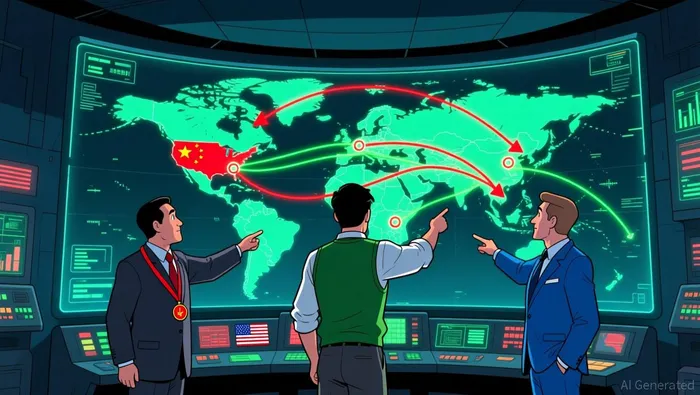
The Agricultural Pivot: Soybeans and the Shifting Trade Flow
The agricultural component of the trade truce is a classic case of tactical buying overriding structural pressures. China has moved decisively to meet its pledge, purchasing approximately 10 million metric tons of U.S. soybeans since the late-October deal. This volume represents over 80% of the 12 million-ton target, a commitment that has provided a crucial floor for global markets. The buying has directly supported Chicago soybean prices, helping the market end 2025 on a positive note and erasing most of the losses incurred during the trade war's peak.
Yet this pivot masks deeper, persistent vulnerabilities. The U.S. Department of Agriculture projects a 2.8% year-over-year decline in the 2025-26 soybean harvest, adding immediate pressure to export volumes at a time when demand is uncertain. More fundamentally, China's purchases are a state-directed political gesture, not a wholesale return to pre-war trade flows. The country's import duty structure remains tilted against U.S. supplies, with a total duty of 13% on U.S. soybeans versus just 3% for Brazilian beans. This fiscal preference ensures that even as China buys from the U.S., it will continue to source the vast majority of its soybeans from Brazil, which is forecast to see a record 177.1 million metric ton harvest this year.
The bottom line is a market in transition. For now, the truce provides a temporary reprieve for American farmers, supported by a $12 billion aid package announced to mitigate trade-related losses. But the structural shift is clear. As one trader noted, the uncertainty is likely to hinder overall exports from the U.S. and could deter planting. The pivot China is executing is not a return to old patterns, but a managed diversification that uses U.S. purchases to ease political tensions while securing the bulk of its supply from a more competitive and favored source. The agricultural trade flow has shifted, and the U.S. must now compete on a more level playing field.
The Strategic Context: China's Global Clean-Tech Capital Deployment
The temporary trade truce is a tactical maneuver within a much larger, long-term offensive. China's strategy is not merely to manage exports of critical minerals but to export its entire industrial model, reshaping global energy and trade flows for decades. Since early 2023, Chinese companies have pledged more than $180 billion for clean energy projects outside China, building complete supply chains from mining to recycling. This is a fundamental shift from project-based aid to integrated industrial ecosystem development, a move that leverages manufacturing overcapacity while driving the global energy transition.
This capital deployment creates a parallel, long-term competitive advantage that complements the short-term trade deal. By establishing factories for solar panels, batteries, and electric vehicles in the Global South, China secures new markets for its goods and technology. It also locks in future demand for its raw materials and creates a web of interdependence. As one report notes, over 75% of these projects go to developing nations, often aligned with the Belt and Road Initiative. The result is a new paradigm of South-South cooperation, where Chinese firms build local capacity while ensuring their own supply chains remain dominant.
The strategic logic is clear. The suspension of export controls buys time for Western firms to secure alternative sources. But China is simultaneously building an alternative global system. Its investments in Southeast Asia and the Middle East, for example, are creating regional hubs for battery production and renewable energy that are directly tied to Chinese supply chains. This integrated approach-linking mines, manufacturing, recycling, and infrastructure-creates efficiencies and influence that are difficult to replicate. It also reduces China's reliance on any single export channel, making its economy more resilient.
Viewed another way, the trade deal and the clean-tech investments are two sides of the same coin. The truce eases immediate friction, while the $180 billion deployment secures China's position as the world's clean-tech industrial heart. This dual strategy ensures that even as Western economies seek to diversify their supply chains, they are simultaneously competing against a global network of Chinese-built capacity. The structural shift is underway, and it is being financed from Beijing.
Catalysts and Risks: The Path to November 2026
The temporary truce now hinges on a series of forward-looking developments that will test its durability. The immediate catalyst is the implementation of the general licenses for critical minerals. Beijing has confirmed that applications are being received and approved, with initial reports indicating European firms are securing them. Yet the lack of granular details on terms, volume caps, and duration creates a critical uncertainty. For U.S. and European companies, the pace of these approvals and the clarity of the rules will determine whether this is a genuine easing of pressure or merely a managed, low-volume flow. The window of operational clarity is narrow, and any friction in the application process could quickly erode confidence.
At the same time, the broader U.S.-China trade conflict remains a live wire. While the November framework included tariff reductions, the baseline rate for Chinese imports to the U.S. remains elevated at 49%. This high tariff wall persists as a structural irritant. Furthermore, the U.S. has extended exclusions for 178 Chinese products until November 10, 2026, a move that itself is a temporary reprieve. The risk is that as these exclusions expire, the full weight of the 49% tariff could be reapplied, reigniting tensions that could spill over into other areas, including the critical minerals trade.
The most definitive catalyst, however, is a fixed date: November 2026. China's suspension of its October 2025 export controls is explicitly set to last until November 27, 2026. This is not a vague promise but a hard deadline that will force a fundamental reassessment. For industries reliant on rare earths, gallium, and other strategic materials, the countdown is on. The next phase of the strategic rivalry will be defined by whether Western firms have secured alternative sources and built sufficient resilience before the controls inevitably return. The investment implication is clear: capital must be directed toward supply chain diversification, stockpiling, and the development of domestic capacity. The truce is a pause, not a resolution. The path to November 2026 will reveal whether the pause was enough to change the strategic calculus or merely bought time for the next escalation.







Comentarios
Aún no hay comentarios