
Decoding the U.S. 10-Year TIPS Auction: Sector Impacts and Strategic Positioning in a Shifting Inflation Landscape
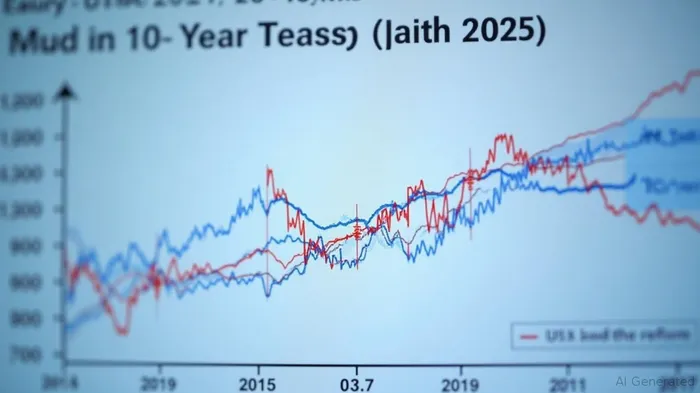
The U.S. Treasury's July 24, 2025, 10-Year TIPS auction—offering a record $21 billion in inflation-protected securities—has become a focal point for investors and policymakers. With a real yield of approximately 2% and an inflation breakeven rate of 2.41%, the auction reflects a nuanced market outlook: inflation expectations remain elevated but are stabilizing, while demand for real-return assets persists. This dynamic has cascading implications across sectors, reshaping investment strategies and corporate risk management frameworks.
The TIPS Signal: A Barometer for Inflation and Risk
The 10-Year TIPS yield, currently near 2%, serves as a proxy for the market's expectation of long-term real interest rates. When combined with the inflation breakeven rate (derived from the spread between nominal and real yields), it paints a picture of how inflation is priced into the economy. The 2.41% breakeven rate suggests investors expect moderate inflation over the next decade—just above the Federal Reserve's 2% target but significantly lower than the 3.02% peak seen in 2022. This decline signals growing confidence in the Fed's ability to normalize monetary policy, even as trade policies and fiscal stimulus create short-term volatility.
For sectors sensitive to inflation, such as manufacturing and energy, the TIPS yield offers a critical benchmark. A real yield of 2% implies that businesses must generate returns above this level to justify long-term capital investments. Conversely, for investors, TIPS' inflation-adjusted returns make them a compelling hedge against macroeconomic uncertainty.
Sector-Specific Impacts and Strategic Adjustments
- Manufacturing and Supply Chains
Tariff policies and global supply chain disruptions have driven input costs higher, creating a dual challenge: rising prices for raw materials and uncertainty about long-term inflation. The TIPS market's 2.41% breakeven rate suggests that while inflation is expected to moderate, businesses must still prepare for sporadic shocks. - Strategic Positioning: Manufacturers are increasingly locking in long-term contracts and diversifying suppliers to mitigate tariff-related risks. For example, automakers are shifting production to North America to avoid Chinese import tariffs, even as they hedge against potential cost overruns using inflation-linked derivatives.
Technology and Innovation-Driven Sectors
The stabilization of inflation expectations has created a more predictable environment for capital-intensive industries. With real yields at 2%, tech firms can secure financing for R&D and infrastructure projects at historically favorable rates.- Strategic Positioning: Companies in AI, clean energy, and semiconductors are accelerating investments in automation and green technologies. The expectation of lower inflation also supports longer-term project timelines, as cash flow uncertainty decreases.
Consumer Goods and Retail
Retailers face a delicate balance: passing on cost increases to consumers without eroding demand. The TIPS breakeven rate of 2.41% suggests that while inflation is no longer surging, it remains above pre-pandemic levels.- Strategic Positioning: Retailers are adopting dynamic pricing models and inventory optimization tools to align with moderate inflation. For example, grocery chains are leveraging AI-driven demand forecasting to reduce overstocking risks.
Financial Services and Fixed-Income Markets
The TIPS auction's 2% real yield has redefined the landscape for institutional investors. Historically, TIPS yields below 2% were considered unattractive, but the current environment—marked by high term premiums and central bank interventions—has made them a cornerstone of diversified portfolios.- Strategic Positioning: Asset managers are increasing allocations to TIPS and inflation-linked bonds, particularly in the front-end of the curve. For example, BlackRock's 2025 Spring Investment Directions recommends a 15% TIPS allocation for portfolios seeking inflation protection.
Real Estate and Infrastructure
With the Fed signaling potential rate cuts in 2025–2026, long-term financing costs for real estate and infrastructure projects are expected to decline. The TIPS yield provides a baseline for evaluating the cost-benefit of these investments.- Strategic Positioning: Developers are prioritizing projects with shorter payback periods and leveraging inflation-linked loans to hedge against rate volatility. Public-private partnerships (PPPs) in renewable energy and smart infrastructure are gaining traction.
Investment Advice: Navigating the TIPS-Driven Landscape
For individual investors, the July 2025 TIPS auction underscores the importance of inflation-protected assets. A 2% real yield, while not extraordinary, is competitive in a low-yield environment. Investors should consider:
- Portfolio Diversification: Allocate 5–10% of fixed-income holdings to TIPS, particularly in the front-end of the curve, to hedge against near-term inflation risks.
- Sector Rotation: Overweight sectors like technology and infrastructure, which benefit from stable inflation expectations and lower borrowing costs.
- Active Hedging: Use TIPS futures or ETFs (e.g., TIP) to gain exposure to inflation-linked returns without direct bond ownership.
For corporations, the TIPS yield serves as a benchmark for evaluating capital allocation. Businesses should:
- Monitor Inflation Breakeven Rates: Adjust pricing strategies and cost structures based on real-time TIPS data.
- Leverage Low Real Yields: Secure long-term financing now, as the Fed's rate cuts could drive TIPS yields lower in 2026.
- Adopt Dynamic Risk Management: Use inflation derivatives to hedge against sector-specific risks, especially in manufacturing and energy.
Conclusion: A New Normal in Inflation and Investment
The July 2025 TIPS auction reflects a market in transition. While inflation expectations remain above pre-pandemic levels, the narrowing spread between real and nominal yields signals a return to stability. For investors and businesses, this environment demands strategic agility: hedging against short-term volatility while capitalizing on long-term opportunities. As the Fed moves toward a neutral rate of 3–3.5%, the TIPS market will remain a critical barometer for navigating the evolving macroeconomic landscape.





Comentarios
Aún no hay comentarios