
Declining Demand for US 10-Year TIPS: A Shift in Inflation Expectations and Investor Sentiment
The U.S. Treasury Inflation-Protected Securities (TIPS) market has long served as a barometer for inflation expectations and investor sentiment. However, recent trends suggest a nuanced shift in demand dynamics, driven by evolving macroeconomic signals and Federal Reserve policy. While auction data and secondary market activity initially pointed to robust demand for TIPS, a closer examination of yield trajectories, breakeven inflation rates, and Fed projections reveals a more complex picture: declining relative demand for inflation-linked assets amid moderating inflation expectations and a pivot toward rate cuts.
Auction Yield Trends: A Tale of Two Phases
The U.S. Treasury's July 2025 10-Year TIPS auction delivered a real yield of 1.985%, slightly below the "when-issued" yield of 1.99%, signaling strong investor appetite[1]. A bid-to-cover ratio of 2.41 underscored the competitive bidding environment[1]. However, by September 2025, the real yield had fallen to 1.69% in a reopened auction, despite a marginally higher bid-to-cover ratio of 2.36[6]. This decline in yields—despite sustained demand—reflects a critical shift: investors are accepting lower returns for inflation protection as expectations of persistent high inflation wane.
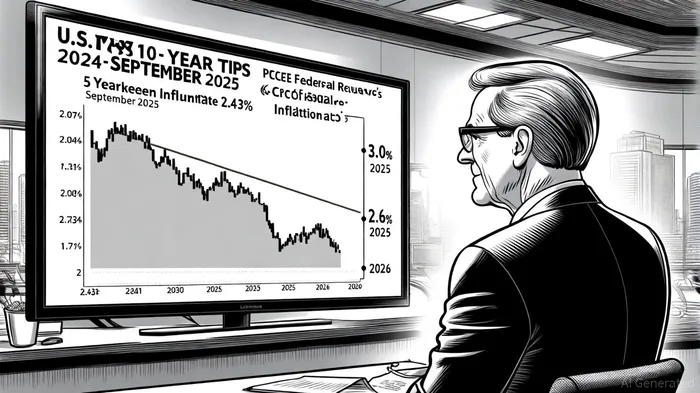
The secondary market corroborates this trend. As of September 9, 2025, the 10-Year TIPS yield stood at 1.71%, down 0.16 percentage points from June 2025 but still 0.09 points above the prior year's level[1]. Analysts project further declines, forecasting a yield of 1.69% by year-end and 1.65% in 12 months[1]. These figures suggest that while TIPS remain attractive, their premium over nominal Treasurys is narrowing—a sign of shifting investor priorities.
Macroeconomic Signals: Inflation Easing, Policy Pivoting
The Federal Reserve's September 2025 FOMC projections provide critical context. The central bank anticipates a gradual decline in inflation, with PCE inflation expected to fall from 3.0% in 2025 to 2.1% by 2027, aligning with its 2.0% long-term target[1]. Core PCE inflation is projected to follow a similar trajectory, reinforcing the narrative of a soft landing. Concurrently, the Fed's rate-cut path—projecting a reduction from 3.6% in 2025 to 3.1% by 2027—signals a pivot toward accommodative policy[1].
These projections are echoed in market-derived indicators. The 5-Year Breakeven Inflation Rate, a proxy for inflation expectations, stood at 2.43% in September 2025[4], down from a peak of 3.59% in March 2022[6]. Meanwhile, actual inflation, as measured by the CPI, reached 2.9% in August 2025[3], slightly above breakeven levels but trending downward. This narrowing gapGAP-- between actual inflation and market expectations suggests that investors are pricing in a future where inflationary pressures abate, reducing the urgency for inflation-linked assets like TIPS.
Secondary Market Dynamics: TIPS vs. Nominal Treasurys
The performance of TIPS relative to nominal Treasurys hinges on the interplay between breakeven inflation rates and actual inflation. As of June 2025, the 10-Year TIPS breakeven rate was 2.362%, derived from a nominal yield of 4.347% and a TIPS yield of 1.985%[2]. This implied that investors expected inflation to average 2.36% over the next decade. However, with actual CPI at 2.9%, TIPS have historically outperformed in such scenarios due to inflation adjustments[2].
Yet, the market's forward-looking nature complicates this dynamic. If investors anticipate that inflation will fall below breakeven levels—a scenario supported by Fed projections—TIPS may underperform nominal Treasurys in the medium term[5]. This expectation is already influencing asset allocation, as evidenced by the declining real yields on TIPS and the rising demand for nominal bonds. Additionally, liquidity premiums for TIPS, which reflect their relative illiquidity compared to nominal Treasurys, may further erode their appeal[2].
Tactical Opportunities in Fixed-Income Portfolios
The evolving landscape presents tactical opportunities for investors. For inflation-linked portfolios, the current environment offers a favorable entry point for TIPS, given the elevated real yields (1.71% as of September 2025[1]) and the likelihood of inflation remaining above breakeven levels in the near term. However, the narrowing yield spread and the Fed's rate-cut trajectory suggest that TIPS should be held with a medium-term horizon, balancing inflation protection against potential underperformance if actual inflation moderates faster than expected.
For core fixed-income portfolios, the shift in investor sentiment highlights the value of diversification. Allocating to nominal Treasurys, which benefit from falling yields in a rate-cutting cycle, could complement TIPS holdings. Additionally, high-quality corporate bonds and short-duration instruments may offer attractive risk-adjusted returns as the Fed's accommodative policy supports credit markets.
Conclusion
The declining demand for U.S. 10-Year TIPS reflects a broader recalibration of inflation expectations and investor sentiment. While auction data and secondary market trends indicate sustained interest, the narrowing yield spread and the Fed's pivot toward rate cuts signal a relative de-escalation in the urgency for inflation protection. Investors navigating this landscape must balance the immediate appeal of TIPS with the evolving macroeconomic outlook, leveraging tactical allocations to hedge against both inflation and rate-driven volatility.







Comentarios
Aún no hay comentarios