
Declining U.S. Bank Reserves at the Fed: A Tightening Regime and Opportunities in Short-Duration Fixed Income
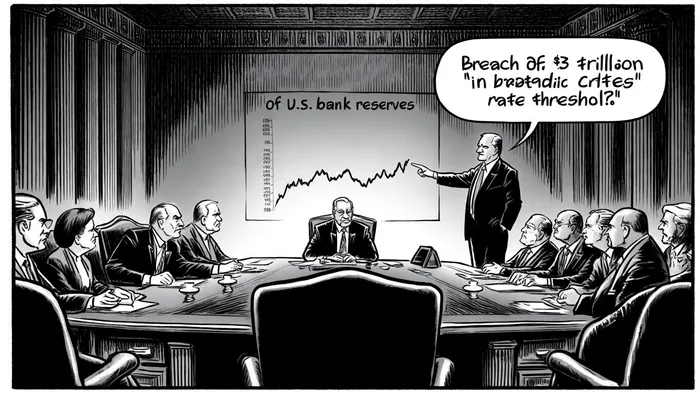
The U.S. banking system's reserves at the Federal Reserve have entered a critical phase, marked by a sustained decline below the $3 trillion threshold—a level not seen since October 2020. As of January 2025, reserves fell to $2.89 trillion, a weekly drop of $326 billion, driven by quantitative tightening (QT) and year-end liquidity adjustments[3]. By September 2025, Goldman SachsGS-- projected reserves would remain below $3 trillion, reflecting the Fed's ongoing efforts to drain excess liquidity from the financial system[2]. This shift signals a tightening of monetary conditions, reshaping investor positioning and unlocking opportunities in short-duration fixed income and liquidity-sensitive assets.
The Fed's Tightening Regime and Liquidity Dynamics
The Federal Reserve's QT program, initiated in 2022, has systematically reduced its balance sheet, removing $326 billion in reserves in January 2025 alone[3]. This contraction is compounded by institutions repaying loans from the Bank Term Funding Program and a shift of cash into the Fed's overnight reverse repo facility (RRP). While the RRP remains a critical tool for managing liquidity, its usage has declined from over $2.5 trillion to around $500 billion, indicating a more balanced but still ample liquidity environment[5].
The Fed's September 2025 rate cut—lowering the federal funds rate to 4.00–4.25%—marks a strategic pivot from tightening to easing, but QT continues to tighten monetary conditions[4]. This duality creates a complex landscape: while lower rates reduce borrowing costs, the shrinking reserves elevate short-term funding pressures. The Secured Overnight Financing Rate (SOFR) surged to 4.51% in late September 2025, reflecting strains from Treasury settlements and corporate tax payments[2]. Such dynamics underscore the Fed's delicate balancing act between managing inflation and avoiding a repeat of the 2019 liquidity crisis[5].
Implications for Short-Duration Fixed Income and Liquidity-Sensitive Assets
The decline in reserves directly impacts short-duration fixed income markets. As liquidity tightens, yields on money market funds and Treasury bills (T-bills) are pressured upward, creating attractive opportunities for income-seeking investors. For instance, the Fed's rate cuts in September 2025 are expected to lower yields on high-yield savings accounts and CDs, but the concurrent QT-driven liquidity crunch may offset this downward pressure[4]. This divergence creates a “yield arbitrage” scenario, where investors can capitalize on the gap between short-term rates and the Fed's target.
Liquidity-sensitive assets, such as commercial paper and short-term corporate bonds, also benefit from this environment. With the Fed's balance sheet reductions slowing to avoid destabilizing the system, these instruments gain appeal as safe, liquid alternatives to longer-duration assets[5]. JPMorgan analysts note that while a temporary liquidity rebound occurred in September 2025 due to a drop in the Treasury General Account (TGA) balance, further contractions are likely as TGA rebuilds and T-bill issuance resumes[4]. This cyclical nature reinforces the need for active portfolio management.
Investor Positioning in a Post-QE Environment
The post-quantitative easing (QE) era has forced investors to adapt to a world of tighter liquidity and higher volatility. The unwinding of QE-era excess reserves has shifted capital toward short-duration instruments, with $6.6 trillion in U.S. money market funds poised to flow into fixed income markets[2]. This influx supports declining yields but also heightens reinvestment risk, as newly issued bonds offer lower returns. Investors are increasingly favoring strategies like bond laddering and sector rotation to mitigate these risks[2].
Moreover, the Fed's communication and tools—such as the Standing Repo Facility (SRF)—provide a buffer against liquidity shocks. However, as reserves approach the $2.7 trillion “ample” level estimated by JPMorgan[4], the risk of a liquidity crunch looms. This scenario favors investors who prioritize liquidity over yield, particularly in sectors like real estate and technology, where lower borrowing costs could drive growth[4].
Conclusion
The breach of the $3 trillion reserve threshold in early 2025 signals a structural shift in U.S. monetary policy, with QT tightening conditions even as the Fed eases rates. This duality creates a fertile ground for short-duration fixed income and liquidity-sensitive assets, offering both income generation and risk mitigation. As the Fed navigates this transition, investors must remain agile, leveraging active management and diversification to capitalize on evolving opportunities.





Comentarios
Aún no hay comentarios