
The Decline of Traditional Brick-and-Mortar Retail: Lessons from an 80-Year-Old Furniture Retailer's Bankruptcy
In the shadow of Connecticut's autumn leaves, a quiet but seismic shift in retail history unfolded. Connecticut Home Furnishings, a family-owned furniture retailer founded in 1932, announced its closure in 2025 after 80 years of operation. The company, which once thrived as a general merchandise store and later specialized in high-quality furnishings, became a casualty of a sector in freefall. Its decision to liquidate inventory without filing for bankruptcy—unlike peers such as 5th Avenue Furniture and Conn's, Inc.—highlighted a grim reality: the furniture retail industry is no longer a safe harbor for legacy businesses.
The story of Connecticut Home Furnishings is not an outlier. It is a microcosm of a broader retail sector rebalancing, driven by digital disruption, inflationary pressures, and shifting consumer priorities. For investors, the collapse of traditional brick-and-mortar models offers a stark lesson: adapt or perish.
The Digital-First Revolution: Winners and Losers
The furniture industry's struggles are emblematic of a sector-wide reckoning. While Connecticut Home Furnishings shuttered its doors, digital-first retailers like AmazonAMZN-- (AMZN) and WalmartWMT-- (WMT) reported explosive growth in 2025. Amazon's Broadline Retail segment alone delivered 30.8% year-over-year earnings growth in Q2 2025, driven by its third-party marketplace and logistics dominance. Walmart, meanwhile, leveraged its low-cost supply chain and grocery-centric model to thrive in a high-inflation environment, with e-commerce contributing 15% to its ex-gasoline sales.
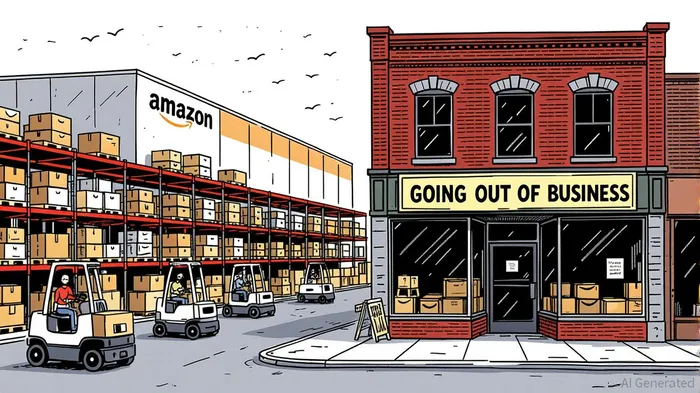
The contrast is stark. Traditional retailers, burdened by high overhead costs and outdated supply chains, have struggled to compete. Conn's, Inc., a century-old furniture and appliance chain, filed for Chapter 11 bankruptcy in 2024, listing over $1.1 billion in debt. Its restructuring, which included a $352.9 million asset sale to Jefferson Capital Systems, underscored the financial fragility of legacy models. Smaller players like 5th Avenue Furniture, which closed multiple New York locations and filed for bankruptcy in 2025, faced similar fates.
The Forces of Disruption: Tariffs, Inflation, and Consumer Behavior
The furniture sector's woes are not isolated. They are part of a larger narrative of retail sector rebalancing. Rising interest rates have stifled home sales, reducing demand for big-ticket items like sofas and dining sets. Global supply chain bottlenecks, exacerbated by tariffs and geopolitical tensions, have inflated costs for manufacturers and retailers alike. Meanwhile, consumers, increasingly price-sensitive, have flocked to online platforms offering convenience and competitive pricing.
For example, CostcoCOST-- (COST) has capitalized on this shift, reporting 5.1% same-store sales growth in 2025 by offering value-driven essentials. Its membership model and digital integration—such as curbside pickup and online grocery services—have insulated it from broader retail declines. Conversely, fashion brands like NikeNKE-- (NKE) and G-III ApparelGIII-- have seen earnings plummet by 41.4%, as consumers prioritize necessity over luxury.
Investment Insights: Where to Allocate Capital
For investors, the key takeaway is clear: prioritize companies that align with long-term consumer trends. Digital-first retailers with scalable logistics networks, such as Amazon and Walmart, are well-positioned to dominate. Essential goods providers like Costco and KrogerKR-- (KR) offer defensive value in an inflationary climate.
Historically, these stocks have demonstrated strong performance following earnings beats. For instance, Amazon (AMZN) has a 70% win rate over 30 days after beating expectations, with a maximum return of 6.75%. Costco (COST) mirrors this pattern, showing a 70% win rate and 6.56% peak return over the same period. While Walmart (WMT) data is less detailed, its peers' track records suggest similar short-to-medium-term gains. These results reinforce the case for holding or overweighting these stocks in a portfolio.
Conversely, sectors like apparel and mall-based retail face structural decline. The Textiles, Apparel & Luxury Goods sector, for instance, is projected to see earnings fall by 41.4% in 2025. Similarly, quick-service restaurants (QSRs) lag behind casual dining chains, reflecting a shift toward value-driven dining.
The Path Forward: Agility and Innovation
The collapse of Connecticut Home Furnishings and the restructuring of Conn's, Inc., serve as cautionary tales. Legacy retailers that fail to innovate—whether through digital integration, supply chain diversification, or value-driven offerings—risk obsolescence. For investors, the path forward lies in identifying companies that not only survive but thrive in this new era.
The future of retail belongs to those who embrace agility. As tariffs and macroeconomic uncertainty persist, resilience will be defined by adaptability, not scale. The question for investors is not whether the retail sector will recover, but which players will lead the next chapter of its evolution.
In the end, the furniture retailer's 80-year journey—from a general merchandise store to a casualty of digital disruption—offers a poignant reminder: in retail, as in life, the only constant is change. Those who recognize it early will be the ones to profit from it."""







Comentarios
Aún no hay comentarios