
The Decline of North Sea Crude-Ekofisk: Energy Transition Risks and Legacy Oil Asset Valuations in 2025
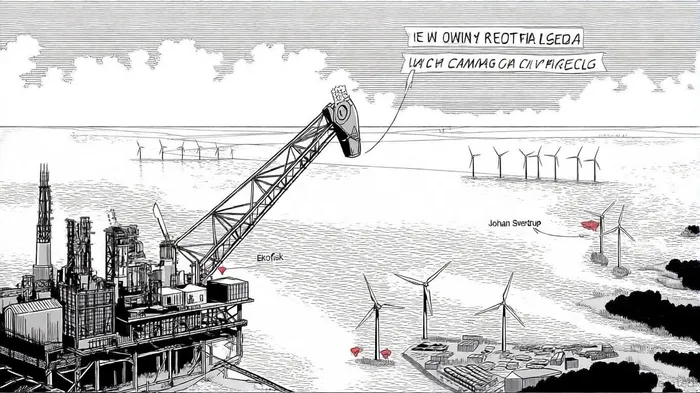
The North Sea, once a cornerstone of global oil markets, is facing a pivotal moment as legacy assets like Ekofisk crude grapple with the dual pressures of operational challenges and the accelerating energy transition. In 2025, the decline in Ekofisk's pricing and its status as a legacy oil asset reflect a confluence of short-term supply disruptions and long-term structural shifts in energy markets. Investors must now weigh the immediate volatility of North Sea crude against the existential risks posed by decarbonization policies, regulatory uncertainty, and the rise of cleaner alternatives.
Short-Term Supply Constraints and Price Volatility
The Ekofisk field's recent price fluctuations are partly attributable to planned maintenance shutdowns in June 2025, which slashed crude exports to historically low levels-only one cargo loaded during the month, the lowest in over 15 years, according to American Mud Pumps' analysis. This reduction, driven by ConocoPhillips' four-week shutdown of the Ekofisk area and the Nordpipe system, tightened supply for North Sea benchmark crudes, temporarily supporting prices during the summer demand window, as Kpler reported. However, broader market forces, including OPEC+ easing production cuts and rising global oil inventories, have tempered this effect, creating a fragile equilibrium, according to Investing News' update.
While October 2025 saw a slight uptick in North Sea crude supply, averaging 542,000 barrels per day compared to 536,000 in September, this increase does not offset the June slump, as Hellenic Shipping News reported. The seasonal maintenance of refineries and fields, coupled with weak pricing for U.S. WTI (which competes with North Sea crude), further complicates the outlook, as MarketScreener noted.
Energy Transition Pressures and Legacy Asset Risks
Beyond operational hiccups, the decline of Ekofisk and other North Sea assets is inextricably tied to the energy transition. Carbon pricing mechanisms, regulatory shifts, and investor sentiment are reshaping the valuation of legacy oil infrastructure. For instance, the UK's Energy Profits Levy and rising carbon trading prices (CTP) have increased the cost of operating carbon-intensive fields, forcing operators to reassess long-term strategies, as Observer explained. According to the World Bank's 2025 report, carbon pricing now covers 28% of global emissions, mobilizing over $100 billion annually for public budgets-a financial burden that disproportionately affects aging oil assets.
The Sullom Voe Terminal (SVT) in Shetland exemplifies this transition. Once a major oil hub, SVT's throughput has dwindled to fewer than 50,000 barrels per day due to natural basin decline, as the World Economic Forum story notes. Yet, its repurposing for e-fuels, hydrogen, and carbon capture offers a lifeline for preserving skilled employment and leveraging existing infrastructure. However, such transitions require substantial investment and careful planning to avoid stranded assets, as seen in the closure of the Grangemouth refinery, as the World Economic Forum observes.
Structural Shifts in the North Sea Oil Sector
The North Sea's oil sector is also undergoing a consolidation phase. Smaller independent companies, strained by weak prices, high taxes, and energy transition risks, are being outmaneuvered by majors like ShellSHEL-- and EquinorEQNR--. These firms are forming joint ventures to manage costs and tax liabilities, focusing on large-scale projects such as Rosebank and Johan Castberg, according to an S&P Global report. While this strategy ensures short-term profitability, it raises concerns about the loss of innovation and expertise from smaller players, as S&P Global warns.
Norway's continued dominance in the region, driven by fields like Johan Sverdrup, underscores the tension between production continuity and sustainability. Despite its efficiency, Johan Sverdrup has faced criticism over safety and environmental impacts, highlighting the sector's struggle to align with net-zero goals, as The National reported.
Long-Term Outlook and Investment Implications
The International Energy Agency (IEA) projects that global oil demand will grow by 800,000 barrels per day in 2025, albeit at a slower pace than previously forecast. J.P. Morgan's forecast puts Brent prices at an average of $66 per barrel in 2025 and $58 in 2026, reflecting persistent downward pressure from U.S. shale and Middle Eastern producers. For Ekofisk and similar assets, the challenge lies in competing with these lower-cost sources while navigating decommissioning costs that Wood Mackenzie estimates will surpass development expenditures by 2032, as Offshore Energy reported.
Investors must also consider the regulatory and reputational risks tied to legacy assets. With 78% of global investors citing policy uncertainty as a key energy transition challenge, KPMG's outlook underscores the North Sea's oil sector's volatile path forward. While repurposing infrastructure for renewables offers a potential exit strategy, success hinges on timely execution and alignment with decarbonization targets.
Conclusion
The decline of North Sea Crude-Ekofisk in 2025 is a microcosm of the broader energy transition. While short-term supply disruptions and benchmark competitiveness provide temporary price support, the long-term viability of legacy oil assets depends on their ability to adapt to a low-carbon economy. For investors, the key lies in balancing exposure to near-term market dynamics with strategic bets on infrastructure repurposing and technological innovation. As the North Sea's oil sector navigates this crossroads, the interplay between energy transition policies and market forces will define its future-and the fate of assets like Ekofisk.





Comentarios
Aún no hay comentarios