
Deckers Outdoor: Unlocking Undervalued Growth in Premium Outdoor Footwear
The premium outdoor footwear market is undergoing a transformative phase, driven by surging demand for performance-driven and lifestyle-oriented products. As global consumers increasingly prioritize health, adventure, and sustainability, the segment is projected to grow at a compound annual growth rate (CAGR) of 7.1%, reaching $36.62 billion by 2033, according to a Global Market Statistics report. Within this dynamic landscape, Deckers Outdoor Corporation (DECK) stands out as a compelling case study in underappreciated growth potential. Despite trailing behind industry giants like Nike (28.94% TTM market share), Deckers has demonstrated resilience and innovation, leveraging its premium brands-UGG and HOKA-to capture a 3.20% TTM market share in Q2 2025, according to CSIMarket data. This article argues that Deckers' strategic focus on direct-to-consumer (DTC) expansion, international growth, and brand differentiation positions it as a high-conviction investment opportunity in an undervalued niche.
Market Share Expansion: A Tale of Two Brands
Deckers' growth trajectory is anchored by the explosive performance of HOKA, its trail-running brand, and the enduring appeal of UGG, its lifestyle footwear line. In Q3 2025, HOKA achieved a 24% revenue increase, while UGG grew by 13% year-over-year, as noted in a Monexa analysis. These figures underscore the company's ability to balance performance innovation with lifestyle relevance. HOKA's success stems from its proprietary cushioning technology and targeted marketing to endurance athletes, while UGG's revival reflects a strategic pivot toward product diversification and e‑commerce optimization, according to a SWOT analysis.
Data from Q2 2025 reveals that Deckers' market share in the Apparel, Footwear & Accessories industry rose to 3.69%, up from 2.57% in the prior quarter, based on a Porter Five Forces analysis. This growth outpaces many competitors, including Skechers and Lululemon, and highlights Deckers' capacity to monetize premium pricing. Notably, the company's gross margin expanded to 57.9% in FY2025, driven by DTC sales (49% of Q3 revenue) and cost efficiencies, as reported in Deckers' FY2025 results. By prioritizing direct channels, Deckers maintains tighter control over brand perception and customer data, enabling hyper-personalized marketing-a critical edge in an era where 68% of consumers prefer brands that offer tailored experiences, according to an Outdoor Industry Association report.
Strategic Leverage in a Fragmented Market
The premium outdoor footwear segment is highly competitive, with Nike and Adidas dominating athletic categories and luxury brands like Gucci and Balenciaga encroaching on lifestyle markets. However, Deckers has carved a unique niche by blending performance innovation with lifestyle appeal. For instance, HOKA's international DTC expansion-particularly in Europe and Asia-has unlocked new revenue streams, with international sales surging 26.3% year-over-year to $1.799 billion in FY2025, as shown in the company's Q4 2025 earnings highlights. This geographic diversification mitigates risks from U.S. market saturation and tariff pressures, which are expected to impact gross margins in 2026, according to a Monexa update.
Deckers' partnership with Legion Technologies further strengthens its operational agility, automating workforce management and reducing labor costs, as reported in a growth-strategy blog. Meanwhile, its commitment to sustainability-via recycled materials and circularity initiatives-aligns with Gen Z and millennial consumers, who prioritize eco-conscious brands, according to a Business Research Insights report. These strategic moves position Deckers to capitalize on the $24.21 billion outdoor shoes market, which is forecasted to grow at a 6.5% CAGR through 2033, per an Outdoor Shoes market report.
Challenges and Mitigations
Critics may argue that Deckers' market share remains modest compared to Nike's dominance. However, this underestimates the company's ability to scale efficiently. For example, HOKA's 24% revenue growth in Q3 2025 outpaced Nike's 8% growth in the same period, as noted in a LinkedIn analysis, suggesting that niche innovation can rival mass-market scale. Additionally, Deckers' $2.5 billion share repurchase program and $1.89 billion in cash reserves, detailed in the Deckers press release, provide financial flexibility to navigate macroeconomic headwinds, such as rising import costs.
The casualization of the market-where consumers increasingly treat outdoor footwear as fashion-also presents risks. Brands risk devaluing premium products through discounts. Deckers mitigates this by fostering emotional connections through loyalty programs and immersive retail experiences, such as pop-up stores and virtualCYBER-- try-ons, as discussed in the Porter Five Forces analysis.
Conclusion: A High-Conviction Play
Deckers Outdoor's undervalued growth potential lies in its ability to harmonize brand equity, operational efficiency, and strategic foresight. While its 3.20% TTM market share may seem small, the company's 16.84% year-over-year revenue growth and 33.43% net margin, per CSIMarket data, demonstrate a model that prioritizes quality over quantity. As the premium outdoor footwear market expands, Deckers is uniquely positioned to outperform peers by doubling down on its DTC strategy, international reach, and brand innovation. For investors seeking exposure to a high-margin, high-growth segment, Deckers represents a compelling opportunity to capitalize on the next phase of the outdoor revolution. 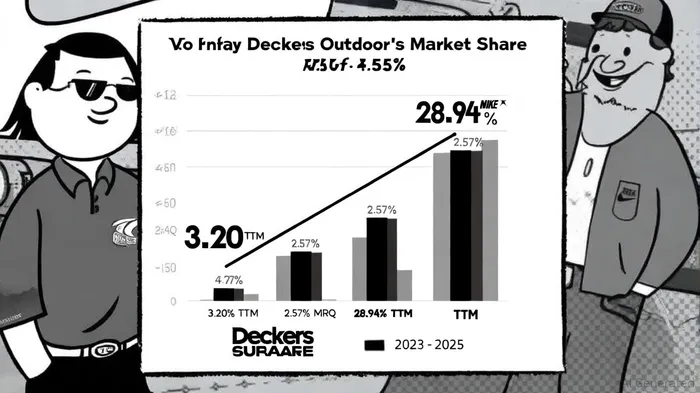





Comentarios
Aún no hay comentarios