
Decentralized Trading Infrastructure: Navigating Regulatory Progress and Market Access in 2025
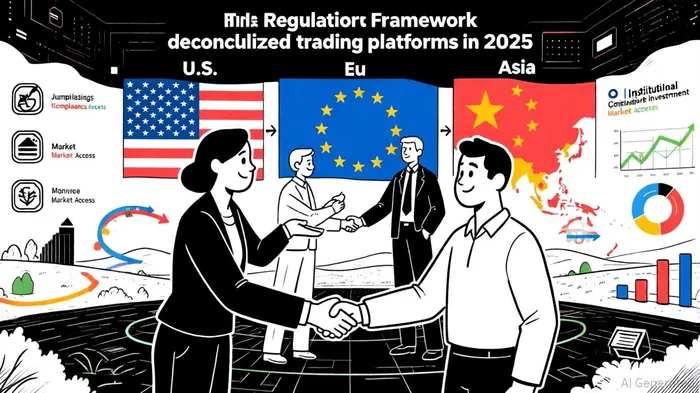
The evolution of decentralized trading infrastructure in 2025 is inextricably linked to the regulatory frameworks shaping its global landscape. As governments and regulators grapple with the dual imperatives of fostering innovation and safeguarding market integrity, the interplay between policy and practice is redefining access, compliance, and investment dynamics. This analysis examines the regulatory progress in the U.S., EU, and Asia, evaluates its impact on decentralized trading platforms, and outlines the implications for investors navigating this rapidly evolving sector.
U.S. Regulatory Clarity: A Catalyst for Institutional Participation
The U.S. regulatory environment has undergone a transformative shift in 2025, marked by coordinated efforts between the Securities and Exchange Commission (SEC) and Commodity Futures Trading Commission (CFTC). A landmark joint statement in September 2025 clarified that registered exchanges can legally list and trade spot crypto assets, provided they meet existing regulatory standards[1]. This resolution ended years of uncertainty, enabling platforms to offer products like bitcoinBTC-- and ether spot trading without fear of enforcement actions.
Legislatively, the Digital Asset Market Clarity Act (CLARITY Act) has provided a critical framework by delineating the SEC's and CFTC's jurisdictions over digital assets. By categorizing assets into securities, commodities, and permitted payment stablecoins, the act reduces regulatory overlap and creates a predictable environment for market participants[2]. Notably, the SEC's transition from aggressive enforcement to structured rulemaking—evidenced by the establishment of a Crypto Task Force and industry roundtables—has fostered dialogue on issues like staking and tokenization[3]. These developments are attracting institutional investors, with digital asset treasuries (DATs) now holding over $50 billion in crypto assets[4].
However, challenges persist. The SEC's ongoing litigation with platforms like CoinbaseCOIN-- and Binance underscores the need for further clarity on token classification under the Howey test[5]. For decentralized platforms, the ripple effect of the SEC v. Ripple case—where secondary market XRPXRP-- sales were deemed non-securities—has provided a legal precedent but left broader ambiguities unresolved[6].
EU's MiCA Framework: Harmonization at the Cost of DeFi Innovation
The EU's Markets in Crypto-Assets Regulation (MiCA), fully implemented by December 2024, represents a comprehensive but contentious approach to regulating decentralized trading. While MiCA mandates transparency, licensing, and whitepaper disclosures for centralized crypto-asset service providers (CASPs), its indirect impact on decentralized finance (DeFi) has been profound. Over 75% of new DeFi projects in 2025 are projected to relocate to non-EU jurisdictions like Singapore or Dubai to avoid MiCA's compliance burdens[1].
The regulation's emphasis on anti-money laundering (AML) and know-your-customer (KYC) measures has proven particularly challenging for permissionless protocols. For instance, DeFi lending platforms have seen a 10.4% decline in Total Value Locked (TVL) as retail investors hesitated to comply with new KYC requirements[7]. Meanwhile, MiCA's licensing framework has incentivized institutional participation, with regulated entities increasingly entering DeFi through hybrid models that combine compliance with decentralized governance[8].
Regional implementation of MiCA has also revealed disparities. While Germany and Malta have proactively streamlined authorization processes, Central and Eastern European countries like Hungary and Romania have prioritized AML alignment and consumer protection, creating a fragmented operational landscape[9]. For decentralized platforms, the lack of a central authority to assign regulatory responsibility under MiCA remains a critical hurdle, prompting some projects to establish “gateway entities” to meet compliance obligations[10].
Asia's Strategic Frameworks: Balancing Innovation and Control
Asia's regulatory approach in 2025 reflects a nuanced balance between fostering innovation and mitigating risks. Singapore, a global crypto hub, has issued 30 “Major Payment Institution” licenses under its Financial Services and Markets Act (FSMA), ensuring that even international digital token service providers must secure local authorization[11]. The city-state's Project Guardian, focused on real-world asset tokenization, further underscores its ambition to lead in blockchain-driven finance.
Hong Kong's emergence as a crypto leader is equally notable. The city's Stablecoins Ordinance, effective since August 2025, imposes licensing and capital requirements on stablecoin issuers, while its launch of spot bitcoin and ether ETFs in April 2025 has attracted over $2 billion in institutional inflows[12]. South Korea's Digital Asset Basic Act, with its ₩500 million capital requirement for stablecoin issuers and 80% cold storage mandate for exchanges, exemplifies a risk-sensitive approach to investor protection[13].
Japan's regulatory refinements, including a new licensing category for crypto-asset brokerages, highlight its focus on market flexibility. By allowing issuers to hold up to 50% of reserves in low-risk financial instruments, Japan is promoting compliance without stifling innovation[14]. Collectively, these frameworks position Asia as a critical battleground for decentralized trading infrastructure, with jurisdictions like Singapore and Hong Kong leveraging regulatory clarity to attract global capital.
Global Implications and Investment Considerations
The divergent regulatory trajectories of the U.S., EU, and Asia are reshaping market access for decentralized trading platforms. In the U.S., the CLARITY Act and SEC-CFTC collaboration are creating a fertile ground for institutional adoption, while the EU's MiCA-driven compliance costs are pushing DeFi innovation to Asia and beyond. For investors, these dynamics present both opportunities and risks:
- U.S. Platforms: Those aligned with SEC-CFTC guidelines, particularly those offering spot crypto products, are well-positioned to capitalize on institutional inflows. However, ongoing litigation and token classification ambiguities necessitate caution.
- EU-Based DeFi Protocols: Projects relocating to non-EU jurisdictions may benefit from lighter regulatory burdens but face challenges in maintaining user trust and liquidity.
- Asian Hubs: Singapore and Hong Kong's structured frameworks offer a compelling value proposition for decentralized platforms seeking to balance compliance with scalability.
Conclusion
The regulatory landscape for decentralized trading infrastructure in 2025 is a mosaic of progress and paradox. While the U.S. and Asia are fostering innovation through structured frameworks, the EU's MiCA-driven approach highlights the tension between regulatory rigor and technological agility. For investors, the key lies in aligning strategies with jurisdictions that offer both clarity and adaptability. As the sector matures, the ability to navigate these regulatory crosscurrents will determine not just survival, but the scale of opportunity in decentralized finance.





Comentarios
Aún no hay comentarios