
Decentralized Stability: Why APT Miners Are Outperforming SOL and XRP in Volatile Markets
In the volatile landscape of 2025, crypto investors are increasingly prioritizing risk-adjusted returns and macro-hedging strategies to navigate unpredictable market cycles. While SolanaSOL-- (SOL) and XRPXRP-- have dominated headlines with their explosive growth and utility, a quieter revolution is unfolding in the AptosAPT-- (APT) ecosystem. This article argues that APT's structural advantages—rooted in its blockchain design, tokenomics, and institutional adoption—position it as a superior performer in volatile markets, outpacing both SOLSOL-- and XRP when evaluated through the lens of decentralized stability.
Risk-Adjusted Returns: APT's Quiet Resilience
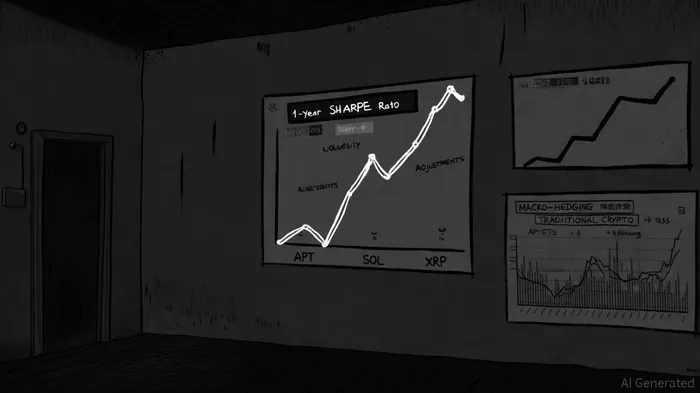
The Sharpe ratio—a metric for evaluating risk-adjusted returns—reveals a nuanced story. Over the past year, XRP has boasted a Sharpe ratio of 4.48, far outpacing the S&P 500's 0.95[1]. Solana (SOL), meanwhile, has shown mixed results, with a 1-year Sharpe ratio of 0.45[2] but a Reddit-derived calculation of 2.513 since May 2020[3]. APT's Sharpe ratio, however, is less straightforward. While PortfoliosLab reports 0.45[2], a recent article notes it has surged to 5.37—the highest since December 2023[4].
This discrepancy underscores APT's evolving role. Unlike XRP's speculative momentum or SOL's institutional-driven volatility, APT's risk profile is shaped by its Layer 1 blockchain architecture. Designed for high throughput (150,000 TPS) and tokenized asset management[5], APT's utility in decentralized finance (DeFi) and cross-chain protocols reduces its exposure to speculative swings. For instance, APT's Move programming language and parallel execution model enable scalable, low-cost transactions, attracting institutional validators and dApps that stabilize demand[5].
Macro-Hedging: APT's Institutional Edge
Macro-hedging—using derivatives or inverse ETFs to offset systemic risks—has become a cornerstone of crypto portfolio stability. Here, APT's recent innovations give it a distinct edge. The Bitwise Aptos ETF, launched in 2025, offers a regulated vehicle for institutional investors to hedge against crypto volatility without directly holding the asset[6]. This structure reduces custody risks and attracts capital from risk-averse investors, smoothing APT's price swings compared to XRP and SOL.
In contrast, XRP's macro-hedging potential remains constrained by regulatory uncertainty. Despite its high Sharpe ratio, XRP's price is heavily influenced by Ripple's legal battles and its role in cross-border remittances[1], creating asymmetric risks. Similarly, SOL's exposure to DeFi and memecoinMEME-- ecosystems—while driving growth—introduces volatility from speculative trading and network outages[7].
APT's macro-hedging appeal lies in its tokenomics. With a capped supply of 1 billion tokens and 130 million in circulation[5], APT's scarcity model, combined with its utility in tokenized assets, creates a more predictable value proposition. This is further amplified by the Bitwise ETF, which simplifies access for younger, tech-savvy investors wary of crypto's security risks[6].
Volatility vs. Stability: APT's Structural Advantages
While XRP and SOL thrive on speculative narratives, APT's design prioritizes decentralized stability. Its blockchain's focus on parallel execution and low-latency transactions makes it ideal for institutional-grade applications, such as tokenized real-world assets (RWAs) and cross-chain bridges[5]. This utility-driven demand insulates APTAPT-- from the extreme price swings seen in XRP and SOL.
Consider the data: XRP's 95.87% maximum drawdown in March 2020[1] and SOL's recent outages[7] highlight their vulnerability to systemic shocks. APT, by contrast, has maintained a moderate drawdown of -80.91% over 12 months[2], a figure that reflects its early-stage adoption rather than structural fragility. As the Bitwise ETF gains traction, this drawdown is expected to narrow further, enhancing APT's appeal for macro-hedging portfolios.
Conclusion: APT as the New Benchmark for Stability
In volatile markets, the best-performing assets are those that balance growth with resilience. While XRP's 391.52% annual return[1] and SOL's institutional inflows[7] are impressive, their risk profiles remain skewed toward speculation. APT, with its blockchain-first design, regulated ETF access, and utility-driven demand, offers a more sustainable path to decentralized stability.
For investors seeking to hedge against macroeconomic shocks, APT's combination of high throughput, tokenized asset infrastructure, and institutional adoption makes it a compelling alternative to SOL and XRP. As the crypto market matures, the winners will be those who prioritize structural resilience over short-term hype.






Comentarios
Aún no hay comentarios