
Decentralized Privacy Infrastructure and Ethereum's Future
The Tornado Cash saga has become a defining case study in the intersection of blockchain privacy, legal risk, and institutional investment. Since its 2022 sanctions by the U.S. Treasury, the protocol's developers-Roman Storm and Alexey Pertsev-have faced unprecedented legal scrutiny. Yet, their defense has been bolstered by a coalition of crypto entities, including the EthereumETH-- Foundation, Paradigm, and Vitalik Buterin, who have collectively allocated over $5 million in legal support via a legal defense fund. This funding isn't just a legal lifeline; it's a strategic investment in Ethereum's future as a privacy-first infrastructure.
Funding the Frontlines: Legal Defense and Institutional Support
The Ethereum Foundation's $2.25 million direct support for Tornado Cash developers-$1 million for Storm and $1.25 million for Pertsev-signals a broader commitment to privacy as a core infrastructure value, as the Foundation provided $2.25 million in direct support. This aligns with a growing industry consensus that privacy tools are essential for blockchain's institutional adoption. Notably, Paradigm's $1.25 million contribution and Buterin's 150 ETH donation (valued at $673,000) underscore the urgency of defending open-source innovation.
These efforts are not merely altruistic. The legal battles have forced Ethereum to confront a critical question: Can privacy coexist with regulatory compliance? The answer lies in Ethereum's post-Tornado Cash strategy. In 2025, the Ethereum Foundation launched a 47-member Privacy Cluster to embed zero-knowledge proofs (ZKPs) into the blockchain's core, aiming to create a framework where privacy and compliance are not mutually exclusive.
Ethereum's Privacy Roadmap: Strategic Shifts and Institutional Appeal
Ethereum's 2025 privacy roadmap is a direct response to the Tornado Cash case. The Privacy Stewards of Ethereum (PSE) initiative focuses on three pillars: private writes, private reads, and private proving. These features enable confidential transactions, data queries, and verification without exposing sensitive information. For example, Oxbow Privacy Pools, launched in March 2025, use ZKPs to allow users to anonymize transactions while filtering out illicit funds via an Association Set Provider (ASP).
Institutional adoption is accelerating. By August 2025, 31% of institutional crypto investments were directed to Ethereum, driven by its robust DeFi ecosystem and privacy advancements. The Pectra upgrade in May 2025 further solidified this trend by streamlining execution and consensus layers, enhancing scalability for privacy-focused applications.
Investment Implications: Privacy as a Catalyst for Institutional Adoption
The funding of Tornado Cash developers has catalyzed a shift in Ethereum's strategic direction. Privacy is no longer a niche concern but a competitive advantage. Institutional investors, who prioritize compliance and data security, are increasingly attracted to Ethereum's hybrid model of transparency and confidentiality. For instance, the Ethereum Foundation's Institutional Privacy Task Force is designing tools that align with GDPR and FATF standards, addressing institutional hesitancy around data exposure.
Market data supports this narrative. TVL in DeFi platforms on Ethereum reached $80 billion by July 2025, with protocols like AaveAAVE-- and Lido dominating. Meanwhile, the approval of Ethereum ETFs-such as BlackRock's ETHA-has drawn $10 billion in assets under management, signaling confidence in Ethereum's institutional readiness.
However, challenges remain. Critics argue that privacy tools could still attract regulatory pushback, as seen with Tornado Cash's initial sanctions. Yet, Ethereum's approach-integrating compliance mechanisms like ASPs and selective disclosure-positions it to navigate these risks. The success of Oxbow Privacy Pools, which processed 21 ETH in deposits by April 2025, suggests that the market is willing to adopt privacy solutions that balance anonymity with accountability.
Conclusion: The Future of Privacy in Ethereum's Ecosystem
The investment implications of funding Tornado Cash developers are clear: Ethereum is redefining privacy as a foundational infrastructure layer. By embedding ZKP-based solutions and aligning with regulatory frameworks, the network is attracting institutional capital while preserving user autonomy. The Tornado Cash case, though fraught with legal uncertainty, has accelerated Ethereum's privacy roadmap, proving that privacy and compliance can coexist.
For investors, this means Ethereum's dominance in the institutional crypto space is not just about scalability or DeFi-it's about privacy as a differentiator. As the 2025–2030 price forecasts range from $1,850 to $35,000, the real value lies in Ethereum's ability to adapt to evolving regulatory and market demands. The funding of Tornado Cash developers is not an outlier; it's a harbinger of Ethereum's next phase-a privacy-first, institution-ready blockchain. 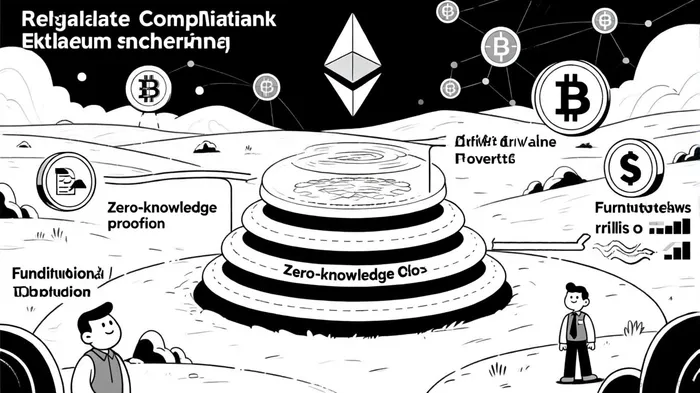






Comentarios
Aún no hay comentarios