
Decentralized Infrastructure Resilience: Navigating Centralization Risks in the Era of Web3
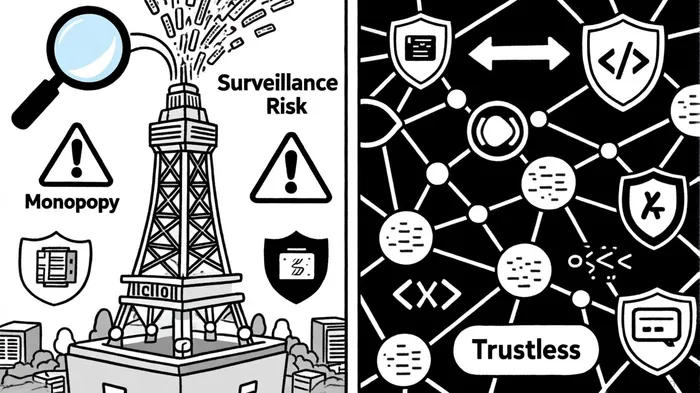
Ethereum co-founder Vitalik Buterin has long sounded the alarm on centralized control risks in decentralized infrastructure, emphasizing that the integrity of systems in healthcare, finance, and governance hinges on open-source, verifiable frameworks. In September 2025, Buterin reiterated that centralized systems create vulnerabilities by enabling monopolization, data exploitation, and erosion of public trust, particularly in critical sectors like health technology [1]. His critique of proprietary health systems—highlighting how closed architectures stifled pandemic-era innovation and amplified surveillance risks—underscores a broader concern: centralization undermines the resilience and equity that decentralized infrastructure promises [1].
The Paradox of Centralization: Efficiency vs. Fragility
Buterin's stance is nuanced. While he advocates for decentralized principles, he has also endorsed hybrid models that balance user experience with security. For instance, his recent endorsement of CoinbaseCOIN-- Base—a centralized LayerLAYER-- 2 rollup—acknowledges that centralized solutions can enhance scalability and accessibility, provided they remain anchored in decentralized security mechanisms [2]. This duality reflects a growing industry trend: leveraging centralized components for efficiency while mitigating risks through transparency and open-source verification.
However, the risks of unchecked centralization are stark. In healthcare, studies reveal that decentralized governance can either exacerbate or reduce inequities, depending on institutional and socio-economic contexts [3]. For example, the "Voting with feet" mechanism in decentralized systems allows communities to tailor solutions to local needs but risks fragmenting resources. Conversely, centralized models like Amazon's cloud services demonstrate operational efficiency but expose single points of failure, as seen in recent outages disrupting global operations.
Case Studies: DeFi and Healthcare as Testbeds
Decentralized finance (DeFi) offers a compelling case study. Over the past two years, DeFi has disrupted traditional finance by enabling peer-to-peer transactions and automated lending via smart contracts. Yet, infrastructure challenges persist. Scalability bottlenecks and smart contract vulnerabilities have hindered adoption, while flash loan attacks and systemic risks threaten long-term resilience [4]. A 2025 report on DeFi resilience engineering highlights the need for fail-safe protocols, such as multi-layered security audits and cross-chain interoperability, to address these gaps [4].
In healthcare, the Open Network for Digital Commerce (ONDC) exemplifies decentralized resilience. By dispersing data control across stakeholders, ONDC has enhanced inclusivity and reduced reliance on monopolistic platforms [5]. Conversely, centralized health systems, such as those reliant on proprietary electronic health records (EHRs), face scrutiny for data monopolies and privacy breaches. A 2025 NIH study notes that decentralized governance in healthcare improves responsiveness but requires robust inter-ecosystem collaboration to avoid fragmentation [3].
The Path Forward: Hybrid Models and Governance Innovation
Buterin's advocacy for verifiable systems aligns with emerging hybrid approaches. Ethereum's EIP-1559 upgrade, driven by community governance, reduced gasGAS-- fees and demonstrated the power of decentralized decision-making [6]. Similarly, Uniswap's integration of Optimism's Layer 2 solution—approved via token holder voting—showcases how decentralized governance can adapt to user needs while maintaining security [6].
For investors, the key lies in identifying projects that balance decentralization with pragmatic efficiency. Decentralized Autonomous Organizations (DAOs) like MakerDAO and MolochDAO illustrate this balance, enabling transparent governance while funding public goods and stabilizing cryptocurrencies [6]. However, challenges such as smart contract vulnerabilities and contentious governance debates remain, necessitating rigorous due diligence.
Conclusion: Resilience as a Competitive Advantage
As Buterin's warnings highlight, the future of decentralized infrastructure depends on mitigating centralization risks through transparency, hybrid models, and governance innovation. Investors should prioritize projects that embed resilience into their core design—whether through open-source verification, fail-safe protocols, or community-driven governance. In an era where trust is a scarce resource, infrastructure that balances decentralization with efficiency will define the next wave of Web3 adoption.





Comentarios
Aún no hay comentarios