
Decentralized Governance in Crypto Innovation: How ARK's AI x DAO Model Reshapes Institutional Investment
The blockchain industry has long grappled with the tension between decentralization and efficiency. Traditional DAOs, while democratic, often suffer from slow decision-making, voter apathy, and governance gridlock. Enter ARK's AI x DAO co-governance model-a paradigm shift that merges algorithmic intelligence with decentralized consensus to create a governance framework tailored for institutional adoption. As of October 2025, ARK's launch of its DAO Governance System marks a pivotal moment in blockchain innovation, offering a blueprint for institutional investors seeking scalable, transparent, and adaptive governance structures.
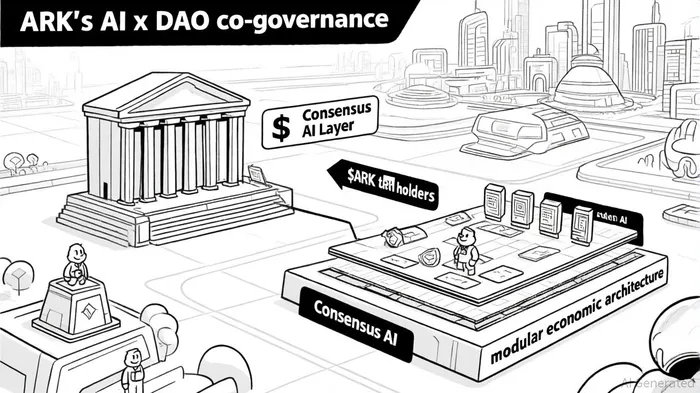
The ARKARK-- Governance Revolution: AI as a Neutral Parliament
ARK's model introduces a dual-core governance system where AI and human participants co-govern. Staked $ARK tokens function as civic votes, enabling holders to propose and vote on protocol decisions. However, the true innovation lies in the Consensus AI Layer, a neural engine that simulates policy outcomes, identifies risks, and provides neutral recommendations, according to an Ambcrypto analysis. This AI layer acts as a "neutral parliament," ensuring decisions are data-driven and free from human bias. For instance, when evaluating treasury proposals, the AI assesses financial efficiency, fraud risk, and ecosystem alignment, streamlining execution while maintaining accountability, according to a Decrypt report.
This hybrid model addresses a critical pain point for institutional investors: governance inefficiency. Traditional DAOs often struggle with low voter turnout and complex proposals that deter participation. ARK's AI-driven simulations simplify decision-making by forecasting outcomes, thereby increasing voter engagement. A KlimaDAO case study demonstrated that AI-assisted governance could boost voter participation by 40% and improve clarity by 35%. By mitigating these challenges, ARK's framework appeals to institutions prioritizing both governance quality and operational speed.
Modular Economics: A Foundation for Institutional Confidence
ARK's governance is underpinned by a modular economic architecture comprising five key modules: EM (Emission Manager), RBS (Range Bound Stabilizer), YRF (Yield Revenue Feedback), MCL (Mint Cap Limit), and RCM (Runway Control Module), as described in an OKX explainer. These modules work in tandem with the DAO layer to stabilize tokenomics, manage liquidity, and ensure long-term sustainability. For institutional investors, this architecture offers a level of predictability and adaptability rarely seen in decentralized systems.
Consider the RBS module, which dynamically adjusts token supply to maintain price stability. Paired with the AI layer's real-time risk monitoring, this creates a self-correcting system that minimizes volatility-a key concern for institutions wary of crypto's inherent instability. Similarly, the RCM module optimizes treasury runway by allocating resources based on AI-evaluated strategic priorities, ensuring fiscal prudence, according to a CryptogridChain analysis. Such features align with institutional demands for robust risk management and transparent financial planning.
Institutional Adoption: From Skepticism to Strategic Investment
ARK's governance innovations have already attracted significant institutional backing. In 2025, the project secured $30 million in funding from the Morgan Crest Web3 Foundation and DeFi/AI experts, signaling confidence in its vision (detailed in OKX coverage). This capital influx is not merely speculative; it reflects a broader trend of institutions recognizing ARK's potential to redefine governance in decentralized ecosystems.
The appeal lies in ARK's ability to reconcile decentralization with institutional requirements. For example, the AI layer's neutral decision recommendations reduce the risk of governance capture-a persistent issue in DAOs where large token holders dominate. By introducing algorithmic checks and balances, ARK creates a governance model that is both participatory and resistant to manipulation. This duality is critical for institutions seeking to comply with regulatory frameworks while engaging in decentralized governance.
Moreover, ARK's bottom-up governance approach-via regional councils, localized node proposals, and open workshops-fosters global participation without compromising on-chain execution. Institutions value this inclusivity, as it aligns with ESG (Environmental, Social, and Governance) principles. The ability to co-govern with stakeholders worldwide, while leveraging AI for efficiency, positions ARK as a scalable solution for institutional portfolios.
Challenges and the Road Ahead
Despite its promise, ARK's model is not without challenges. The integration of AI in governance raises questions about transparency and accountability. While the Consensus AI Layer is designed to be neutral, its algorithms must remain auditable to maintain trust. Additionally, the success of the DAO hinges on sustained community engagement-a challenge even with AI-driven simulations.
However, ARK's iterative approach-continuously refining its AI models and governance processes-suggests a commitment to addressing these issues. The project's vision of a "civilization protocol" extends beyond finance, aiming to create a decentralized framework for education, healthcare, and creative industries, according to a Chainwire report. For institutions, this long-term vision offers not just investment opportunities but a stake in shaping the future of digital governance.
Conclusion: A New Era of Institutional Participation
ARK's AI x DAO co-governance model represents a tectonic shift in blockchain governance. By harmonizing human agency with algorithmic intelligence, it addresses the scalability, transparency, and efficiency concerns that have historically hindered institutional adoption. As institutional investors increasingly prioritize governance quality and adaptability, ARK's framework offers a compelling case for redefining how value is created and managed in decentralized ecosystems.
For institutions, the message is clear: the future of blockchain governance is not a choice between AI and decentralization but a synthesis of both. ARK's model, with its emphasis on collective intelligence and protocol-driven fairness, may well become the gold standard for institutional participation in the crypto age.







Comentarios
Aún no hay comentarios