
Decentralized Governance in Blockchain: A New Paradigm for Risk Mitigation in Emerging Asset Classes
Decentralized Governance: A Structural Shift in Risk Management
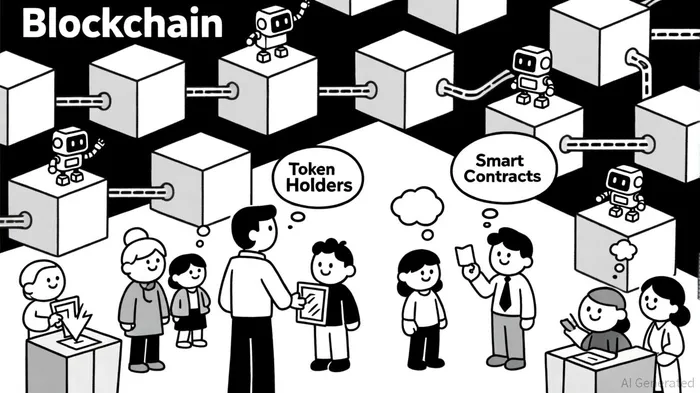
Decentralized governance models, such as DAOs, leverage tokenization and smart contracts to distribute decision-making authority among stakeholders. For instance, MakerDAO's MKRMKR-- token enables holders to vote on critical parameters like stability fees and collateral ratios, directly influencing risk exposure in its stablecoin ecosystem, according to a Frontiers study. Similarly, MolochDAO funds public goods and infrastructure projects within the EthereumETH-- ecosystem, demonstrating how decentralized governance can align incentives for long-term value creation, as shown in a ScienceDirect study.
These models draw parallels to Elinor Ostrom's principles of commons governance, emphasizing participatory decision-making and self-monitoring, as discussed in the Frontiers study. However, challenges persist in enforcing sanctions against malicious actors and scaling governance processes across global jurisdictions. For example, while tokenized asset securitization streamlines institutional asset management, it also introduces risks such as smart contract vulnerabilities and regulatory arbitrage, as reviewed in a ResearchGate review.
Risk Mitigation Frameworks: Bridging Innovation and Compliance
Recent industry initiatives highlight the need for structured risk mitigation frameworks tailored to blockchain's unique attributes. A collaborative effort between BCG, DTCC, Clearstream, and Euroclear has produced a comprehensive risk and control framework for digital financial assets; the six core principles are detailed in a BCG report. By fostering industry collaboration, such frameworks aim to standardize practices in the digital asset securities ecosystem.
Complementing this, Oliver Wyman advocates for risk mitigation strategies specific to public blockchain infrastructures, which differ from traditional systems due to their decentralized and open-source nature, as outlined in an Oliver Wyman report. Strategies include engaging third-party node operators and prioritizing open-source development to address operational uncertainties. Meanwhile, Deloitte's proprietary digital asset risk assessment tool identifies over 300 blockchain-specific risks, enabling organizations to align with evolving regulatory expectations, as noted by Deloitte's risk assessment.
Regulatory Evolution and the Dual Edge of Blockchain
The regulatory landscape for blockchain assets is rapidly evolving, with policymakers balancing innovation and financial stability. Regulatory sandboxes and international coordination are increasingly recommended to address cross-border challenges, as argued in a ScienceDirect analysis. For example, the European Union's MiCA (Markets in Crypto-Assets) regulation, set to take effect in 2025, mandates transparency requirements for DAOs and tokenized assets, reflecting a shift toward harmonizing decentralized governance with existing legal frameworks, as discussed in a Taylor & Francis analysis.
However, the adoption of blockchain by states for governance purposes raises critical questions. While decentralized systems can democratize power, they also risk reinforcing centralized control if dominated by a few large token holders, a point illustrated in a BlockchainTechFlow case study. This duality underscores the need for hybrid governance models that blend centralized oversight with decentralized participation, ensuring flexibility in enterprise settings, according to an IEEE review.
Conclusion: The Path Forward
Decentralized governance in blockchain presents a transformative yet complex approach to risk mitigation in emerging asset classes. While DAOs and tokenized governance mechanisms offer transparency and inclusivity, their scalability and enforceability remain under scrutiny. Industry frameworks and regulatory advancements are critical to addressing these gaps, ensuring that blockchain's potential to democratize finance is realized without compromising stability.
For investors, the key lies in adopting a dual strategy: engaging with decentralized governance platforms to align with innovation while leveraging structured risk frameworks to navigate regulatory and operational uncertainties. As the ecosystem matures, the interplay between decentralization and compliance will define the next era of digital asset management.






Comentarios
Aún no hay comentarios