
Decentralized Fundraising Innovation: Can Fundraise.fun Disrupt Traditional Venture Capital Models?
The Rise of Tokenized Fundraising
Decentralized fundraising has surged in popularity, with crypto projects raising $16.1 billion through token sales in 2024 alone-a 53% year-over-year increase. Public token sales now account for 83% of all fundraising events, driven by their accessibility, transparency, and ability to bypass equity dilution. Platforms like AvalancheAVAX-- and ArweaveAR-- have demonstrated the viability of community-driven development, where token holders contribute to governance and infrastructure rather than relying on VC-backed hierarchies.
Fundraise.fun, while not explicitly profiled in recent analyses, appears to fit this paradigm. Its business model likely centers on enabling startups to issue utility or governance tokens, fostering global participation and liquidity. Unlike traditional VC rounds, which often require startups to surrender significant equity and cede decision-making power, tokenized fundraising allows founders to retain autonomy while engaging a decentralized investor base.
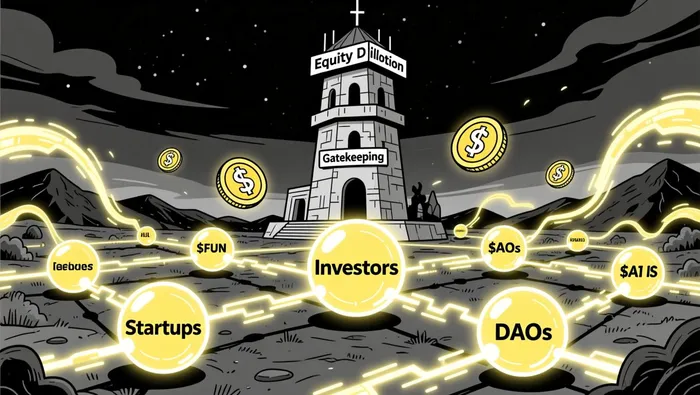
Traditional VC vs. Decentralized Models: A Comparative Edge
Traditional VC models remain critical for startups requiring specialized expertise, regulatory navigation, or access to corporate partnerships. In 2025, late-stage VC funding continues to prioritize profitability, with limited partners demanding rigorous financial traction before committing capital. However, this approach often clashes with the ethos of Web3 projects, which emphasize community governance and open-source collaboration over profit-centric metrics.
Decentralized platforms address these gaps by offering:
1. Global Liquidity: Token sales enable instant liquidity for investors, unlike traditional VC exits that can take years.
2. Transparency: Smart contracts automate fund distribution and governance, reducing information asymmetry.
3. Inclusivity: Startups in emerging markets or niche sectors can bypass geographic and institutional barriers.
For instance, AI-driven crypto projects-such as those integrating machine learning with blockchain oracles-are increasingly opting for token sales to avoid the rigid structures of VC term sheets. This trend aligns with the broader shift toward tokenized real-world assets (RWAs) and DAOs, which further decentralize capital allocation.
Challenges and the Road Ahead
Despite its promise, decentralized fundraising faces hurdles. Regulatory uncertainty, particularly around securities laws, remains a significant barrier. Additionally, the lack of due diligence mechanisms in public token sales can deter risk-averse investors. Fundraise.fun's potential to scale will depend on its ability to integrate compliance tools (e.g., KYC/AML protocols) while preserving the decentralized ethos that attracts founders.
Moreover, the success of platforms like Fundraise.fun hinges on their capacity to foster long-term community engagement. Unlike VCs, which provide mentorship and operational support, decentralized models must rely on token incentives and DAO governance to sustain project development. Early adopters like Helium and Arweave have shown this is possible, but scalability remains untested for broader adoption.
Conclusion
The 2025 VC landscape is at an inflection point. While traditional VCs retain their relevance for late-stage, profit-driven ventures, decentralized platforms are redefining capital access for innovation-driven startups. Fundraise.fun, as part of this ecosystem, could play a pivotal role by bridging the gap between Web3 ideals and practical fundraising needs. However, its long-term impact will depend on regulatory clarity, technological maturation, and the ability to balance decentralization with accountability.
For investors, the key takeaway is clear: diversifying exposure to both traditional and decentralized fundraising models is no longer optional-it's a strategic imperative in an increasingly fragmented capital landscape.







Comentarios
Aún no hay comentarios