
Decentralized Finance (DeFi) in 2025: Navigating Volatility and Unlocking Value
In 2025, the DeFi ecosystem has matured into a cornerstone of global finance, with total value locked (TVL) surging to $237 billion in Q3 alone, despite a 22% decline in DApp wallet activity, according to a Cointelegraph report. This growth is driven by institutional adoption, regulatory clarity under the U.S. GENIUS Act, and the tokenization of real-world assets (RWAs). However, as the sector evolves, investors must navigate a complex interplay of volatility, risk-adjusted returns, and innovative risk management tools. This article examines how DeFi protocols are redefining value creation in a maturing market, with a focus on metrics like Sharpe ratios, impermanent loss mitigation, and cutting-edge technological advancements.
Risk-Adjusted Returns: The Sharpe Ratio as a Benchmark
The Sharpe ratio remains a critical metric for evaluating DeFi protocols, balancing potential rewards against volatility. For instance, a protocol offering 10% annualized returns with a Sharpe ratio of 0.5 is outperformed by another yielding 8% but with a Sharpe ratio of 1.0, as the latter achieves a superior risk-return tradeoff, as explained in the Decen Masters blog. In Q3 2025, advanced frameworks like AlphaSharpe- which leverages large language models (LLMs) to optimize risk-adjusted metrics-have demonstrated a 3x improvement in predictive accuracy for future returns, according to the AlphaSharpe paper. This innovation is particularly relevant for DeFi, where market conditions shift rapidly due to macroeconomic factors like Fed rate cuts and AI-driven demand surges, as noted in the Schroders Q3 2025 review.
However, traditional Sharpe ratios face limitations in DeFi. Short track records and estimation errors can distort results, prompting the adoption of tools like the Deflated Sharpe Ratio and the Jobson–Korkie/Memmel test to validate statistical significance, as illustrated by the Sharpe Ratio Visualizer. These methods help investors avoid overfitting strategies to historical data, a common pitfall in high-volatility environments.
Impermanent Loss: Mitigation Strategies in a Volatile Market
Impermanent loss (IL) remains a persistent challenge for liquidity providers (LPs), particularly in volatile asset pairs like ETH/USDC. When token prices diverge, AMMs rebalance pools using formulas like $ x \times y = k $, eroding LP value compared to holding tokens outright, as reported by Cointelegraph. In Q3 2025, IL risks were exacerbated by a 66% surge in EthereumETH-- prices and increased trading volumes driven by AI-driven demand, as noted in the Schroders Q3 2025 review.
To combat this, LPs are adopting three key strategies:
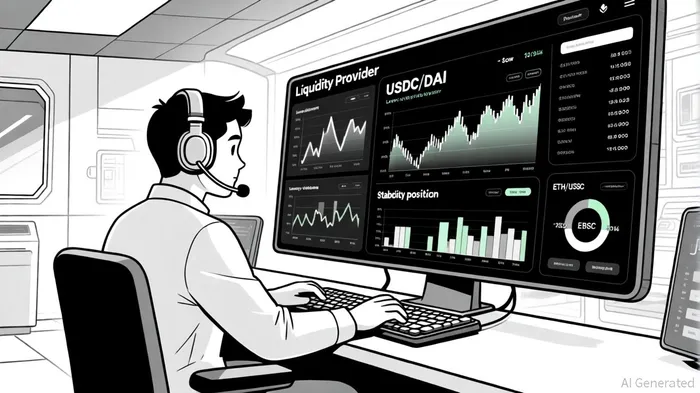
1. Stablecoin Pairs: Pools like USDC/DAI, with minimal price divergence, reduce IL exposure (see the AlphaSharpe paper for framework examples).
2. Concentrated Liquidity: Protocols like UniswapUNI-- v3 allow LPs to allocate capital within specific price ranges, boosting fees but requiring active monitoring.
3. IL Protection Mechanisms: Platforms such as Bancor v2 offer compensation for losses under predefined conditions.
Derivative tools are also gaining traction. Delta-neutral hedging and on-chain options enable LPs to offset price divergence risks, while yield farming aggregators optimize pool diversification, as outlined in the DepegWatch guide. These strategies reflect a shift toward proactive risk management in DeFi.
Technological Innovations: Neuromorphic Computing and Quantum-Resistant Security
The 2025 risk-adjusted yield stack is defined by cutting-edge infrastructure. Neuromorphic processors and spiking neural networks now power real-time recalibration of liquidity positions, reducing prediction latency and energy consumption, a trend highlighted in the Schroders Q3 2025 review. Meanwhile, quantum-resistant cryptographic modules ensure protocol security amid growing computational threats.
Generative AI further enhances decision-making by simulating market scenarios and optimizing capital allocation across protocols like Curve and AaveAAVE--, another point emphasized in the Schroders Q3 2025 review. These advancements align with the EU AI Act's compliance requirements, fostering trust in DeFi's institutional-grade infrastructure.
Conclusion: Balancing Risk and Reward in a Maturing Ecosystem
DeFi's 2025 landscape is marked by both opportunity and complexity. While TVL records and institutional adoption signal maturation, volatility and IL risks demand sophisticated risk-adjusted strategies. Investors who leverage tools like AlphaSharpe, concentrated liquidity, and IL protection are better positioned to capitalize on DeFi's potential. As the sector integrates AI, quantum-resistant security, and neuromorphic computing, the focus will shift from speculative yield farming to sustainable, data-driven value creation.
For those navigating this evolving terrain, the key lies in aligning risk tolerance with innovation. DeFi's future is not just about higher returns-it's about smarter, more resilient capital.






Comentarios
Aún no hay comentarios