
Decentralized Data Marketplaces and the Future of Web Infrastructure: How Web3 is Reshaping Cloud and Advertising Models
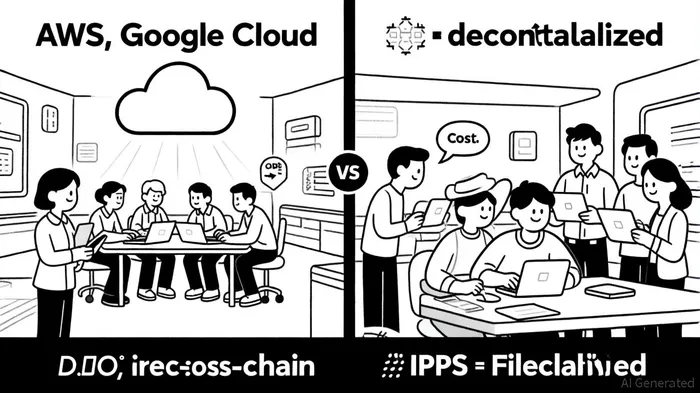
The rise of Web3 has ignited a paradigm shift in how data is stored, accessed, and monetized. Decentralized data marketplaces, a cornerstone of this evolution, are poised to disrupt traditional cloud infrastructure and advertising models by leveraging blockchain's inherent advantages: transparency, cost efficiency, and user sovereignty. As the DeFi ecosystem expands at a blistering pace, with the Data & Analytics segment accounting for 15% of the $20.48 billion DeFi market in 2024 and projected to grow at a 53.7% CAGR to $231.19 billion by 2030[1], the implications for legacy systems are profound.
The Case for Decentralized Data Marketplaces
Decentralized data marketplaces, such as The Graph, are redefining access to real-time, trustless data. In Q2 2025, The Graph reported a 46.3% quarter-over-quarter increase in new Subgraphs (1,673 total) and a record 6.49 billion queries, underscoring sustained demand for decentralized data solutions[2]. These platforms eliminate intermediaries, enabling developers and enterprises to access and monetize data directly. For instance, IPFS and Filecoin have pioneered decentralized storage, distributing data across global nodes to mitigate single points of failure—a critical advantage over centralized providers like AWS, which suffered a catastrophic outage in April 2024, disrupting global financial systems[3].
The economic incentives of decentralized systems further amplify their appeal. Traditional cloud providers charge premium fees for storage and compute, while decentralized alternatives like Akash Network and Golem Network leverage unused hardware resources, reducing costs by up to 70%[4]. This cost efficiency is compounded by tokenized economies, where users are rewarded for contributing storage or bandwidth, creating a self-sustaining ecosystem.
Disrupting Traditional Advertising Models
Web3's impact extends beyond infrastructure to advertising. Decentralized ad networks, powered by smart contracts, enable direct interactions between advertisers and publishers, bypassing intermediaries like GoogleGOOGL-- and Meta. For example, Binance's Web3 influencer campaigns achieved higher ROI than traditional ads by engaging crypto-native audiences through tokenized incentives[5]. Similarly, Coca-Cola's NFT campaign demonstrated how brands can leverage decentralized platforms to target niche, tech-savvy demographics[5].
Cost structures in decentralized advertising contrast sharply with traditional models. Google Ads, which relies on a pay-per-click (PPC) model, charges an average $1.16 CPC in e-commerce, while Meta Ads offers lower $0.70 CPC but lacks transparency in algorithmic targeting[6]. Decentralized platforms, however, prioritize user control: users own their data and can opt into ad experiences, fostering trust and reducing ad fraud. Projects like DPSN are pioneering permissionless, hyper-specific data feeds, enabling advertisers to access niche audiences without compromising privacy[7].
Challenges and the Path Forward
Despite their promise, decentralized systems face hurdles. Scalability remains a concern, as latency and usability lag behind centralized solutions. For instance, while Ethereum dominates DeFi with $78.1 billion in TVL, cross-chain activity must mature to support global data trading[1]. Additionally, governance issues—such as token holder centralization—threaten the decentralization ethos[8].
However, hybrid models are emerging as a bridge. Platforms like Mizzle combine traditional cloud scalability with decentralized resilience, addressing enterprise needs for flexibility and compliance[9]. Regulatory clarity will also be pivotal; as data sovereignty laws tighten, decentralized systems' inherent privacy advantages will become increasingly attractive.
Investment Implications
The DePIN (Decentralized Physical Infrastructure Network) sector, valued at $19.3 billion in 2025, is projected to reach $3.5 trillion by 2028, driven by rising cloud costs and sustainability demands[10]. Investors should prioritize projects with robust token economies, cross-chain interoperability, and real-world use cases. For example, The Graph's migration to Arbitrum has catalyzed a 46.3% QoQ growth in Subgraphs, signaling strong network effects[2].
Conclusion
Web3's decentralized data marketplaces are not merely an alternative to traditional cloud and advertising models—they are a transformative force. By democratizing data access, reducing costs, and empowering users, these platforms address systemic flaws in centralized systems. While challenges persist, the trajectory of growth, adoption, and innovation suggests that Web3 will redefine the digital infrastructure landscape. For investors, the key lies in identifying projects that balance scalability with decentralization, ensuring long-term resilience in an increasingly data-driven world.







Comentarios
Aún no hay comentarios