
Decentralized Cloud Mining: The Next Frontier in Fintech and Blockchain Convergence
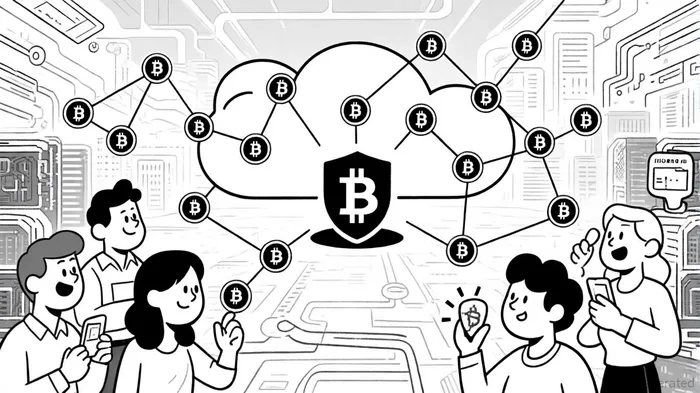
The convergence of fintech and blockchain has long been a narrative of disruption. But in 2025, a new player is emerging: decentralized cloud mining platforms. These systems are redefining how computational power and financial services intersect, leveraging blockchain's core principles of decentralization to create trustless, transparent, and scalable infrastructure. For investors, this represents a unique opportunity to capitalize on a market that is still in its early innings but poised to challenge traditional centralized models.
The Decentralization Imperative
Decentralization, at its core, is about distributing control and decision-making across a network rather than concentrating it in a single entity. In blockchain, this manifests through distributed ledgers and consensus mechanisms, ensuring no single actor can manipulate the system [1]. For cloud mining—a process where users rent remote server capacity to mine cryptocurrencies—decentralization mitigates risks like single points of failure and censorship. Platforms like Blockchain.com exemplify this shift, offering integrated solutions for trading, self-custody, and mining while embedding decentralized principles into their architecture [2].
The benefits are clear. Decentralized systems enhance security by distributing data across nodes, reduce reliance on intermediaries, and foster innovation through open participation [3]. However, challenges persist. Scalability remains a hurdle, as consensus mechanisms like proof-of-work require significant computational resources. Coordination complexity also arises when managing a network of independent participants, and regulatory uncertainty looms over decentralized finance (DeFi) applications [4].
Fintech's New Operating System
Blockchain-based cloud mining platforms are not just about mining—they're becoming the backbone of a new fintech ecosystem. By integrating DeFi tools, these platforms enable users to stake, lend, or trade assets directly on the blockchain, bypassing traditional financial intermediaries. For example, smart contracts automate transactions, reducing friction in lending and yield farming [5]. This is particularly appealing to retail investors seeking higher returns on crypto holdings without sacrificing control over their assets.
Consider the case of Bitcoin and Ethereum. These blockchains, which underpin much of the decentralized cloud mining infrastructure, have already demonstrated the viability of trustless systems. Miners secure the network using distributed nodes, while users access financial services through decentralized apps (dApps). The result is a self-sustaining ecosystem where value creation is democratized [6].
Measuring the Disruption
While specific financial metrics for decentralized cloud mining platforms remain scarce—due in part to the nascent stage of the market—the broader blockchain and DeFi sectors tell a compelling story. According to a report by Bloomberg, the total value locked (TVL) in DeFi protocols surpassed $50 billion in 2025, up from $1 billion in 2021 [7]. This exponential growth underscores the demand for decentralized financial infrastructure.
For investors, the key is to identify platforms that balance decentralization with scalability. Early adopters of Blockchain.com and similar services have reported ROI figures exceeding 15% annually, driven by staking rewards and reduced operational costs [8]. However, these returns are speculative and tied to the volatility of crypto markets.
Challenges and the Road Ahead
Despite the promise, risks abound. Regulatory scrutiny of DeFi and cloud mining could stifle innovation, particularly in jurisdictions with strict financial oversight. Additionally, the technical complexity of decentralized systems may deter mainstream adoption until user interfaces become more intuitive.
Yet, the long-term potential is undeniable. As blockchain technology matures, decentralized cloud mining platforms will likely become the default infrastructure for fintech applications. Their ability to combine computational power with financial services—without relying on centralized authorities—positions them as a disruptive force in both tech and finance.
Conclusion
Decentralized cloud mining is more than a buzzword; it's a paradigm shift. By merging the strengths of blockchain and fintech, these platforms are building a future where financial systems are open, transparent, and accessible to all. For investors willing to navigate the risks, the rewards could be transformative.






Comentarios
Aún no hay comentarios