
Decentralization vs. Security: The Growing Trend of Protocol-Level Fund Freezing in Blockchain Ecosystems
The Crisis of Confidence: DeFi's Security Challenges
The past two years have been a litany of disasters for DeFi. In November 2025 alone, the BalancerBAL-- protocol suffered a $116–$128 million exploit due to access control vulnerabilities, while Stream Finance collapsed after a $93 million loss from an external fund manager's liquidation, as a Financial Content report noted. These events, coupled with the depegging of stablecoins like Elixir's deUSD and Stable Labs' USDX, have eroded investor trust. According to a report by Bybit's Lazarus Security Lab, 16 major blockchains-including BNBBNB-- Chain, SuiSUI--, and Aptos-now possess the ability to freeze user funds during security incidents, as the report found. For example, Sui froze $162 million in stolen assets after the CetusCETUS-- hack, and BNB Chain used hardcoded blacklists to contain a $570 million bridge exploit, as the same report noted.
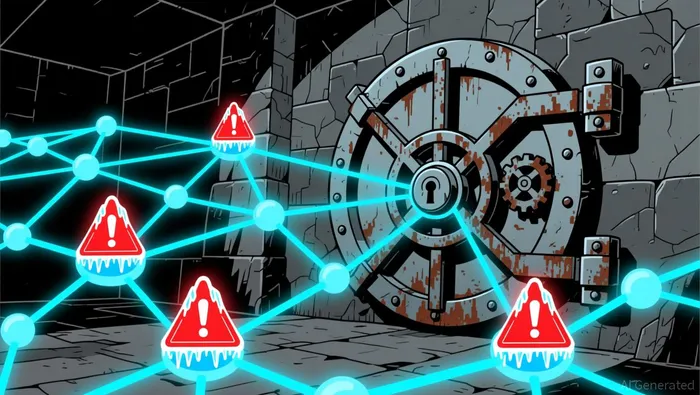
While these actions prevented further losses, they also exposed a paradox: blockchains designed to eliminate intermediaries are now acting as centralized arbiters of user funds, according to the report. This undermines the core promise of DeFi, where users are supposed to retain full control over their assets.
The Rise of Centralized Security: A Necessary Evil?
The adoption of fund-freezing mechanisms reflects a pragmatic shift in the industry. As stated by a 2025 report from Bybit's Lazarus Security Lab, such measures are increasingly seen as a "security trade-off" to balance decentralization with rapid threat response, as the report found. However, this approach introduces centralization risks. For instance, EthereumETH--, Binance Smart Chain, and Polygon-blockchains collectively controlling over 80% of DeFi's total value locked (TVL)-now have the power to pause, freeze, or filter transactions, as a Yahoo Finance article reported. This has led to accusations of a "decentralization illusion," where protocols claim autonomy but rely on centralized governance councils or core developers to enforce security, as the Yahoo article noted.
Investors must weigh these risks against the benefits. While fund freezes can protect capital during crises, they also create uncertainty. A 2025 academic study on DeFi's macroeconomic vulnerabilities highlights how protocols are now exposed to traditional financial shocks, such as central bank policy changes, due to their reliance on stablecoins backed by treasury bills and commercial paper, as a ScienceDirect article observed. This interdependence complicates token price dynamics and investment flows, as DeFi platforms must now navigate both on-chain risks and off-chain macroeconomic conditions.
Institutional Adoption and the Path Forward
Despite these challenges, institutional interest in DeFi remains robust. Franklin Templeton's partnership with Canton Network to tokenize real-world assets (RWAs) and KODA Clearpool's custodial solutions for institutional DeFi participation signal a growing appetite for regulated, secure blockchain products, as a Financial Content report and a BitcoinWorld article noted. By mid-2025, the RWA market had already reached $24–25 billion, with projections of $1,244 billion by 2025, as the Financial Content report noted. These developments suggest that protocols prioritizing compliance, KYC/AML frameworks, and transparent governance are better positioned to attract institutional capital.
However, the recent "risk-off" sentiment in DeFi has prompted a shift toward traditional safe-havens. Data from late 2024 to 2025 shows investors reallocating capital to gold and silver as DeFi protocols like Balancer and DeFi Development Corp.DFDV-- faced reputational and financial losses, as a Financial Content report noted. This trend underscores the need for DeFi platforms to enhance transparency and regulatory alignment to retain investor confidence.
Investment Implications: Balancing Autonomy and Safety
For investors, the key question is whether the benefits of fund-freezing mechanisms outweigh their centralizing effects. The data is mixed. While DeFi exploits declined by 40% in 2024 (to $474 million in losses), centralized exchange losses surged to $694 million, more than double the $339 million in 2023, as a report found. This suggests that DeFi's improved security tools, such as zero-knowledge cryptography, are effective-but only when paired with cautious governance.
Protocols that adopt hybrid models-combining decentralized governance with limited, transparent fund-freezing capabilities-may strike the optimal balance. For example, Sui's post-Cetus hack response demonstrated how rapid, on-chain interventions can mitigate damage without fully compromising decentralization, as the report found. Conversely, protocols that rely on opaque, hardcoded blacklists (like BNB Chain's bridge exploit containment) risk alienating users who value transparency, as the report found.
Conclusion: A New Era for DeFi Security
The rise of protocol-level fund freezing marks a pivotal moment in DeFi's evolution. While these measures are necessary to address the sector's inherent vulnerabilities, they also challenge the philosophical foundations of blockchain technology. For investors, the path forward lies in supporting protocols that prioritize security without sacrificing transparency and decentralization without ignoring risk management. As institutional adoption accelerates and regulatory scrutiny intensifies, the protocols that thrive will be those that navigate this delicate balance with innovation and integrity.





Comentarios
Aún no hay comentarios