
End-to-End Decentralization as a Core Resilience Strategy for Crypto Protocols
The Post-Cloudflare Era: Vulnerabilities Exposed
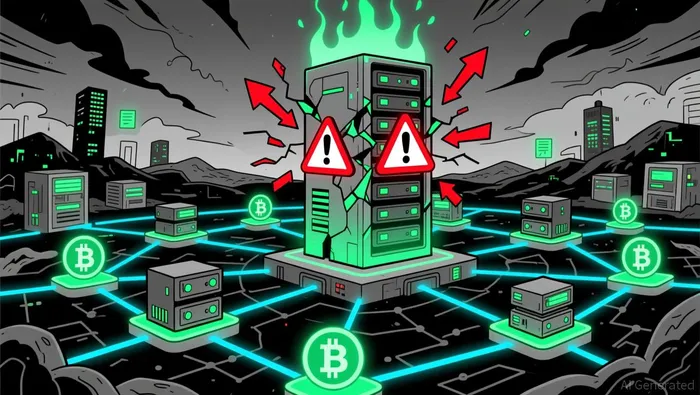
Cloudflare's 2025 outage, which affected 20% of global web traffic, highlighted the fragility of centralized routing systems. Major crypto platforms, including Arbiscan, BitMEX, and DeFiLlama, faced downtime, revealing the sector's reliance on third-party infrastructure despite its ideological commitment to decentralization according to industry analysis. Meanwhile, Cloudflare's legal liability for enabling manga piracy-ordered to pay $3 million in damages-set a precedent for holding service providers accountable for facilitating copyright infringement as per legal rulings. These incidents collectively signaled a shift in investor sentiment, amplifying scrutiny over the trade-offs between convenience and resilience.
Decentralized Protocols as a Resilience Strategy
End-to-end decentralized protocols are designed to eliminate single points of failure, a principle that has gained renewed relevance post-2025. EthereumETH--, for instance, anchors global economic security through its Proof-of-Stake (PoS) system, securing $90 billion in value with a decentralized validator network of over one million nodes. Similarly, Celestia's modular data availability layer employs cryptographic sampling to ensure transaction data remains verifiably accessible, reducing reliance on centralized storage.
Zero-knowledge (zk) protocols like StarknetSTRK-- and Polygon zkEVM further exemplify this resilience. Starknet's use of zk-STARK proofs guarantees deterministic trust without intermediaries, while Polygon zkEVM's zk-SNARKs enable scalable, auditable computation. Optimistic rollups such as Arbitrum and OptimismOP--, though dependent on Ethereum for finality, employ fraud-proof mechanisms that balance speed with conditional assurance. These architectures collectively redefine security as a shared resource, leveraging economic and cryptographic guarantees to withstand infrastructure shocks.
Investment Performance: Resilience in Action
The investment landscape post-2025 reveals mixed signals. Starknet's STRKSTRK-- token, despite losing 96% of its TGE value, has surged 40% in 30 days as of November 2025, driven by a 200% TVL increase fueled by decentralized perpetual futures exchanges. This growth, however, occurred amid monthly token unlocks, suggesting market confidence in the protocol's long-term utility. In contrast, Ethereum's TVL declined 13% to $74.2 billion post-Cloudflare outage, reflecting broader DeFi pullback amid security concerns.
Celestia, with a TVL of $0 in DeFi and a $0.75 TIATIA-- token price, remains a speculative bet on modular infrastructure. Its lack of DeFi integration contrasts with Ethereum's entrenched ecosystem, yet its focus on data availability aligns with growing demand for scalable, censorship-resistant solutions. Meanwhile, EigenLayer's $25 billion TVL in restaking markets highlights the monetization of validator trust, though it introduces correlated risks across ecosystems.
The Paradox of Centralized Convenience
Cloudflare's foray into crypto infrastructure-via its NET Dollar stablecoin-exemplifies the tension between innovation and vulnerability. While NET Dollar aims to enable AI-driven transactions, its reliance on centralized routing systems exposes it to outages like the 2025 incident. This duality raises questions for investors: Can centralized services adapt to mitigate such risks, or will decentralized alternatives increasingly dominate?
Conclusion: Investing in Resilience
The post-Cloudflare era has crystallized a key investment thesis: Protocols with end-to-end decentralization offer superior resilience against infrastructure shocks, albeit with trade-offs in scalability and user experience. Ethereum's validator network, Celestia's data availability, and Starknet's zk-verified execution represent distinct but complementary approaches to this challenge. For investors, the lesson is clear-allocating capital to protocols that engineer resilience through layered security, cryptographic guarantees, and shared economic trust is not just prudent but imperative in an era where infrastructure vulnerabilities can cascade globally.
As the crypto ecosystem matures, the divide between centralized convenience and decentralized resilience will only widen. The question is no longer whether decentralization matters, but how quickly investors can adapt to its implications.





Comentarios
Aún no hay comentarios