
How the December CPI Report Could Shape Fed Policy and Market Volatility in 2026
The December 2025 Consumer Price Index (CPI) report, set for release on January 13, 2026, has emerged as a pivotal data point for investors and policymakers alike. With inflation remaining stubbornly above the Federal Reserve's 2% target, the report will not only clarify trends obscured by the October 2025 government shutdown but also test the Fed's resolve to balance political pressures with its mandate for price stability. For markets, the outcome could determine whether the central bank pauses its easing cycle or accelerates rate cuts, amplifying volatility in an already uncertain environment.
Inflation Resilience Amid Data Distortions
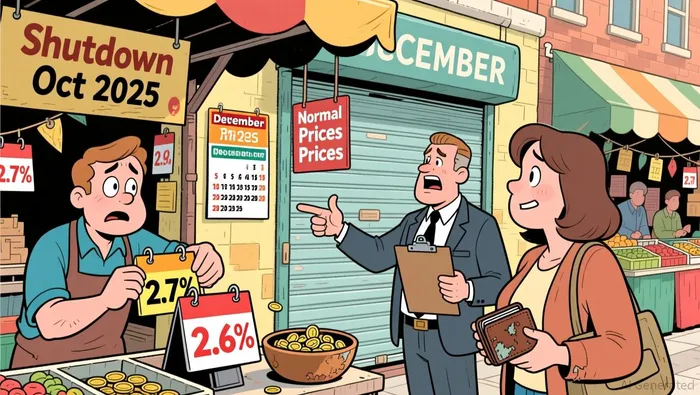
The December CPI is projected to show a year-over-year increase of 2.6%, slightly below November's 2.7% but still exceeding the 12-month average of 2.7%. This resilience reflects persistent inflationary pressures, particularly in core CPI (excluding food and energy), which rose 2.7% annually. However, interpreting this data requires caution. The October government shutdown disrupted the Bureau of Labor Statistics' price surveys during the critical holiday shopping period, potentially understating November's inflation and creating a "payback" effect in December as prices normalize. Analysts warn that the December report could overcorrect for these distortions, masking the true trajectory of inflation.
Energy and housing costs remain key drivers. While gasoline prices have declined, electricity costs surged 6.9% over the past year, and housing inflation-though slowing-continues to outpace wage growth. According to BLS data, these dynamics suggest that even if the December CPI aligns with projections, the underlying forces sustaining inflation are unlikely to abate quickly.
Political Pressures and the Fed's Independence
The Federal Reserve's policy calculus in early 2026 is further complicated by political headwinds. The Department of Justice's subpoena of Fed Chair Jerome Powell has raised concerns about the central bank's independence, with critics fearing political interference in monetary policy. This tension is compounded by Powell's impending term expiration in May 2026, creating uncertainty about the Fed's leadership and priorities. A potential successor aligned with President Trump's pro-growth agenda could shift the central bank's focus toward short-term economic stimulus, potentially exacerbating inflation risks. Market analysis suggests such a shift could have significant implications for monetary policy.
These pressures are already influencing market expectations. While the Fed is widely expected to hold rates steady at its January 2026 meeting, some economists argue that political noise may delay rate cuts until mid-2026, even if inflation trends suggest otherwise. As reports indicate, the prospect of a policy pivot-whether driven by economic data or political expediency-has heightened volatility in bond markets, with Treasury yields fluctuating on shifting bets about the pace of easing.
Implications for Markets and Investors
The December CPI report will serve as a litmus test for the Fed's ability to navigate these challenges. If inflation remains stubbornly above 2.7%, the central bank may adopt a "wait-and-see" approach, prolonging the current pause in rate cuts and allowing markets to price in higher-for-longer rates. Conversely, a sharper-than-expected decline in core CPI could embolden the Fed to accelerate cuts, particularly if political pressures mount for accommodative policy.
Investors should also brace for volatility. The interplay between inflation data, political uncertainty, and Fed policy is likely to create whipsaw movements in equities and fixed income. Sectors sensitive to interest rates-such as real estate and utilities-may face headwinds if the Fed signals prolonged high rates, while cyclical sectors could benefit from aggressive easing. Hedging strategies, including allocations to inflation-protected securities and diversified equity portfolios, will be critical in navigating this environment.
Conclusion
The December 2025 CPI report is more than a routine economic update; it is a barometer of the Fed's credibility and the broader economy's resilience. While data distortions and political pressures cloud the picture, the underlying forces-sticky housing costs, global supply chain dynamics, and fiscal policy-suggest inflation will remain a drag on policy flexibility in 2026. For investors, the key takeaway is to remain agile, balancing defensive positioning with opportunities in sectors poised to benefit from a recalibrated monetary policy landscape.







Comentarios
Aún no hay comentarios