
The December CPI Release and Its Implications for Fed Policy and Market Volatility
The U.S. December 2025 Consumer Price Index (CPI) report, scheduled for release on January 13, 2026, will serve as a pivotal data point for assessing inflationary pressures and shaping Federal Reserve policy. With the previous November CPI showing a 0.2% two-month increase and a 2.7% annual rise, the market is bracing for a report that could either confirm a cooling trend or signal persistent inflationary risks according to the Federal Reserve's FOMC projections. The October 2025 data, distorted by a government shutdown, has cast doubt on prior readings, making the December release critical for recalibrating expectations. Analysts project headline CPI at 2.6–2.8% year-over-year and core CPI at 2.7–2.9%, with energy and shelter costs remaining key drivers according to BLS data.
Fed Policy: A Delicate Balancing Act
The Federal Reserve's December 2025 policy projections underscore a cautious approach to inflation. Atlanta Fed President Raphael Bostic emphasized that "inflation remains a primary concern despite labor market shifts," justifying a 25-basis-point rate cut to mitigate labor market risks according to Bostic's message. This decision reflects the Fed's struggle to balance employment support with price stability, a tension exacerbated by structural factors like demographic changes and AI-driven productivity shifts as Bostic noted. The December rate cut, while signaling a pivot toward easing, has not resolved the central bank's dilemma: aggressive monetary tightening risks stifling growth, while delayed action could entrench inflation.
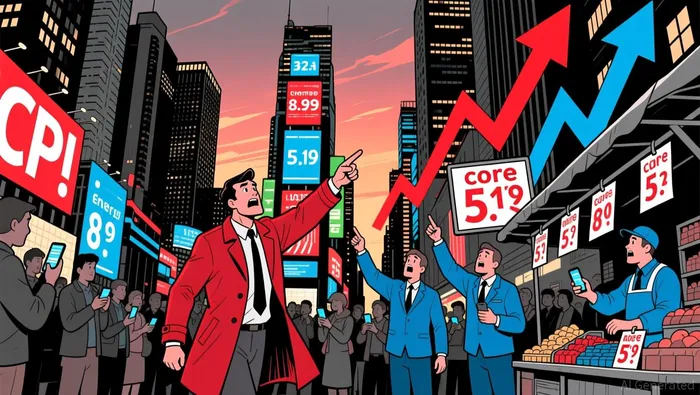
Historically, the Fed's communication strategy has amplified market volatility. A study by CEPR found that volatility during FOMC press conferences under Chair Jerome Powell has been three times higher than under previous chairs, driven by the language used rather than policy surprises. This dynamic suggests that the Fed's post-CPI messaging-particularly around inflation "stickiness"-will heavily influence market sentiment, even if the data itself aligns with expectations.
Market Volatility: CPI as a Double-Edged Sword
The bond market's reaction to CPI data has been particularly swift. Unexpectedly high inflation readings typically trigger a flight to short-duration bonds and a sell-off in long-term treasuries, as investors price in higher yields according to market analysis. For equities, the impact is more nuanced. While a "hot" CPI report might pressure growth stocks (which thrive on low-rate environments), it could also buoy sectors like energy and real estate, which benefit from inflation-linked cash flows as financial experts observe.
The December CPI release will test the resilience of the current market regime. If inflation remains above 2.7%, the Fed may delay rate cuts into Q2 2026, prolonging uncertainty and increasing volatility. Conversely, a reading near the lower end of forecasts could accelerate easing, favoring risk-on assets. Either way, the bond market's immediate response-via yield curve steepening or flattening-will serve as a leading indicator for equity and credit markets according to market data.
Strategic Positioning: Navigating a Data-Driven Environment
Investors must adopt a dual approach to manage CPI-driven volatility and Fed policy uncertainty. First, asset allocation should prioritize diversification across uncorrelated assets. Short-duration bonds (3–7-year maturities) offer a sweet spot for income and duration risk management, while inflation-linked bonds (TIPS) provide a hedge against persistent price pressures according to BlackRock's investment insights. Liquid alternatives, including commodities and gold, also gain relevance in a world where traditional correlations are breaking down as BlackRock notes.
Second, sector rotations should reflect both macroeconomic trends and policy signals. U.S. growth stocks, particularly in AI-driven tech, remain compelling in a low-rate environment according to BlackRock analysis. However, a "barbell" strategy-pairing growth with value sectors like energy and industrials-can mitigate downside risk if inflation proves more entrenched than expected as Aspiriant suggests. International equities, especially in Asia and Latin America, offer diversification and exposure to supply-chain rebalancing trends according to BlackRock's research.
Third, hedging strategies must evolve with the volatility landscape. Options on the S&P 500 and sector-specific puts can protect against CPI-driven selloffs, while tactical use of Bitcoin-a digital asset with a distinct risk-return profile-adds a speculative but uncorrelated hedge according to BlackRock's investment guidance. For fixed income, laddering maturities and tilting toward floating-rate notes can insulate portfolios from rate hikes.
Conclusion: Flexibility as a Core Principle
The December CPI release is more than a data point-it is a stress test for the Fed's credibility and a catalyst for market repositioning. Investors must remain agile, adjusting allocations based on real-time policy signals and inflation trends. A data-driven approach, combining tactical hedging, diversified asset classes, and sector agility, will be critical to navigating the volatility ahead. As the Fed walks the tightrope between growth and inflation, the markets will demand nothing less than strategic precision.






Comentarios
Aún no hay comentarios