
December CPI 2025: A Make-or-Break Inflation Barometer for 2026 Markets
The December 2025 Consumer Price Index (CPI) report, slated for release on January 13, 2026, will serve as a pivotal inflection point for global markets in the coming year. With inflationary pressures still lingering from 2025's tariff-driven shocks and persistent data distortions from the October government shutdown, the CPI reading will not only test the Federal Reserve's resolve but also dictate the trajectory of sector rotation and risk allocation in 2026. Investors must prepare for a bifurcated market environment, where strategic positioning hinges on the interplay between inflation resilience and policy caution.
CPI Expectations: A Tug-of-War Between Tariffs and Data Gaps
Analysts project that headline inflation will rise 0.3% month-over-month in December 2025, translating to a 2.7% year-over-year increase, while core inflation is expected to climb 0.26% monthly and 2.7% annually according to Morningstar analysis. These figures, however, are clouded by methodological challenges. The government shutdown disrupted data collection in October, artificially suppressing goods and rental price metrics, which may bias December's CPI upward. Meanwhile, the Cleveland Fed's Inflation Nowcasting tool estimates a 2.57% year-over-year CPI, slightly below the 2.7% consensus, underscoring the uncertainty.
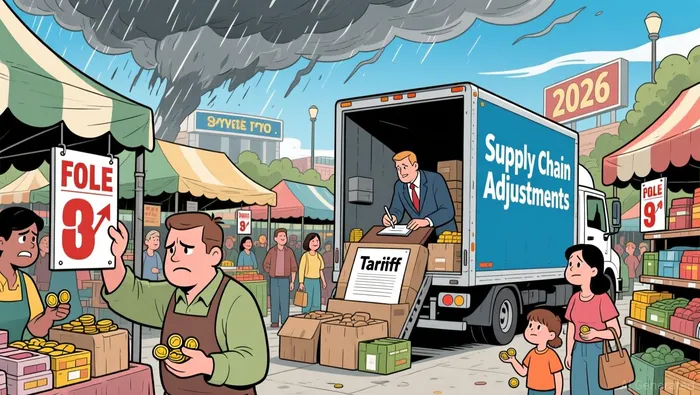
The inflationary narrative is further complicated by the lingering effects of 2025's tariffs. Sectors such as food, apparel, and vehicles remain vulnerable to price surges in early 2026, though these pressures are expected to wane by midyear as supply chains adjust. This dynamic creates a "front-loaded" inflation risk, where the first half of 2026 could see volatility, followed by a gradual normalization.
Fed Policy: A Delicate Balancing Act
The Federal Reserve faces a critical dilemma: interpreting distorted data while avoiding over-tightening. With the CPI release coinciding with the January 27-28 FOMC meeting, the central bank is likely to adopt a wait-and-see approach. Bond futures markets and professional forecasters anticipate no rate hikes in early 2026, with the benchmark rate remaining in the 3.50%-3.75% range. However, the Fed's policy path hinges on two key factors:
1. Data Clarity: If the CPI exceeds 2.7% year-over-year, the Fed may delay rate cuts until mid-2026 to allow for clearer inflation signals. Conversely, a reading below 2.5% could accelerate easing.
2. Labor Market Signals: A weak December jobs report-a potential outcome amid slowing wage growth-would tilt the Fed toward dovish policy, even if inflation remains sticky according to Schwab analysis.
This cautious stance reflects the Fed's broader challenge: reconciling its 2% inflation target with the reality of a post-shutdown data landscape. As UBS notes, "The Fed's hands are tied by the quality of the data, not the level of inflation itself."
Sector Rotation: From Tech Dominance to Broadening Participation
The 2025 AI-driven rally in large-cap tech stocks is expected to give way to a more diversified market in 2026. The December CPI outcome will act as a catalyst for sector reallocation:
- Defensive Sectors: Utilities, industrials, and financials-less sensitive to inflation-could outperform if the Fed maintains higher rates longer. These sectors benefit from stable cash flows and lower duration risk.
- Small-Cap and Non-Mag 7 Stocks: With the Fed signaling a pause in rate hikes, small-cap equities and non-"Magnificent 7" names may attract capital seeking growth in a lower-volatility environment.
- Commodities and Emerging Markets: A CPI above 2.7% could reignite demand for inflation-linked assets like copper, aluminum, and agricultural commodities, driven by AI infrastructure needs and global energy transitions. Conversely, a weaker reading might see capital retreat to yield-sensitive sectors like real estate and consumer discretionary.
Investors should also monitor the interplay between tariffs and trade policy. While the first half of 2026 may see elevated goods prices, the second half could witness a rebalancing toward services-driven growth, favoring healthcare and education sectors.
Strategic Positioning: Navigating Uncertainty
Given the high stakes of the December CPI release, investors should adopt a dual strategy:
1. Hedge Against Data Volatility: Allocate a portion of portfolios to inflation-protected securities (TIPS) and short-duration bonds to mitigate risks from potential rate hikes.
2. Diversify Across Sectors: Overweight sectors poised to benefit from both inflationary and disinflationary scenarios-such as industrials (for tariff-driven demand) and technology (for secular AI growth).
3. Monitor Emerging Markets: A clearer inflation picture in early 2026 could spur capital flows into EM equities and commodities, particularly in regions with robust energy and mining infrastructure.
The December 2025 CPI is more than a monthly data point-it is a litmus test for the resilience of the U.S. economy and the Fed's policy framework. As markets brace for the January 13 release, strategic positioning will hinge on the ability to parse signal from noise in a data environment still recovering from systemic distortions.







Comentarios
Aún no hay comentarios