
Debt vs. Emergency Savings: Strategic Prioritization for Financial Freedom
In the evolving landscape of personal finance, the tension between debt repayment and emergency savings has become a defining challenge for early-stage wealth builders. Recent data reveals a stark shift in priorities: 42% of Americans now rank reducing high-interest debt-particularly credit card balances-as their top financial goal for 2025, while 36% report holding more credit card debt than emergency savings, the highest proportion in 12 years, according to a CBS News analysis. This trend, driven by inflation and rising interest rates, underscores the urgency of balancing immediate debt obligations with the need for a financial safety net.
Opportunity Cost: The Hidden Price of Delay
The opportunity cost of prioritizing one financial goal over another is a critical factor in wealth-building decisions. For example, paying off a $5,000 credit card balance at 22% interest incurs $1,100 in annual fees, while a high-yield savings account would generate only $225 in interest over the same period, according to a Forbes Advisor analysis. This 5:1 ratio of lost value versus potential gains illustrates why financial experts advocate for prioritizing high-interest debt repayment over low-yield savings. However, this calculus assumes perfect financial discipline and ignores the behavioral biases that skew decision-making.
Behavioral finance theories reveal how cognitive biases like present bias and loss aversion distort choices. Present bias-the tendency to favor immediate rewards-often leads individuals to delay savings in favor of short-term spending, even when long-term costs are higher, as noted in a Brookings analysis. Conversely, loss aversion-the fear of realizing losses-can trap individuals in suboptimal strategies, such as clinging to high-interest debt instead of exploring refinancing options, a point the Forbes Advisor analysis also highlights. These biases create a paradox: while debt repayment may mathematically dominate, psychological barriers often prevent individuals from executing optimal strategies.
Risk Mitigation: Building a Safety Net Without Sacrificing Progress
Emergency savings act as a buffer against financial shocks, yet 45% of Americans had no emergency reserves in 2024, according to the Federal Reserve report. For low-income households, the absence of a safety net exacerbates vulnerability to job loss or medical emergencies, creating a cycle of debt dependency. A balanced approach requires addressing both risks simultaneously.
Income-driven allocation strategies offer a framework for this balance. The 50/30/20 rule-allocating 50% of income to essentials, 30% to discretionary spending, and 20% to savings and debt-provides a flexible structure. For instance, an individual earning $4,000 monthly could allocate $800 to debt repayment and $400 to emergency savings while maintaining financial stability, as suggested in a MyFinancialGoals guide. Automation further enhances this strategy by ensuring consistent contributions to both goals, reducing the temptation to divert funds to non-essential expenses, as the Federal Reserve report underscores.
Quantitative models also support hybrid approaches. A 2023 study demonstrated that households with income volatility benefit from maintaining a small emergency fund (covering 1–3 months of expenses) while aggressively targeting high-interest debt. This "dual-track" strategy minimizes the risk of financial shocks while accelerating debt reduction, as illustrated by case studies like Neha's, who eliminated ₹800,000 in credit card debt over two years while building a modest safety net through budgeting and side income, a pattern also noted in the Federal Reserve report.
The Role of Behavioral Adjustments in Execution
Overcoming cognitive biases requires deliberate strategies. The debt avalanche method-prioritizing debts with the highest interest rates-maximizes long-term savings, while the debt snowball method-targeting smaller debts first-provides psychological wins to sustain motivation, as discussed in the MyFinancialGoals guide. Combining these approaches with mental accounting-treating emergency savings as a non-negotiable expense-can counteract present bias and foster discipline, an insight the Brookings analysis also emphasizes.
For example, Amit, an engineer with ₹1.2 million in student loans, restructured his payments, utilized prepayments, and generated additional income through tutoring to reduce his debt by 60% in three years while maintaining a $2,000 emergency fund, illustrating recommendations from the Federal Reserve report. His success highlights the importance of aligning repayment plans with income fluctuations, such as income-driven repayment (IDR) programs that adjust monthly payments based on earnings, as explained in the Brookings analysis.
Conclusion: A Path to Financial Resilience
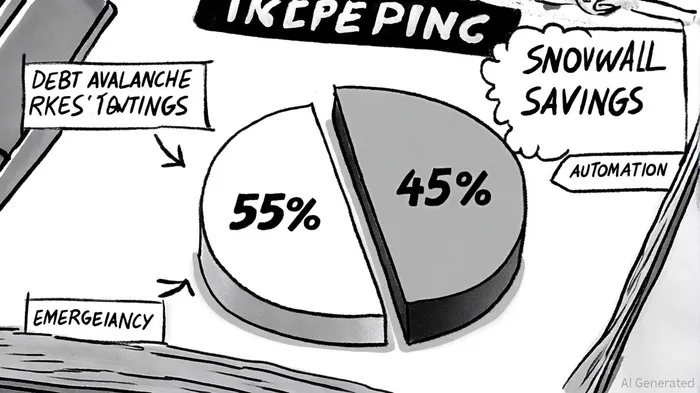
The optimal strategy for early-stage wealth builders lies in harmonizing debt repayment and emergency savings through income-driven frameworks. By quantifying opportunity costs, mitigating behavioral biases, and leveraging automation, individuals can navigate the debt-savings trade-off without sacrificing long-term stability. As the data shows, 55% of Americans now have reserves covering three months of expenses-a 4 percentage-point decline since 2021, according to the Federal Reserve report. This underscores the need for proactive, balanced strategies to rebuild financial resilience in an era of economic uncertainty.







Comentarios
Aún no hay comentarios