
Debt Allocation vs. Crypto Exposure in Millennial and Gen Z Portfolios: How Shifting Financial Priorities Are Reshaping Risk Appetite and Asset Allocation Strategies
The financial priorities of Millennials and Gen Z are reshaping the investment landscape, challenging traditional notions of risk, debt, and asset allocation. These generations, shaped by economic turbulence, technological innovation, and a desire for value alignment, are redefining how wealth is managed and grown. Their portfolios reflect a duality: a surge in non-mortgage debt and a bold embrace of cryptocurrencies. This duality underscores a broader shift in risk appetite and financial behavior, with implications for markets, institutions, and policymakers.
The Debt Dilemma: Credit Cards, Auto Loans, and Inherited Wealth
Gen Z's debt profile has undergone a dramatic transformation. Non-mortgage debt among this cohort has surged by 99% in two years, driven by credit card balances (up 174%) and auto loans (46% of non-mortgage debt) [2]. This contrasts with Millennials, who carry heavier educational debt but are increasingly inheriting wealth. Over a third of Millennials have received inheritances exceeding $1 million, enabling a more diversified approach to investing [3]. For Gen Z, however, debt is a tool for mobility and financial maturity—a response to rising living costs and a post-pandemic economy where gig work and part-time employment are common [2].
Millennials, meanwhile, are leveraging inherited assets to mitigate risk. While 56% of this generation includes cryptocurrency in their portfolios, their debt strategies remain anchored to long-term goals like homeownership, albeit with modest progress: ownership rates have risen just 2% since 2018 [3]. This generational divergence highlights a key trend: younger investors are prioritizing liquidity and flexibility over traditional wealth-building pathways like real estate.
Crypto as a Core Asset: Risk Appetite and Value Alignment
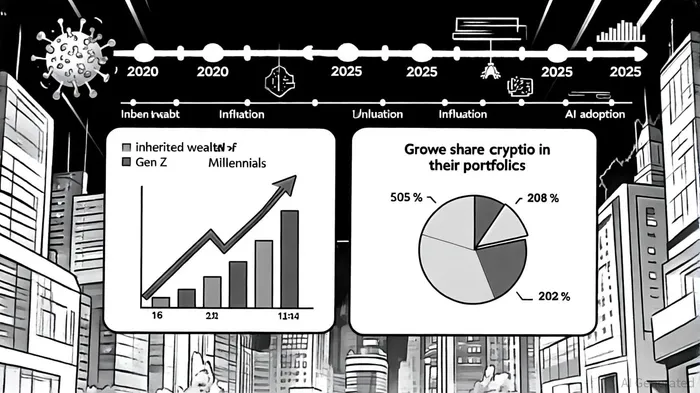
Cryptocurrencies have become a cornerstone of Millennial and Gen Z portfolios, with 62% of Millennials and 35% of Gen Z allocating more than a third of their assets to digital assets [3]. This enthusiasm is fueled by a combination of technological affinity, perceived ease of understanding, and a desire for financial independence. For Gen Z, in particular, crypto represents more than speculation—it is a vehicle for aligning investments with personal values. Decentralization and transparency resonate with a generation skeptical of traditional institutions, with 66% of Gen Z selecting financial services based on ethical alignment [3].
The surge in crypto adoption is also geographically nuanced. In emerging markets like India and Brazil, where banking systems are less developed, crypto offers an accessible gateway to capital markets [3]. This global trend is reinforced by digital platforms and peer networks, which Gen Z and Millennials use to bypass traditional advisors and make real-time decisions. JPMorgan Chase notes that crypto activity spikes during price surges, such as Bitcoin's rallies in March and November 2024, indicating a speculative yet strategic approach to risk [2].
The Role of Technology and Social Media in Shaping Portfolios
Artificial intelligence and social media are pivotal in how these generations manage debt and allocate assets. Millennials and Gen Z are increasingly reliant on AI-driven tools for personalized investment advice, with 66.5% of Millennials and 50% of Gen Z valuing such technologies [3]. These tools help balance high debt loads with crypto exposure, optimizing for both growth and risk mitigation.
Social media's influence is equally profound. Over 60% of Gen Z report that platforms like TikTok and Instagram shape their financial decisions, often through influencers who demystify complex topics like credit card rewards and crypto trading [1]. This dynamic creates a feedback loop: peer-driven insights drive adoption, which in turn fuels further innovation in fintech and digital assets.
Implications for Financial Institutions and Markets
The shifting priorities of Millennials and Gen Z demand a reimagining of financial services. Institutions must integrate education into digital platforms, offering tools that address debt management, crypto literacy, and ethical investing [1]. For markets, the rise of crypto-centric portfolios signals a potential reallocation of capital away from traditional assets like bonds and ETFs. However, regulatory uncertainty and volatility remain risks, particularly for Gen Z's more aggressive allocations.
Conclusion
Millennials and Gen Z are not merely adapting to economic challenges—they are redefining the rules of investing. Their portfolios reflect a generation that views debt as a strategic tool and crypto as a symbol of autonomy. As these trends mature, the interplay between risk appetite, technological adoption, and value-driven investing will continue to shape global markets. For investors and institutions alike, understanding this generational shift is no longer optional—it is essential.






Comentarios
Aún no hay comentarios