
The May Day Uprising: How Trump's Policies Are Shaking Markets and Investors
The May Day 2025 protests, dubbed the “50501 Movement,” marked a historic nationwide uprising against President Donald Trump’s policies, with demonstrations spanning all 50 U.S. states and drawing tens of thousands of participants. Organized by a coalition of labor unions, student groups, and grassroots activists, the protests targeted everything from aggressive tariffs and federal job cuts to the administration’s cozy relationship with billionaires like Elon Musk. While the immediate political impact remains uncertain, the economic consequences are already rippling through markets, raising profound questions for investors about the durability of growth and the risks of prolonged instability.
A Perfect Storm of Tariffs, Strikes, and Stagflation
The protests are rooted in the economic fallout of Trump’s “America First” agenda. His sweeping tariffs—10% on all imports, 25% on steel and aluminum, and 145% on Chinese goods—have triggered a cascade of cost pressures and supply chain disruptions. For small businesses like Pittsburgh’s Brew Gentleman, the pain is immediate: one supplier’s order recently spiked by 130%, while customs delays have caused bottlenecks. “It’s like a second wave of the pandemic,” said a steel industry executive, echoing warnings of “Covid 2.0”-style disruptions.
The broader economic toll is even starker. The Bank of Japan recently slashed its 2026 growth forecast to 0.5%, citing U.S. tariff-driven uncertainty. Meanwhile, the U.S. faces stagflation—high inflation paired with stagnant growth—as businesses delay hiring and investment. The Federal Reserve’s toolkit, already stretched thin, now confronts a dilemma: raising rates to curb inflation risks choking off what little growth remains, while inaction could let inflation spiral.
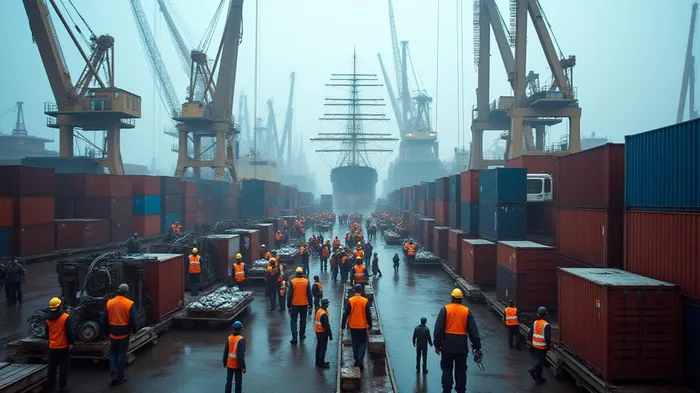
The Port Strike Threat: A $3.78 Billion Gamble
Nowhere is the economic risk more acute than at U.S. ports. A potential strike by East and Gulf Coast port workers—whose contracts expire September 30—could cost the economy $3.78 billion for a one-week walkout, per The Conference Board. These ports handle 57% of U.S. container volume, including critical shipments for sectors like autos and electronics. A strike in October would disrupt holiday retail prep, with delays lasting weeks even after a brief stoppage.
The administration has ruled out invoking the Taft-Hartley Act to force workers back, despite the economic stakes. Instead, it faces a standoff over wages (70% hikes demanded) and automation fears, as terminal operators push autonomous systems to bypass union labor. The result? A $3 trillion trade chokepoint hangs in the balance.
Markets: Mixed Signals Amid Policy Chaos
Stock markets have reacted with characteristic ambivalence. U.S. tech stocks like Nasdaq dipped 0.1% amid trade war fears, while the S&P 500 rose 1.5%, buoyed by optimism about corporate earnings. Steel stocks initially rallied on tariff-driven price spikes, but longer-term skepticism persists: investors doubt the sustainability of a strategy reliant on protectionism.
The UAW’s support for tariffs contrasts with broader industry unease. “Uncertainty is pressing down on the economy,” said Carnegie Mellon economist Lee Branstetter. Small businesses like Pennsylvania Macaroni Company face margin-squeezing price hikes, while consumers in Manila and Jakarta protest stagnant wages—a global warning of rising social unrest.
Investors, Beware: The Fragile Foundation of Growth
For investors, the May Day protests and their economic fallout highlight three existential risks:
1. Stagflation: The Fed’s inability to tame inflation without crushing growth could prolong market volatility.
2. Supply Chain Disruptions: A port strike or further tariff escalation would amplify costs for sectors like manufacturing and retail.
3. Political Volatility: Trump’s pro-biz, anti-labor stance—stripping 1 million federal workers of collective bargaining rights—fuels labor strife and regulatory unpredictability.
The data underscores the stakes:
- A one-day port strike costs the economy $540 million—a hit that compounds if disputes drag on.
- Steel stocks (e.g., NUE, X) have surged 20% YTD on tariff optimism but face headwinds if global trade collapses.
- Consumer staples (e.g., PG, KO) may benefit from recession resilience, but supply chain delays could dent margins.
Conclusion: A New Era of Economic Uncertainty
The May Day protests are not just a political flashpoint—they’re a mirror reflecting the fragility of the U.S. economy. With stagflation looming, trade wars intensifying, and labor disputes escalating, investors must brace for prolonged volatility. Sectors reliant on global supply chains, like autos and tech, face the sharpest risks, while defensive plays in healthcare or utilities may offer shelter.
Yet the ultimate risk is systemic. As the Bank of Japan warns, the U.S. has become a “policy uncertainty engine,” exporting instability to global markets. For investors, the lesson is clear: in an era where trade wars and strikes rival interest rates as key risks, portfolios must prioritize flexibility—and a healthy dose of caution.
The numbers tell the story: a $3.78 billion strike, 0.5% growth, and a Fed stuck between a rock and a hard place. The May Day uprising isn’t just about politics—it’s about the economy’s breaking point.







Comentarios
Aún no hay comentarios