
DAX Index: Technical and Macroeconomic Catalysts for a Near-Term Breakout
The DAX index, Germany's benchmark equity gauge, is poised at a critical juncture as it navigates a confluence of technical and macroeconomic factors. With the index trading near pivotal resistance levels and amid a backdrop of stabilizing inflation and cautious ECBXEC-- policy, the stage is set for a potential breakout toward its July 2025 record. This analysis synthesizes technical signals and macroeconomic drivers to assess the near-term upside potential.
Technical Indicators Signal Mixed but Constructive Setup
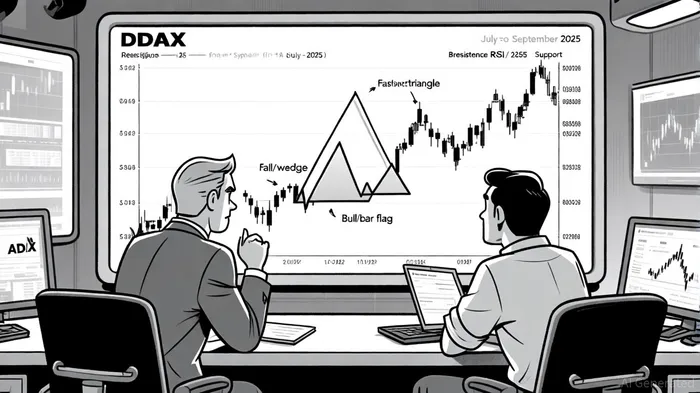
The DAX's technical profile reveals a mixed but ultimately constructive environment for a breakout. The Relative Strength Index (RSI) currently stands at 43.91, indicating a neutral to slightly bearish short-term bias, while the Average Directional Index (ADX) of 19.27 underscores a weak trend, suggesting consolidation, according to the FXLeaders forecast. However, this consolidation phase has formed a symmetrical triangle pattern, a classic precursor to a breakout, as noted in the ChartDepth analysis. The index is now trading near the upper edge of this pattern, with 24,650 EUR emerging as a key target in the ECB projections.
Historically, the DAX has shown a tendency to consolidate around these levels, as evidenced by its behavior since 2022. The support level at 23,516 EUR has been tested multiple times, acting as a reliable floor, according to the SolidECN analysis, while the resistance at 24,650 EUR has consistently capped upward movement in the ECB projections. This range-bound dynamic suggests that a breakout would require a significant shift in market sentiment or external catalysts.
On the daily chart, the DAX has formed a bear flag pattern, and a breakout above its upper boundary could trigger gains of approximately 140 points, as highlighted in the MarketPulse outlook. Meanwhile, the two-hour chart reveals a bull flag pattern, with a break above this structure potentially driving the index 400 points higher - a point the same MarketPulse outlook also emphasizes. These patterns, combined with OANDA client sentiment data showing 71% of traders are net short, hint at a contrarian bullish bias noted in that MarketPulse piece. Such positioning often precedes a reversal, as short-covering and fresh long entries can amplify upward momentum.
Macroeconomic Tailwinds Provide a Favorable Backdrop
Beyond technicals, macroeconomic factors are aligning to support the DAX's near-term trajectory. The European Central Bank (ECB) has maintained a wait-and-see approach in July 2025, with inflation stabilizing at 2.0%, in line with its 2% target, a development discussed in the MarketPulse outlook. This has allowed the ECB to avoid aggressive policy surprises, reducing volatility and creating a more predictable environment for equity markets. ECB staff projections further reinforce this stability, forecasting Eurozone GDP growth of 1.2% in 2025, bolstered by German government spending and improved financing conditions, as outlined in the ECB projections.
Trade dynamics also play a role. While persistent US-EU trade tensions have weighed on sentiment, incremental progress in negotiations has sparked cautious optimism. For instance, the DAX climbed 0.25% on July 1, 2025, as trade talks showed signs of movement, according to a KQMarkets note. Although the index closed lower that day due to lingering uncertainties, the broader trend suggests that resolution-however gradual-could act as a catalyst for risk-on sentiment.
Synthesis: A Confluence of Catalysts
The interplay between technical and macroeconomic factors creates a compelling case for a near-term breakout. Technically, the DAX is primed to test key resistance levels, with patterns and sentiment indicators suggesting a higher probability of a bullish outcome. Macroeconomically, the ECB's dovish stance and stabilizing inflation provide a supportive backdrop, while trade-related optimism, though fragile, offers additional upside potential.
Investors should monitor the 23,516 EUR pivot level as a critical support zone; a break below this could trigger a retest of 23,600, which remains a short-term floor noted in the SolidECN analysis. Conversely, a sustained move above 24,500 EUR would validate the bullish case, with 24,650 EUR as the next major target referenced in the ECB projections. Given the current setup, a strategic entry near key support levels, with a stop-loss below 23,500 EUR, could offer favorable risk-reward dynamics.







Comentarios
Aún no hay comentarios