
DAX Index: Navigating Short-Term Gains in a Volatile Landscape
DAX Index: Navigating Short-Term Gains in a Volatile Landscape
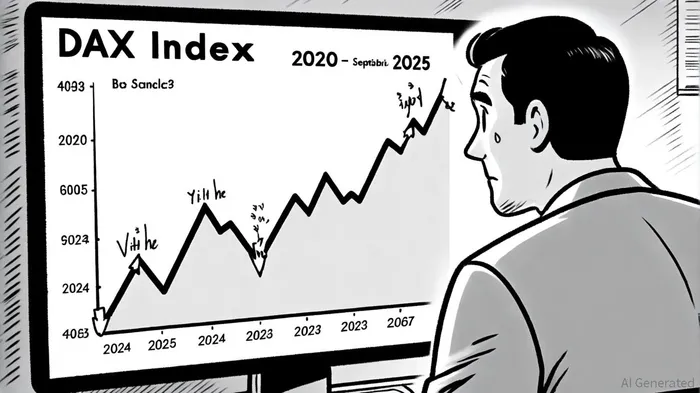
The DAX Index, a barometer of Germany's economic health, has entered a pivotal phase in 2025. As the index hovers near 23,600–24,000 points, investors face a dual challenge: capitalizing on short-term gains amid heightened volatility while managing risk through disciplined entry strategies. This analysis explores strategic entry points and risk-adjusted returns, drawing on recent performance data and historical benchmarks.
Strategic Entry Points: Volatility as a Double-Edged Sword
The DAX's 10-day historical volatility of 12.49 as of September 2025 reflects a 52.5% year-to-date surge, underscoring its sensitivity to macroeconomic shifts, according to PortfoliosLab. While this volatility creates opportunities for tactical entry, it also amplifies downside risks. Analysts project a potential range of 24,000–26,000 points by year-end under favorable conditions, but caution persists over export-dependent sectors and global trade tensions, per CentstoSense.
A disciplined approach to entry points requires aligning with the index's historical averages. From 2020 to 2025, the DAX has delivered an 18.6% year-on-year return, with annualized gains peaking at 26.22% in 2025, according to WallStreetNumbers. Investors might consider weighted averaging strategies, purchasing incremental positions as the index consolidates near its 52-week low of ~19,000 points, a level last seen in early 2023 (WallStreetNumbers). This approach balances exposure to upward momentum while mitigating the impact of short-term corrections.
Risk-Adjusted Returns: Sharpening the Lens
The DAX's Sharpe ratio of 0.76 over the past five years highlights its relatively strong risk-adjusted performance compared to global benchmarks (PortfoliosLab). However, this metric treats all volatility equally, potentially masking the asymmetry of downside risks. A more nuanced view emerges from the Sortino ratio, which isolates negative deviations. Given the DAX's 12.3% decline in 2022 and its susceptibility to trade tensions, investors should prioritize strategies that hedge against tail risks, such as options collars or sector rotation into defensive stocks, as discussed by OptimizedPortfolio.
Long-term investors might also consider the Calmar ratio, which evaluates returns relative to maximum drawdowns. The DAX's 40.4% drop during the 2008 crisis, highlighted in WallStreetNumbers, underscores the importance of liquidity buffers and stop-loss mechanisms. For 2025, a risk-adjusted allocation of 15–20% to the DAX, paired with dynamic rebalancing, could optimize returns while preserving capital.
Navigating the Risks: Beyond the Numbers
While quantitative metrics provide a framework, qualitative factors cannot be ignored. Germany's export-heavy economy remains vulnerable to U.S.-China trade dynamics and energy price shocks. Recent data reported by CentstoSense indicate that manufacturing PMI has contracted for three consecutive quarters, signaling near-term headwinds. Investors should monitor policy responses, such as subsidies for green energy transitions, which could stabilize the index's long-term trajectory.
Conclusion: A Calculated Path Forward
The DAX Index offers compelling opportunities for investors willing to navigate its volatility. Strategic entry points near historical averages, combined with risk-adjusted metrics like the Sharpe and Sortino ratios, provide a robust framework for decision-making. However, success hinges on proactive risk management and a keen eye on macroeconomic signals. As the year draws to a close, a balanced approach-leveraging tactical buying while hedging against downside risks-will be key to unlocking the DAX's potential in 2025.







Comentarios
Aún no hay comentarios