
The DAX at a Crossroads: Market Psychology and Technical Risks Behind Repeated Resistance Failures
The DAX index, a barometer of European economic sentiment, has entered a critical phase in 2025. Despite a 19.83% year-to-date recovery, according to a long-term forecast, the index has repeatedly failed to breach key resistance levels, most notably 24,280–24,300 and 24,500, as noted in a consolidation guide. This stalling has sparked debates among traders and analysts about whether the DAX is consolidating for a breakout or teetering on the edge of a breakdown. To understand this impasse, we must dissect the interplay of technical indicators and market psychology, which together paint a nuanced picture of risk and opportunity.
Technical Indicators: A Tale of Two Forces
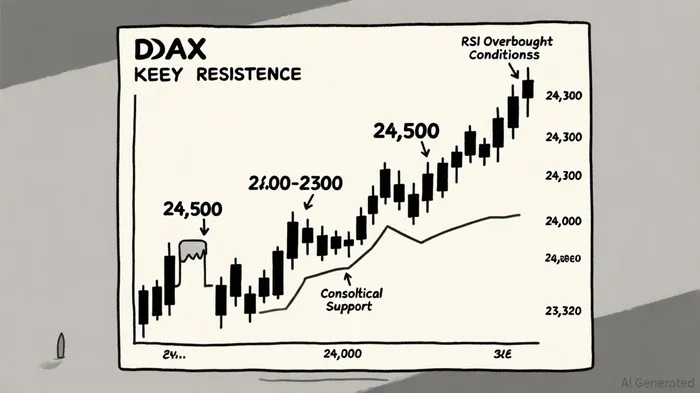
From a technical perspective, the DAX's inability to sustain a close above 24,300 has been a recurring theme. This level, identified as a "horizontal supply zone" by multiple analysts, has acted as a psychological barrier, triggering bearish reversals despite bullish momentum. The Relative Strength Index (RSI) currently sits at 64.93 (per that long-term forecast), nearing overbought territory, while the ADX (53.24) confirms a strong trend, per FX Leaders. However, the Parabolic SAR-a tool for identifying potential trend reversals-suggests upward bias is intact (again referenced in the long-term forecast), creating a paradox: momentum indicators hint at exhaustion, yet trend strength persists.
A critical concern lies in the index's consolidation below 24,500, a level that has historically marked a turning point. Technical analysts note that the DAX's failure to break above this threshold, coupled with thin trading volume (reported in the consolidation guide), signals a lack of conviction among buyers. This is further compounded by the index's recent consolidation within a narrow range between key moving averages, noted in a market analysis, a pattern often preceding directional clarity. If the DAX were to close below 24,180-a support zone identified as a "failed recovery" marker in that market analysis-it could trigger a cascade of selling pressure, targeting the psychological 24,000 level (as highlighted in the long-term forecast).
Market Psychology: Fear, Hype, and the Herd Mentality
Market psychology plays an equally pivotal role in the DAX's current impasse. Investor sentiment has swung wildly in 2025, influenced by macroeconomic shocks and behavioral biases. For instance, the index's 7.44% single-day plunge in April 2025-triggered by Trump's retaliatory tariffs-pushed Eurozone investor sentiment to a 16-month low of -19.5, an episode documented in the market analysis. This event exposed the fragility of bullish sentiment, as confirmation bias and herd mentality amplified short-term volatility.
Despite these headwinds, the DAX has shown resilience, buoyed by ECB rate cuts and lower energy prices, as discussed in a bullish momentum piece. However, this optimism is tempered by macroeconomic uncertainties. Softer PMI data in Germany, reflecting a weakening services sector (noted in that bullish momentum piece), and geopolitical tensions-such as U.S.-China trade dynamics and potential Israeli-Iranian conflicts-have kept risk aversion alive. Behavioral finance principles further complicate the narrative: social media-driven retail investor activity on platforms like Reddit and Telegram has exacerbated short-term volatility, creating a feedback loop where fear and greed alternate rapidly.
Breakdown Risks and Strategic Implications
The DAX's repeated failure to break through resistance levels raises the specter of a technical breakdown. A sustained close below 24,180 would not only confirm a bearish shift but also validate the five-wave impulsive decline observed from March 18's high (documented in coverage of recent market moves). This pattern, if completed, could drive the index toward 23,600–23,400 (as suggested in the market analysis), with further downside contingent on macroeconomic catalysts like a U.S. credit rating downgrade or renewed geopolitical flare-ups.
For traders, the key lies in managing risk amid this uncertainty. Tight stop-loss orders and diversification are essential, given the index's heightened sensitivity to macroeconomic developments (as highlighted in the long-term forecast). Long-term investors, meanwhile, should monitor whether the DAX can retest 24,500 with stronger volume-a potential precursor to a bullish resumption.
Conclusion
The DAX's struggle against key resistance levels in 2025 is a microcosm of broader market dynamics. Technical indicators and psychological factors are locked in a tug-of-war, with neither side gaining decisive control. While the index's resilience offers hope for a breakout, the risks of a breakdown remain tangible. Investors must remain vigilant, balancing technical signals with an understanding of the behavioral forces shaping market sentiment.







Comentarios
Aún no hay comentarios