
DAX at a Crossroads: Can It Break Out Amid S&P 500's Rally?
The DAX index and the S&P 500 have diverged sharply in August 2025, reflecting contrasting technical and macroeconomic dynamics. While the S&P 500 has surged to record highs, driven by tech-sector dominance and Fed policy expectations, the DAX remains trapped in a prolonged sideways consolidation pattern. This divergence raises a critical question: Can the DAX break out of its technical confines and capitalize on its strong fundamentals, or will it remain a cautious play amid U.S.-EU trade tensions and ECB policy uncertainty?
Technical Divergence: DAX Consolidates, S&P 500 Extends Rally
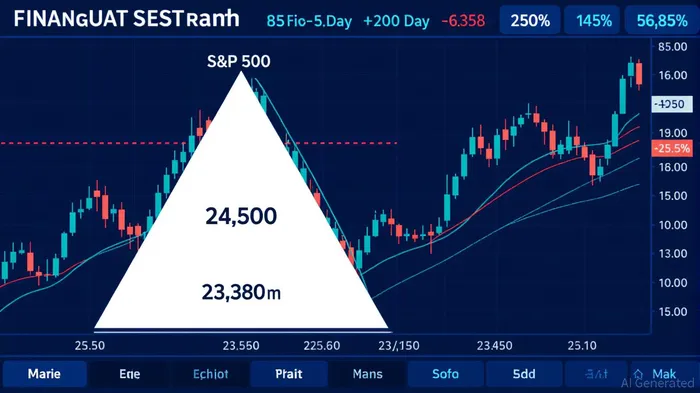
The DAX has been trading within a symmetrical triangle pattern for over a month, oscillating between key resistance at 24,500 and support at 23,380 [1]. This consolidation, while not inherently bearish, has created a high degree of volatility as momentum indicators like RSI and Stochastic suggest overbought conditions, hinting at a potential pullback before a decisive breakout [2]. A clean breach above 24,500 could target 25,500–26,000, but a breakdown below 23,950 would signal a bearish reversal [5].
In contrast, the S&P 500 has extended its rally, buoyed by record highs in tech stocks like NVIDIANVDA-- and MicrosoftMSFT--. The index remains above its 50-day and 200-day moving averages, with a MACD crossover in July 2025 signaling bullish momentum [3]. However, recent signs of weakening—such as a bearish MACD crossover and overbought Stochastic readings—suggest caution for near-term traders [5]. The S&P’s resilience is underpinned by corporate earnings growth and Fed rate-cut expectations, but its reliance on tech-driven growth exposes it to sector-specific risks.
Macroeconomic Fundamentals: ECB Dovishness vs. Fed Hesitation
The DAX’s technical indecision contrasts with its robust macroeconomic backdrop. Germany’s fiscal stimulus package, including a €500 billion investment in infrastructure and defense, has bolstered industrial and export sectors [2]. The ECB’s dovish stance—keeping rates at 2% and signaling potential rate cuts—has further supported the index, particularly for industrials and financials [1]. However, the DAX faces headwinds from U.S. tariff threats, which have introduced uncertainty for automotive and industrial firms [4].
Meanwhile, the S&P 500 benefits from the Fed’s cautious approach to rate cuts. With the federal funds rate at 4.25%-4.5%, the Fed has prioritized inflation control over growth, but recent labor market softness has increased the likelihood of a September cut [2]. The U.S. economy’s resilience—evidenced by a 3.0% Q2 GDP rebound and low unemployment—has underpinned the S&P’s rally, though trade tensions with the EU and China could introduce volatility.
Trade Tensions and Sectoral Exposure: DAX’s Export Risks vs. S&P’s Tech Resilience
The U.S.-EU trade deal, which caps automotive tariffs at 15%, has provided some relief for the DAX’s export-dependent sectors. However, the lack of a clear implementation timeline has created planning challenges for German automakers like BMW and Volkswagen [1]. The DAX’s industrials sector has also been impacted by EU tariffs on steel and aluminum, which threaten supply chain efficiency [4].
In contrast, the S&P 500’s tech-driven growth has been less affected by trade tensions. The U.S.-EU deal has stabilized supply chains for tech companies reliant on global inputs, while Q2 earnings from firms like AppleAAPL-- and Microsoft have driven market optimism [2]. However, long-term risks—such as potential escalations with China and the EU’s weaker digital ecosystem—could challenge sustained tech growth [3].
Is the DAX a Buy or a Watch?
The DAX’s technical and macroeconomic profile presents a nuanced case. On the bullish side, its strong fundamentals—including fiscal stimulus, ECB easing, and foreign investment—suggest a long-term upward trajectory [2]. A breakout above 24,500 could unlock significant gains, particularly if the ECB follows through on rate cuts. However, the index’s consolidation phase and overbought technical indicators indicate caution for near-term entry.
Conversely, the S&P 500’s rally, while impressive, is increasingly dependent on tech-sector performance and Fed policy. A rate cut could extend its momentum, but a bearish MACD crossover and overbought conditions signal potential corrections.
For investors, the DAX offers a strategic entry point for those willing to tolerate short-term volatility in exchange for long-term growth. However, the index’s exposure to trade tensions and geopolitical risks means it should be cautiously watched, particularly as the ECB’s policy signals and U.S. tariff developments unfold.
Source:
[1] DAX Forecast: Technical Tuesday, August 28, 2025 [https://www.forex.com/en/news-and-analysis/dax-forecast-technical-tuesday-august-28-2025/]
[2] The DAX at a Crossroads: Bearish Sentiment and Market ... [https://www.ainvest.com/news/dax-crossroads-bearish-sentiment-market-inaction-dovish-policy-environment-2508/]
[3] S&P 500 (ES) Technical Analysis, 7 August 2025 [https://blog.oneuptrader.com/analysis/technical-analysis/sp-500-es-technical-analysis-7-august-2025/]
[4] The Transatlantic Trade Reset: How EU-US Policy Shifts ... [https://www.ainvest.com/news/transatlantic-trade-reset-eu-policy-shifts-reshape-global-industrial-automotive-supply-chains-2508/]
[5] S&P 500, Nasdaq 100 Technicals: Breakouts Stall as ... [https://www.tastylive.com/news-insights/spx-500-nasdaq-100-technicals-breakouts-stall-as-traders-look-towards-powell-speech]







Comentarios
Aún no hay comentarios