
Datadog's Recent Underperformance and Its Implications for Growth Stock Valuation
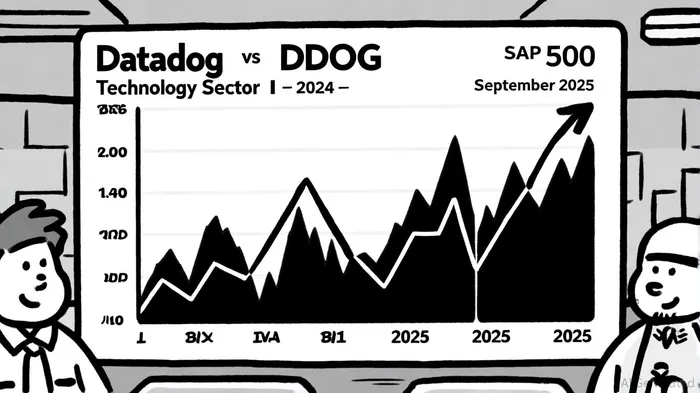
The recent volatility in DatadogDDOG-- (NASDAQ: DDOG) has sparked debate among investors about whether its stock dip represents a strategic entry point or a warning sign of broader growth stock fatigue. With a 19% decline following weaker-than-expected 2025 guidance[1], Datadog's underperformance must be contextualized within its financial fundamentals, sector dynamics, and macroeconomic trends.
Datadog's Financial Resilience Amid Mixed Signals
Despite the recent pullback, Datadog's Q3 2025 results underscore its operational strength. Revenue surged 28% year-over-year to $827 million, with earnings per share (EPS) of $0.46 exceeding analyst estimates[2]. The company's guidance for Q3 2025-$847–851 million in revenue-also outpaced consensus forecasts[3]. These figures reflect Datadog's entrenched position in cloud observability and security, with 800 new customers added in a single quarter[4]. However, the stock's decline followed tepid forward guidance, which highlighted slower growth (18–19% revenue growth) and margin pressures[5]. This duality-strong execution versus cautious outlook-has left investors weighing near-term risks against long-term potential.
Valuation Metrics: A Tale of Two Extremes
Datadog's valuation metrics starkly contrast with sector averages. As of September 2025, its trailing P/E ratio stands at 324.00[6], dwarfing the S&P 500 Software Sector's average of 40.77[7] and the Technology Sector's 38.62[8]. Similarly, its price-to-sales (P/S) ratio of 17.51[6] exceeds the software sector's 2025 average of 11.20[9]. While Datadog's premium reflects investor optimism about its AI-driven innovation and enterprise client expansion[10], it also raises concerns about overvaluation. For context, growth stocks as a category trade at a trailing P/E of 38.82 and a forward P/E of 28.06[11], levels not seen since the dot-com bubble.
Sector-Wide Fatigue or Isolated Hiccups?
The broader growth stock sector in 2025 is navigating a complex landscape. The AI boom and Federal Reserve rate cuts have fueled gains in tech-heavy indices like the Nasdaq[12], yet challenges persist. Trade policy shifts, geopolitical tensions, and concerns about U.S. debt sustainability[13] have introduced volatility. For Datadog, sector-specific headwinds include intensifying competition from cloud providers (AWS, Microsoft Azure) and native monitoring tools[14], as well as margin compression due to consumption-based pricing models[15].
However, Datadog's strategic pivot toward AI-powered automation and enterprise security[16] aligns with long-term tailwinds. Analysts remain cautiously bullish, with 25 of 30 Wall Street analysts assigning "Buy" or "Outperform" ratings and an average price target of $156.69[17]. This suggests that while near-term guidance has dented sentiment, the company's innovation pipeline and market leadership could drive recovery.
Strategic Implications for Investors
The current dip in Datadog's stock price presents a nuanced opportunity. On one hand, its valuation appears stretched relative to both historical averages and sector peers, raising risks of further correction if growth slows. On the other, the company's robust revenue growth, expanding client base, and AI integration position it to capitalize on the $3.33 billion revenue forecast for 2025[18]. For investors with a long-term horizon, the pullback may offer a discounted entry point into a company with durable competitive advantages.
Yet, the broader growth stock sector's valuation extremes[11] cannot be ignored. If macroeconomic risks-such as trade policy shifts or inflationary pressures-intensify, sector-wide underperformance could amplify Datadog's challenges. Diversification and careful monitoring of margin trends and competitive dynamics will be critical.
Historical patterns around Datadog's earnings releases also warrant caution. A backtest of seven earnings events since 2022 reveals a win rate below 50% for most time horizons, with average cumulative returns trailing benchmarks over 30 days. This suggests that while Datadog's fundamentals remain strong, a simple buy-and-hold strategy around earnings announcements has historically yielded mixed results. Investors should balance optimism about its long-term potential with awareness of short-term volatility.
Conclusion
Datadog's recent underperformance is a microcosm of the broader growth stock sector's struggles with valuation sustainability. While its fundamentals remain strong, the stock's premium pricing demands continued execution on AI innovation and margin improvement. For now, the dip appears more reflective of sector-wide caution than a fundamental flaw in Datadog's business model. Investors who can tolerate near-term volatility may find value in its long-term potential-but should proceed with eyes wide open to the risks of a crowded and overvalued market.





Comentarios
Aún no hay comentarios