
Dassault Systèmes' Share Buybacks: A Strategic Move or a Value Trap?
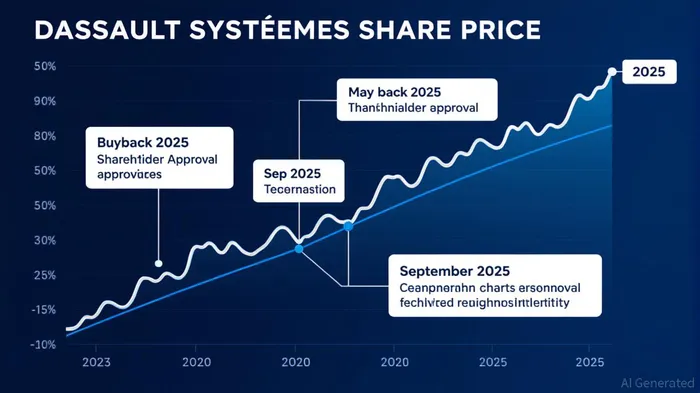
In the realm of corporate capital allocation, share buybacks have long been a double-edged sword—either a disciplined way to return value to shareholders or a desperate attempt to mask stagnation. For Dassault Systèmes, the French software giant, its 2025 share repurchase program has sparked debate among investors. With a 99.78% shareholder approval at its May 2025 meeting[1], the company launched a 18-month initiative to repurchase up to 10% of its share capital[4], citing goals such as boosting return on equity, supporting employee ownership, and enhancing liquidity[1]. But does this strategy align with the company's broader financial health, or does it risk becoming a value trap?
Strategic Rationale: Aligning Buybacks with Core Objectives
Dassault's buyback program is embedded in a broader capital allocation framework. The company repurchased 4.29 million shares in early September 2025 alone, with a single transaction accounting for 4.2 million shares[1]. These moves are explicitly tied to its FY2025 guidance, which includes 6–8% revenue growth and 7–10% EPS expansion[2]. By canceling repurchased shares, Dassault aims to increase earnings per share—a metric that rose to €0.30 in Q2 2025, up 4% year-over-year[2].
The rationale extends beyond short-term EPS math. The program also allocates shares to employees and corporate officers, a move that aligns long-term incentives with shareholder interests[1]. Additionally, the company's use of liquidity contracts with investment service providers suggests an effort to stabilize its stock price amid macroeconomic volatility[1]. This multifaceted approach mirrors strategies employed by peers like PTCPTC--, which reported 9.3% constant currency ARR growth in Q3 2025[3], underscoring the sector's focus on capital efficiency.
Financial Health and Risk Mitigation
Dassault's Q2 2025 results provide a mixed picture. While revenue grew 6% year-over-year (constant currency) and operating cash flow surged 21% to €813 million[2], the company's buyback yield of 0.4% lags behind its dividend yield of 0.9%[4]. This discrepancy raises questions about the program's prioritization. For context, the company spent €80 million on treasury shares in Q2 2025, alongside €191 million for the ContentServ acquisition[2]. Such allocations suggest a balanced approach to growth and shareholder returns, but the relatively modest buyback yield—compared to peers like PTC—hints at cautious capital deployment[3].
Risks, however, are not negligible. A three-year average buyback ratio of -0.1%[1] indicates historical underperformance in this area, though the 2025 program represents a strategic pivot. Critics argue that aggressive buybacks could strain liquidity, particularly if foreign exchange headwinds or trade policy shifts disrupt cash flows[2]. Yet, Dassault's FY2025 guidance remains intact, and its 3DEXPERIENCE platform—responsible for 20% YoY growth[2]—provides a buffer against near-term volatility.
Industry Benchmarks and Value Creation
Comparisons to peers highlight both strengths and vulnerabilities. PTC's Q3 2025 results, with EPS of $1.64 exceeding forecasts[3], demonstrate how disciplined capital allocation can drive outperformance. Meanwhile, the HIG sector's 9.4% YoY revenue growth and low PEG ratio[3] illustrate the risks of undervaluation—a concern if Dassault's buybacks are perceived as a signal of undervalued shares rather than a strategic rebalancing.
Dassault's 0.4% buyback yield, while modest, contributes to a total shareholder yield of 1.3%[4], outpacing its dividend alone. However, this pales in comparison to the AI chip sector's projected 2025 growth, where firms leveraging digital transformation could see higher returns[3]. For Dassault, the challenge lies in aligning its buyback program with its role as a leader in AI-driven cloud infrastructure and aerospace/defense solutions[2].
Conclusion: Strategic, But Not Without Caution
Dassault Systèmes' 2025 share buyback program reflects a calculated effort to enhance shareholder value while supporting long-term growth. By tying repurchases to employee incentives, liquidity stability, and EPS growth, the company has crafted a rationale that aligns with its strategic priorities. However, the program's modest yield and historical underperformance in buyback ratios[1] suggest a cautious approach, one that prioritizes flexibility over aggressive stock price manipulation.
For investors, the key question is whether this strategy will translate into sustained value creation. While Dassault's Q2 results and FY2025 guidance are encouraging, the absence of independent analyst evaluations on the buyback's effectiveness[2] leaves room for skepticism. In a sector where peers like PTC are outpacing expectations[3], Dassault must ensure its capital allocation remains agile—avoiding the pitfalls of overleveraging while capitalizing on its strengths in AI and digital transformation.
In the end, Dassault's buybacks appear to be a strategic move—but one that demands close scrutiny as macroeconomic and industry dynamics evolve.







Comentarios
Aún no hay comentarios