
Darden Restaurants: Strategic Resilience and Value Retention in the Post-Pandemic Dining Era
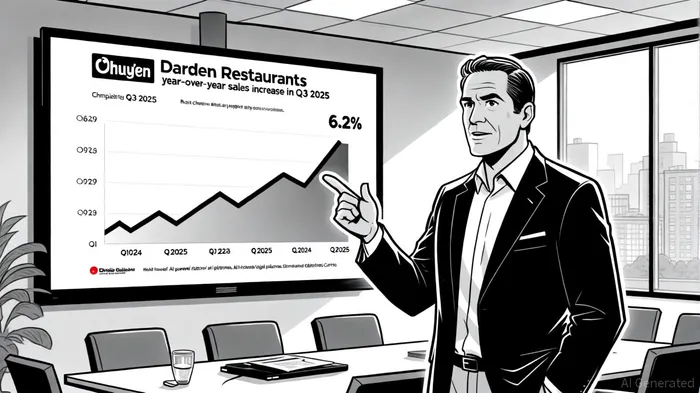
In the post-pandemic restaurant industry, where consumer preferences and operational challenges continue to evolve, Darden RestaurantsDRI-- has emerged as a standout performer. With a 6.2% year-over-year increase in total sales to $3.2 billion in Q3 2025, driven by strategic acquisitions and same-restaurant sales growth, the company has demonstrated its ability to adapt and thrive[1]. This resilience is underpinned by a dual focus on operational efficiency and strategic value retention, positioning Darden as a leader in the full-service dining segment.
Operational Resilience and Financial Performance
Darden's operational strength lies in its ability to balance cost management with innovation. The company's adjusted diluted EPS rose 6.9% to $2.80 in Q3 2025, reflecting disciplined execution amid rising labor and commodity costs[1]. Automation initiatives, such as kitchen display systems and AI-powered personalization in digital platforms, have enhanced order accuracy and guest engagement[1]. These technologies not only improve efficiency but also align with the growing demand for off-premise dining, a trend Darden is capitalizing on through expanded delivery partnerships and ghost kitchen operations[1].
Financially, Darden has maintained strong profitability, with segment profit margins expanding across all categories. Shareholder returns remain a priority, evidenced by a $1.40 per share dividend and $53 million in share repurchases during Q3 2025[1]. For fiscal 2025, the company projects total sales of $12.1 billion, with same-restaurant sales growth expected to reach 1.5%[1]. While challenges like labor costs persist, Darden's scale and cost control measures—such as centralized procurement and menu simplification—position it to navigate macroeconomic headwinds[1].
Strategic Value Retention: Digital and Cost Management
Darden's value-retention strategies are rooted in digital innovation and cost optimization. The company has leveraged data analytics to create personalized guest experiences, a tactic that has bolstered brand loyalty and retention[2]. For instance, Olive Garden's “Buy One, Take One” promotion drove a 2% increase in same-restaurant sales, prompting an extension of the campaign[2]. Similarly, LongHorn Steakhouse's value-driven menu offerings contributed to a 2.6% sales growth, underscoring the effectiveness of targeted pricing strategies[1].
Cost management remains a cornerstone of Darden's approach. By streamlining kitchen processes, negotiating supplier contracts, and reducing food waste through menu simplification, the company has mitigated inflationary pressures without compromising guest value[2]. Labor cost challenges are addressed through automation, such as robotic kitchen assistants piloted in 50 locations, which aim to reduce labor hours by 12%[1]. These initiatives not only stabilize margins but also enhance operational consistency in a tight labor market[2].
Market Positioning Amidst Competition
Darden's competitive edge stems from its diversified brand portfolio, including Olive Garden, LongHorn Steakhouse, and The Capital Grille, which cater to varying dining segments[3]. This diversification allows the company to weather market fluctuations and appeal to a broad demographic. In contrast to competitors like Brinker InternationalEAT-- (Chili's) and Bloomin' BrandsBLMN-- (Outback Steakhouse), Darden's focus on digital transformation—such as a 45% digital sales mix target—positions it to capture the growing off-premise dining market[1][3].
However, Darden faces intensifying competition from fast-casual chains like ChipotleCMG-- and Panera Bread, which offer affordability and convenience[3]. To counter this, Darden has expanded its digital footprint, including first-party delivery services via UberUBER-- Direct and AI-powered personalization engines[1]. These efforts align with industry forecasts predicting a $1.5 trillion U.S. restaurant market in 2025, where omnichannel engagement is critical[4].
Long-Term Growth Initiatives and Projections
Looking ahead, Darden's long-term strategy emphasizes international expansion, unit growth, and technological innovation. The company plans to open 50–55 new restaurants in 2025 and 65 in 2026, with 25 of these in Canada and the UK[1]. The Chuy's acquisition, which added 103 locations, is expected to generate supply chain and technology synergies, though integration challenges remain[1].
Analysts remain optimistic about Darden's trajectory, citing its ability to adapt to consumer trends and maintain profitability[4]. For fiscal 2026, the company projects 7.5–8.5% total sales growth, with same-restaurant sales increasing 2.5–3.5%[1]. These projections are supported by Darden's strong balance sheet and history of consistent dividend payments, which signal confidence in its long-term value creation[1].
Challenges and Mitigation Strategies
Despite its strengths, Darden must address risks such as high debt levels from acquisitions and economic vulnerabilities tied to its U.S.-centric model[3]. Rising commodity costs, particularly for beef, also pose margin pressures[3]. To mitigate these, Darden is diversifying its revenue streams through international expansion and smaller-format restaurants, which appeal to younger demographics[4]. Additionally, workforce retention programs—such as enhanced compensation and manager training—aim to reduce turnover to 28%[1].
Conclusion
Darden Restaurants' strategic focus on operational resilience, digital innovation, and value retention has solidified its position in the post-pandemic dining landscape. With a robust brand portfolio, disciplined cost management, and forward-looking initiatives like AI-driven personalization and international expansion, the company is well-positioned to navigate industry challenges and sustain long-term growth. For investors, Darden represents a compelling opportunity in a sector poised for continued evolution.







Comentarios
Aún no hay comentarios