
Darden Restaurants: Strategic Expansion and Q1 2025 Performance Fuel Long-Term Shareholder Value
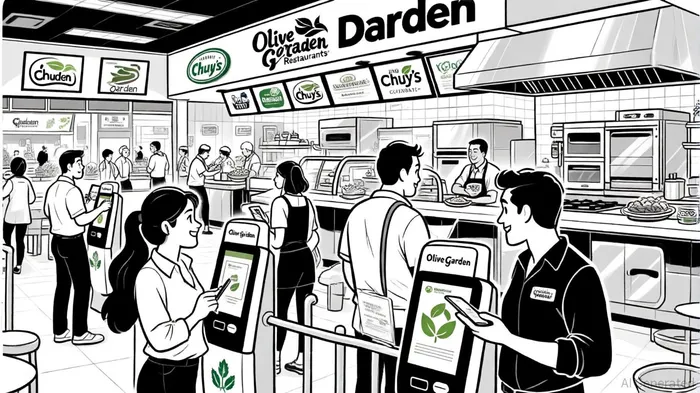
Darden Restaurants (NYSE: DRI) has emerged as a compelling case study in post-pandemic resilience, leveraging strategic expansion and operational discipline to navigate a challenging macroeconomic environment. The company's Q1 2025 financial report, coupled with its aggressive growth initiatives, underscores its potential as a high-conviction investment in the consumer discretionary sector. While the quarter revealed mixed results—$2.8 billion in revenue (up 1.0% year-over-year) and a GAAP EPS of $1.74, missing estimates by $0.10[1]—Darden's long-term value proposition remains intact, driven by its diversified brand portfolio, digital transformation, and disciplined capital allocation.
Strategic Expansion: A Dual-Pronged Approach
Darden's growth strategy in 2025 hinges on two pillars: organic unit expansion and strategic acquisitions. The company added 42 net new restaurants in Q1 2025, bringing its total to 2,165 locations, including the recently acquired Chuy's Holdings[1]. This acquisition, valued at $300 million, has already proven accretive, with Chuy's contributing to a 6.2% year-over-year revenue increase in Q3 2025[2]. By diversifying its brand mix—from upscale LongHorn Steakhouse to casual Chuy's—Darden is capturing a broader demographic spectrum, mitigating risks tied to any single segment.
Complementing this is Darden's focus on digital innovation. A partnership with UberUBER-- Eats for nationwide delivery services, launched in May 2025, has boosted digital sales by over 40%[3]. This shift not only enhances customer convenience but also improves operational efficiency, with AI-driven personalization tools optimizing marketing spend and guest retention. Analysts note that Darden's digital footprint now accounts for a significant portion of its revenue, a critical edge in an industry where off-premises dining is projected to grow by 15% annually[3].
Financial Resilience and Shareholder Returns
Despite a 1.1% decline in same-restaurant sales for the quarter—driven by a 2.9% drop at Olive Garden—Darden's financial discipline shines through. The company repurchased $172 million of shares in Q1 2025, with $743 million remaining under its $1 billion buyback authorization[1]. This, paired with a 7.1% increase in its quarterly dividend to $1.40 per share[4], reflects a commitment to balancing growth investments with shareholder returns.
Darden's balance sheet further supports this strategy. With a net margin of 10.24% and a return on equity (ROE) of 15.13%—both exceeding industry averages[5]—the company is well-positioned to sustain its dividend hikes and fund new unit development. Its $650 million capital expenditure plan for 2025, targeting 50–55 new locations[6], is underpinned by a strong cash flow profile and an investment-grade credit rating[5].
Navigating Challenges and Long-Term Outlook
Darden's path to sustained growth is not without hurdles. Rising commodity costs and labor expenses, coupled with moderating comp sales, pose near-term margin pressures[6]. However, the company's strategic focus on sustainability—including energy-efficient technologies and a 25% carbon reduction target by 2025—mitigates some of these risks while aligning with ESG-driven investor preferences[1].
Analysts remain cautiously optimistic. A recent survey of 20 analysts revealed 6 bullish and 6 somewhat bullish ratings, with an average 12-month price target of $210.80[5]. This optimism is grounded in Darden's ability to execute its dual strategy: expanding its footprint while enhancing unit-level profitability. For instance, LongHorn Steakhouse's 3.7% same-restaurant sales growth in Q1 2025[1] highlights the potential of its premium brands to outperform in a fragmented market.
Conclusion: A High-Conviction Play in a Resilient Sector
Darden Restaurants' Q1 2025 results and strategic initiatives position it as a standout in the post-pandemic consumer discretionary sector. By combining disciplined capital allocation, digital innovation, and a diversified brand portfolio, the company is not only weathering macroeconomic headwinds but also creating long-term value for shareholders. While challenges like inflation and integration risks persist, Darden's financial strength and operational agility make it a compelling high-conviction investment. As the restaurant industry braces for $1.5 trillion in foodservice sales by 2025[3], Darden's strategic bets—on digital, sustainability, and global expansion—could drive outsized returns for investors with a multi-year horizon.





Comentarios
Aún no hay comentarios