
Darden Restaurants: Governance Alignment and Shareholder Value Creation in the Post-2024 Era
The alignment between corporate governance and long-term value creation has become a critical metric for investors, particularly in industries where operational complexity and capital allocation decisions shape competitive advantage. Darden Restaurants' 2024 Annual Shareholders Meeting offers a compelling case study in this dynamic. The company's strong governance outcomes—coupled with strategic financial moves—underscore how shareholder confidence can translate into tangible value, even amid divergent priorities on ESG issues.
Governance Outcomes Reflect Shareholder Confidence
At Darden's 2024 meeting, shareholders overwhelmingly re-elected all nine director nominees, approving their election with votes ranging from 94 million to 96 million shares[5]. The advisory resolution on executive compensation received 92 million votes in favor, while the ratification of KPMG as auditor secured 101 million votes[5]. These results signal robust trust in the board's leadership and compensation frameworks. Notably, amendments to the 2015 Omnibus Incentive Plan were also approved, reinforcing alignment between executive incentives and long-term shareholder interests[5].
However, the meeting also revealed friction. Proposals requesting enhanced disclosures on pork sourcing, antimicrobial use, and climate impact were rejected[5]. This divergence highlights a broader trend: while investors prioritize financial stewardship and governance clarity, they remain divided on the urgency of ESG mandates. For Darden, this suggests that its current governance model—focused on operational efficiency and shareholder returns—resonates more strongly with its investor base than prescriptive ESG demands.
Strategic Moves and Financial Performance: A Governance-Driven Trajectory
Darden's post-2024 strategy has leveraged this governance alignment to drive value. The company announced a $1 billion share repurchase program, projected to boost earnings per share (EPS) by 5% annually[2]. Combined with an 8% dividend increase and $1.71 billion in free cash flow for fiscal 2025, these moves reflect a capital allocation strategy that prioritizes shareholder returns[2].
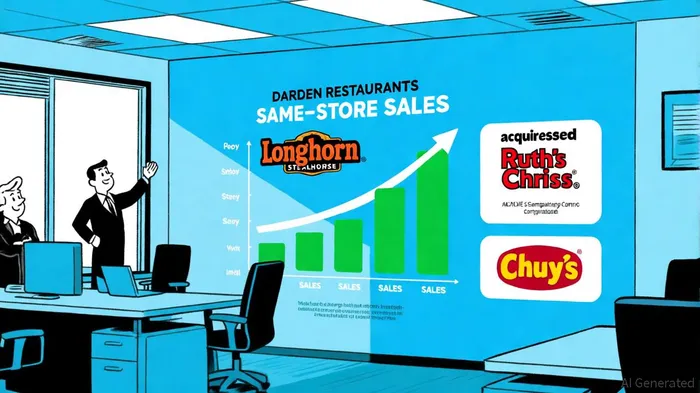
Financial results validate this approach. For fiscal 2024, total sales rose 8.6% to $11.4 billion, driven by a 1.6% increase in same-restaurant sales and the addition of 80 new units[1]. While Q1 2025 saw a 1.1% decline in same-store sales, the LongHorn Steakhouse brand outperformed with 4.0% growth[3]. Darden's Q1 2026 results further illustrate momentum: total sales surged 10.4% to $3.0 billion, with same-restaurant sales up 4.7% and adjusted EPS rising 12.6%[2].
Strategic acquisitions, such as the $605 million purchase of Chuy's, have also diversified Darden's brand portfolio. Analysts project Chuy's to be accretive within a year, adding resilience to its casual dining segment[2]. These moves align with the board's focus on growth through diversification and operational efficiency, as endorsed by shareholders.
Divergent Priorities: ESG and the Limits of Governance Influence
The rejection of ESG-related proposals, however, complicates the narrative. Shareholders declined requests for detailed disclosures on pork sourcing and adherence to WHO antimicrobial guidelines[5]. This outcome suggests that, at least for now, investors view Darden's current risk management and operational focus as sufficient. Yet, it also raises questions about the long-term relevance of ESG metrics in the restaurant sector. While climate impact reporting and supply chain transparency are gaining traction, Darden's shareholder base appears to prioritize immediate financial returns over prescriptive sustainability mandates.
This dynamic is not unique to Darden. A 2025 Bloomberg report notes that U.S. restaurant chains face a “governance gap” in ESG integration, with investors often deferring to management's operational expertise[6]. For Darden, this means its governance model—centered on profitability and capital discipline—remains its strongest asset.
The Path Forward: Balancing Governance and Innovation
Darden's 2026 outlook projects sales growth of 7.5–8.5%, supported by 60–65 new restaurant openings and $667 million in capital expenditures[2]. Analysts from BMO Capital and KeyBanc have raised earnings estimates, citing the company's ability to navigate inflation and optimize its delivery partnerships[4]. These developments suggest that Darden's governance-aligned strategies are fostering resilience.
Yet, the company must remain vigilant. The rejection of ESG proposals does not eliminate the need for proactive risk management. As consumer preferences evolve, Darden's ability to balance profitability with sustainability—without diluting shareholder returns—will be critical.
Conclusion
Darden Restaurants' 2024 shareholder meeting and subsequent financial performance demonstrate how governance alignment can drive value creation. By prioritizing board continuity, executive compensation tied to performance, and aggressive shareholder returns, Darden has reinforced investor confidence. While ESG-related proposals were rejected, the company's strategic focus on operational efficiency and diversification has yielded robust financial results. For investors, this underscores a key insight: governance effectiveness is not solely about adopting every shareholder demand but about aligning with the priorities that directly enhance long-term value.







Comentarios
Aún no hay comentarios