
DAO Sustainability in 2025: The Tension Between Governance Discipline and Structural Privilege
In 2025, the promise of Decentralized Autonomous Organizations (DAOs) as a model for equitable, community-driven governance faces a critical juncture. While early optimismOP-- centered on token-based democratization, the year's case studies and reports reveal a stark divide between aspirational ideals and operational realities. At the heart of this divide lies a tension between governance discipline-the mechanisms to ensure accountability and participation-and structural privilege, the systemic advantages granted to large token holders or technically sophisticated actors. For investors, understanding this dynamic is essential to evaluating the long-term viability of DAOs as sustainable governance models.
Governance Discipline: The Struggle for Accountability and Participation
DAOs in 2025 continue to grapple with foundational governance challenges, particularly in maintaining disciplined, inclusive decision-making. A key issue is low voter turnout, which undermines the decentralization ethos. According to a report by , major DAOs saw a sharp decline in proposals and voter participation in late 2025, with governance increasingly dominated by a small group of professional delegates and long-term token holders. This trend reflects a broader governance paradox: while decentralization empowers communities, it can also lead to fragmentation and inconsistent decision-making, as seen in climate-focused DAOs like KlimaDAO and Regen Network.
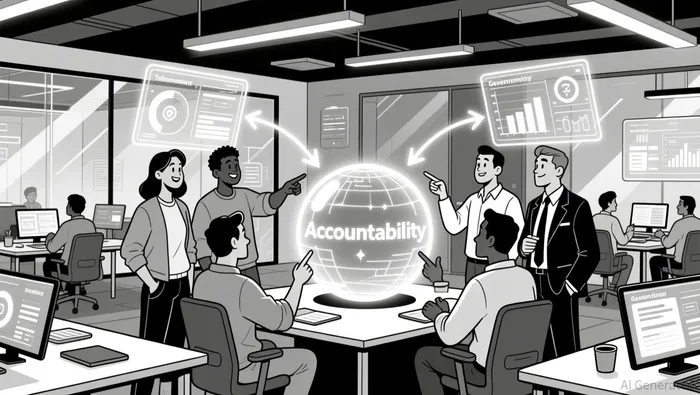
To address these challenges, researchers have proposed Key Performance Indicators (KPIs) to evaluate governance efficiency, financial robustness, and community engagement according to research. For instance, PythPYTH-- DAO has adopted a "specialized agency + community oversight" model to streamline decision-making while maintaining broader participation as detailed in Okx's analysis. Similarly, Lido DAO's dual governance system allows stETH holders to veto decisions, creating a system of checks and balances according to Okx's framework. These innovations highlight a growing emphasis on structured, data-driven governance frameworks to enforce discipline and prevent capture by unrepresentative actors.
Structural Privilege: The Concentration of Power
Despite these efforts, structural privilege remains a persistent threat to DAO sustainability. Tokenized governance models inherently favor those with larger stakes, enabling financially or technically privileged users to dominate decision-making. As noted in a study by , DAOs often reflect the biases of their creators, prioritizing efficiency over fairness. For example, flash loan exploits and off-chain voting manipulation have allowed well-resourced actors to sway outcomes, undermining the ideal of decentralized accountability.
This concentration of power is particularly evident in climate DAOs, where the need for coordinated action clashes with decentralized governance. found that while decentralization empowers community participation, it also risks fragmentation, as smaller stakeholders struggle to influence outcomes. The result is a governance landscape where structural privilege-rooted in token distribution and technical expertise-often overrides the principles of inclusivity.
Legal and Structural Innovations: A Path Forward?
To mitigate these challenges, 2025 saw the emergence of legal and structural innovations aimed at balancing decentralization with accountability. The Harmony Framework, introduced in February 2025, provides a jurisdiction-neutral legal structure for DAOs, enabling enforceable governance rules while protecting members from personal liability according to Aurum Law. This framework is critical for addressing the scalability issues inherent in Ostrom's commons governance principles, which emphasize local participation but struggle with enforcement in decentralized environments as analyzed in Frontiers in Blockchain.
Additionally, DAOs are experimenting with decentralized models to counteract structural privilege. Buyback programs and token distribution mechanisms aim to reduce concentration, while specialized agencies-like Pyth DAO's model-delegate technical decisions to experts while retaining community oversight as described by Okx. These approaches suggest a shift toward hybrid governance models that combine the efficiency of specialization with the inclusivity of decentralized participation.
Conclusion: Balancing Discipline and Equity for Sustainable DAOs
For investors, the sustainability of DAOs in 2025 hinges on their ability to reconcile governance discipline with the risks of structural privilege. While innovations like the Harmony Framework and KPI-driven governance offer promising solutions, the underlying tension between decentralization and power concentration remains unresolved. DAOs that succeed will be those that adopt adaptive, transparent frameworks-leveraging data-driven metrics to enforce accountability while actively redistributing influence to underrepresented stakeholders.
As the year draws to a close, the lessons from 2025 underscore a critical truth: DAOs are not inherently sustainable. Their longevity depends on the deliberate design of governance systems that prioritize both efficiency and equity-a challenge that will define the next phase of decentralized innovation.






Comentarios
Aún no hay comentarios