
Dangote Refinery's Operational Readiness and Procurement Strategies: Implications for Regional Gasoline Supply and Investment Risks
The Dangote Refinery, Africa's largest industrial project, has emerged as a pivotal player in reshaping regional gasoline supply dynamics and energy sector investment landscapes. As of late 2025, the refinery's operational readiness and procurement strategies are both a beacon of progress and a source of growing scrutiny. This analysis examines how these developments influence regional energy stability and the risks they pose to investors.
Operational Readiness: Progress Amidst Challenges
The Dangote Refinery has made significant strides in 2025, operating at 360,000 barrels per day (bpd) as of February and projected to reach 65% utilization by year-end, according to Kpler. However, operational disruptions have persisted. A September 2025 strike by PENGASSAN, the oil workers' union, temporarily halted refining processes and fertilizer operations, though government mediation restored partial stability, reported by DW. Compounding these issues, the Residue Fluid Catalytic Cracker (RFCC) unit, critical for gasoline production, was offline for months due to technical faults, delaying Euro VI-grade gasoline output until early November, according to Discovery Alert.
Despite these setbacks, the refinery is expanding its capacity to 700,000 bpd by Q4 2025, with the RFCC already operating at 85% capacity in July, Kpler reported. This progress underscores its potential to meet Nigeria's domestic fuel demand and export 40% of its output, aligning with Aliko Dangote's vision of energy self-sufficiency, as noted by EcofinAgency.
Procurement Strategies: Diversification and Vertical Integration
The refinery's procurement strategies have been instrumental in stabilizing feedstock supply. By diversifying crude sources to include U.S. WTI, Angolan, and Cameroonian oil, Dangote has mitigated risks from Nigeria's inconsistent domestic production, according to Blueprint. For instance, 19 million barrels of U.S. crude were imported in June–July 2025, reflecting a strategic pivot to cost-effective, high-quality feedstock, Kpler reported. Additionally, a 6-month Naira-for-Crude contract with the Nigerian National Petroleum Company Limited (NNPCL) has secured 48 million barrels, Blueprint reported, though renegotiation is underway to extend this supply.
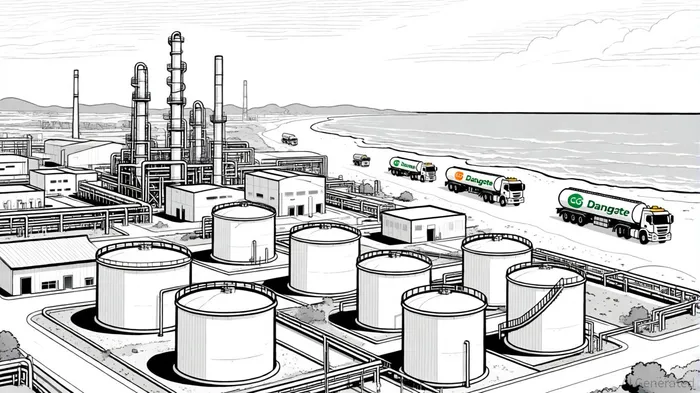
Logistically, Dangote has invested in 4,000 CNG-powered tankers and associated infrastructure to streamline distribution, aiming to reduce costs and enhance fuel accessibility, Kpler notes. Partnerships with entities like PETROAN and IPMAN further strengthen its supply chain, enabling direct-to-consumer distribution starting August 2025, Blueprint reported. These moves position the refinery to undercut traditional midstream players, compressing margins for independent hauliers and raising concerns about market concentration, warned Business Insider Africa.
Regional Gasoline Supply Stability: A Double-Edged Sword
The refinery's operations have already reduced Nigeria's reliance on imported refined products, with projections suggesting it could become a net exporter of gasoline and diesel, according to African Security Analysis. However, its reliance on U.S. crude has disrupted regional trade flows, cutting European gasoline exports to West Africa by one-third as the region becomes self-sufficient, Blueprint reported. While this shift benefits Nigeria, it creates vulnerabilities: any disruption in crude supply or refinery operations could leave the country with less than 30 days of fuel reserves, Business Insider Africa warned.
Moreover, the refinery's direct distribution model has sparked fears of monopolistic practices. Industry associations like PETROAN warn that Dangote's control over logistics and pricing could suppress competition, leading to job losses and systemic instability, Kpler notes. Regulatory bodies, including the Federal Competition and Consumer Protection Commission (FCCPC), have flagged potential violations of free market principles, Business Insider Africa reported.
Investment Risks: Monopolistic Tendencies and Operational Volatility
Investors must weigh the refinery's transformative potential against significant risks. Operationally, the refinery's single-point failure model-reliant on a centralized logistics system-poses acute vulnerabilities. A prolonged shutdown of the RFCC or crude supply chain could destabilize regional markets, Business Insider Africa argued.
Strategically, Dangote's aggressive tactics, including lobbying to ban petrol imports and undercutting competitors with subsidized pricing, have drawn regulatory scrutiny, according to Business Insider Africa. Critics argue these practices mirror historical monopolies, stifling innovation and competition, EcofinAgency observed. Additionally, the refinery's IPO plans, delayed to 2026, face execution risks tied to political interference and market volatility, EcofinAgency noted.
Conclusion: Balancing Ambition and Risk
The Dangote Refinery's operational readiness and procurement strategies are redefining Nigeria's energy landscape, offering both opportunities and challenges. While its capacity to stabilize regional gasoline supply and reduce import dependency is undeniable, the risks of monopolistic behavior, operational fragility, and regulatory pushback cannot be ignored. For investors, the key lies in monitoring Dangote's ability to navigate these challenges while aligning with Nigeria's broader economic goals.







Comentarios
Aún no hay comentarios