
Daktronics' Fiscal Q1 Earnings Turnaround and Share Price Surge: Assessing Sustainability and Long-Term Value Creation Amid Declining Revenue
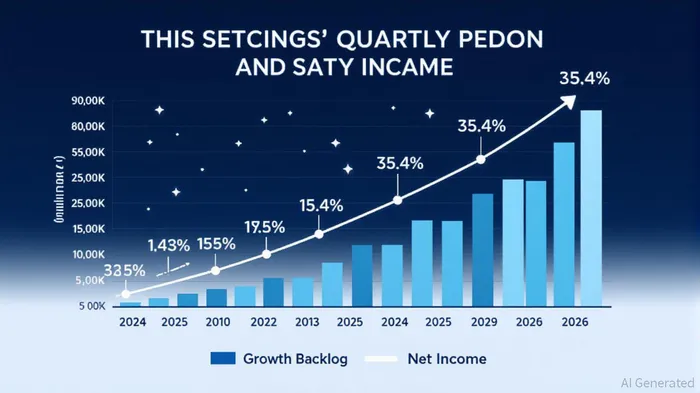
Daktronics Inc. (DAKT) has captured investor attention with a dramatic fiscal Q1 2026 earnings turnaround, marked by a net income of $16.5 million and operating income of $23.3 million—sharp contrasts to the $4.9 million net loss in the same period of fiscal 2025[2]. While revenue dipped slightly to $219.0 million year-over-year, the company's gross margin expanded to 29.7%, driven by manufacturing efficiencies, value-based pricing, and a higher-margin project mix[2]. This performance has fueled a share price surge, raising critical questions: Is this turnaround sustainable, and does it align with long-term value creation amid broader revenue declines?
Operational Efficiency and Strategic Pricing: The Immediate Drivers
The earnings rebound reflects Daktronics' focus on operational discipline. Gross margin expansion to 29.7%—up from 26.4% in Q1 2025[1]—underscores the impact of manufacturing streamlining and a shift toward higher-margin projects. According to a report by the company, these improvements were achieved through “value-based pricing strategies and PDCA (Plan-Do-Check-Act) processes to refine operations”[2]. Sequential revenue growth of 26.9% from Q4 2024 further highlights the company's ability to capitalize on seasonal demand in sports and outdoor markets[1].
However, Daktronics' total fiscal 2025 revenue fell 7.5% to $756.5 million compared to fiscal 2024[3], a decline attributed to delayed order placements and extended lead times for large projects[4]. This raises concerns about the sustainability of Q1's performance. Yet, the company's order backlog of $342 million as of April 28, 2025[5], and a 35.4% year-over-year increase in Q1 2026 orders to $238.5 million[2] suggest robust near-term visibility.
Long-Term Value Creation: R&D, Sustainability, and Market Expansion
To assess whether Daktronics' turnaround is more than a short-term fix, one must examine its long-term strategic initiatives. The company has committed $22.5 million annually to R&D, focusing on next-generation products like flip-chip COB LED displays and microLED technology, which promise 15–20% improvements in operational efficiency and display longevity[5]. These innovations align with its goal of achieving 17–20% return on invested capital (ROIC) over the next three years[5].
Sustainability also plays a pivotal role. DaktronicsDAKT-- has integrated ESG practices into its operations, emphasizing energy efficiency, waste reduction, and sustainable material sourcing[2]. Its digital transformation initiatives—spanning SaaS trials and inventory optimization—further enhance profitability while reducing exposure to volatile tariff environments[5]. For instance, supply chain diversification efforts aim to mitigate risks from Chinese tariffs, a strategic pivot that could stabilize margins in uncertain global markets[5].
Navigating Revenue Volatility: A Structural Shift or Cyclical Recovery?
The 7.5% decline in fiscal 2025 revenue appears cyclical rather than structural. Management attributes this to timing of large project deliveries and seasonal demand patterns[3]. The sequential 4.7% revenue growth in Q1 2025 compared to Q4 2024[1] and the 26.9% sequential rise in Q1 2026[2] indicate that the company is recalibrating its order flow. With a 29% sequential increase in Q4 2025 orders[3], Daktronics is positioned to leverage its backlog into sustained revenue growth.
Moreover, the company's tiered product strategy—aligning offerings with customer needs—and its focus on high-margin verticals like intelligent transportation systems and digital billboards[5] suggest a deliberate shift toward sustainable revenue streams. International expansion, particularly in the Middle East and North America, further diversifies its customer base[5].
Conclusion: A Turnaround with Legs?
Daktronics' Q1 2026 results demonstrate that operational efficiency and strategic pricing can drive profitability even amid revenue volatility. However, the company's long-term success hinges on its ability to execute its R&D roadmap, sustain margin expansion, and convert its $342 million order backlog into recurring revenue[5]. With targets of 7–10% compound annual growth and 10–12% operating margins by FY2028[5], Daktronics is betting on a future where innovation and sustainability drive value. For investors, the key question remains: Can these initiatives outpace macroeconomic headwinds and ensure that the current earnings surge is not a flash in the pan?





Comentarios
Aún no hay comentarios