
Dakota Gold's Richmond Hill 2025 Drill Campaign and Metallurgical Progress: A Strategic Investment in a High-Potential Gold Project
The global gold market in 2025 is at a pivotal juncture. With production peaking at 3,250 tonnes before projected declines by 2030[1], and all-in sustaining costs rising to $1,399 per ounce[3], the industry is increasingly focused on projects that combine high-grade resources with cost-efficient, sustainable extraction methods. Dakota GoldDC-- Corp.'s Richmond Hill Oxide Heap Leach Gold Project stands out as a prime candidate in this landscape, offering a blend of operational momentum, metallurgical innovation, and robust economic potential.
Operational Momentum: A 27,500-Meter Drill Campaign Unveils High-Grade Zones
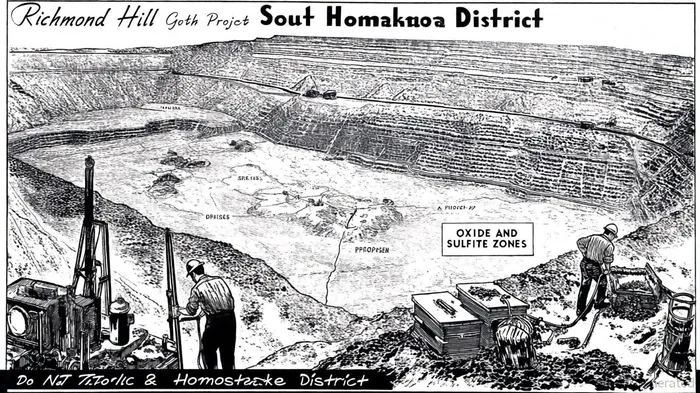
Dakota Gold's 2025 drill campaign, targeting 27,500 meters of Reverse Circulation and Core drilling, has already delivered compelling results. Notably, metallurgical drill holes RH25C-171 and RH25C-200 intersected 1.50 g/t Au over 62.1 meters and 2.25 g/t Au over 33.4 meters, respectively[1]. These grades exceed the project's average resource grade, signaling the potential to refine oxide and sulfide boundaries and enhance the geo-metallurgical model for the Feasibility Study[4].
The northeast Project area, including the Chism Gulch zone, remains open for expansion, with core drilling underway to delineate higher-grade zones[2]. Assay results from this region, expected by year-end, could boost Measured, Indicated, and Inferred resources[3]. Such progress aligns with broader industry trends, where exploration-driven resource growth is critical for offsetting declining ore grades at mature mines[1].
Metallurgical Advancements: Optimizing Recovery and Cost Efficiency
Dakota Gold's collaboration with Forte Dynamics, a specialist in heap leach projects, underscores its commitment to optimizing recovery and reducing capital expenditures. The metallurgical test program, spanning Q4 2025 to Q3 2026, includes ore characterization, column leach testing, and comminution studies[5]. Initial results from 1,500-pound composite samples are expected before year-end, informing follow-up drilling and process optimization[1].
The appointment of Mike Eiselein, a 34-year mining veteran, as Vice President of Project Development further strengthens the team's technical capabilities[4]. His expertise in process engineering and cost optimization is pivotal for refining the project's geo-metallurgical domains and conducting trade-off studies to maximize recoveries while minimizing CAPEX and OPEX[3].
Economic Viability: A Project with Substantial Upside
The Richmond Hill project's economic projections are compelling. Under a $3,350/ounce gold price assumption, the project's after-tax NPV5% reaches $3.7 billion for the Measured, Indicated, and Inferred (MI&I) scenario, with an IRR of 59%[2]. These figures are bolstered by low initial capital expenditures ($384 million) and all-in sustaining costs of $1,050 per ounce[1]. Analyst Peter Bell of Canaccord Genuity has highlighted the project's scalability, noting that ongoing drilling could further enhance economics by expanding high-grade zones[2].
The Feasibility Study, slated for completion in early 2027, will provide critical clarity on the project's technical and financial viability. Construction is expected to begin in 2028, with production targeted for 2029[2]. For investors, this timeline offers a clear pathway to value realization, supported by the project's potential to generate $400 million in state severance taxes and create hundreds of high-paying jobs in South Dakota[1].
Industry Context: Aligning with Sustainable and Technological Trends
Dakota Gold's focus on heap leach technology and metallurgical optimization positions it well within the industry's shift toward sustainable practices. Innovations like bio-mining and reduced cyanide use are gaining traction[1], and Richmond Hill's low-impact, open-pit design aligns with these trends. Additionally, the project's proximity to the historic Homestake District—a region with established infrastructure—reduces logistical and environmental risks[2].
Conclusion: A Strategic Investment in a High-Potential Gold Project
Dakota Gold's Richmond Hill project exemplifies the qualities sought by investors in emerging gold ventures: high-grade resources, metallurgical innovation, and a clear path to profitability. With a robust 2025 drill campaign, advanced metallurgical testing, and alignment with industry trends, the project is well-positioned to capitalize on the current gold price environment and rising demand for ethically sourced gold. As the Feasibility Study nears completion, the company's ability to deliver on its economic projections will be a key catalyst for shareholder value.





Comentarios
Aún no hay comentarios