
Dacia Hipster: A Bold New Vision for Affordable Electric Mobility
PorAinvest
lunes, 6 de octubre de 2025, 1:03 pm ET1 min de lectura
STLA--
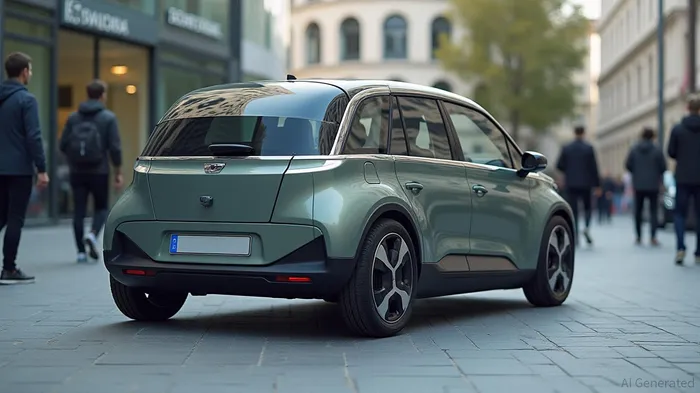
The Hipster concept car measures 3 meters in length and weighs under 800 kg, making it one of the shortest and lightest vehicles in Europe. Its design philosophy emphasizes simplicity, sustainability, and low cost. The car features four full-sized seats, up to 500 liters of boot space, and is designed to be efficient and easy to produce [1].
The Hipster's specifications include a maximum speed of around 90 km/h and an estimated range of 150 km, making it suitable for daily urban or suburban use. Dacia estimates that the average car travels less than 40 km daily at an average speed of 56 km/h, suggesting that the Hipster's range is sufficient for most daily commutes [1].
To keep the starting price below EUR 15,000, Dacia has made several sacrifices in the Hipster's design. The car features canvas seats, manual windows, very little electronics, and straps instead of door handles. It is expected to be sold in a single color, similar to the grey-blue of the prototype [1].
The Hipster is part of a broader initiative supported by Renault and Stellantis to create a new European category of small cars inspired by the Japanese "Kei Car" concept. This category would include urban vehicles with basic equipment and reduced safety requirements, allowing for lower weight and production costs [1].
Dacia's CEO, Katrin Adt, stated that the company is ready to mass produce the Hipster if the European Union agrees to create a new small car category. However, the regulations for this new category are still under discussion, and it is expected that the vehicles will need to be produced in Europe [1].
The Hipster concept car represents Dacia's vision for local, affordable, and everyday mobility. Its design-to-cost and design-to-weight philosophy aims to demonstrate what could be achieved if manufacturers were given more flexibility to create small, efficient electric cars.
Dacia has unveiled a compact electric city car concept called the Hipster, which channels the minimalist spirit of the original Mini and Fiat 500. Weighing under 800kg and measuring 3.0 meters long, the Hipster features four full-sized seats, up to 500 liters of boot space, and is designed to be simple, sustainable, and low-cost. The car's design-to-cost and design-to-weight philosophy aims to show what could be achieved if manufacturers were given more flexibility to create small, efficient electric cars.
Dacia, the low-cost brand of Renault, has unveiled the "Hipster" mini-EV concept car, aiming to challenge the dominance of low-cost Chinese electric vehicles (EVs) in the European market. The Hipster, unveiled in Meudon, France, on September 30, 2025, is a compact, lightweight car designed to provide accessible and practical everyday mobility.The Hipster concept car measures 3 meters in length and weighs under 800 kg, making it one of the shortest and lightest vehicles in Europe. Its design philosophy emphasizes simplicity, sustainability, and low cost. The car features four full-sized seats, up to 500 liters of boot space, and is designed to be efficient and easy to produce [1].
The Hipster's specifications include a maximum speed of around 90 km/h and an estimated range of 150 km, making it suitable for daily urban or suburban use. Dacia estimates that the average car travels less than 40 km daily at an average speed of 56 km/h, suggesting that the Hipster's range is sufficient for most daily commutes [1].
To keep the starting price below EUR 15,000, Dacia has made several sacrifices in the Hipster's design. The car features canvas seats, manual windows, very little electronics, and straps instead of door handles. It is expected to be sold in a single color, similar to the grey-blue of the prototype [1].
The Hipster is part of a broader initiative supported by Renault and Stellantis to create a new European category of small cars inspired by the Japanese "Kei Car" concept. This category would include urban vehicles with basic equipment and reduced safety requirements, allowing for lower weight and production costs [1].
Dacia's CEO, Katrin Adt, stated that the company is ready to mass produce the Hipster if the European Union agrees to create a new small car category. However, the regulations for this new category are still under discussion, and it is expected that the vehicles will need to be produced in Europe [1].
The Hipster concept car represents Dacia's vision for local, affordable, and everyday mobility. Its design-to-cost and design-to-weight philosophy aims to demonstrate what could be achieved if manufacturers were given more flexibility to create small, efficient electric cars.


Divulgación editorial y transparencia de la IA: Ainvest News utiliza tecnología avanzada de Modelos de Lenguaje Largo (LLM) para sintetizar y analizar datos de mercado en tiempo real. Para garantizar los más altos estándares de integridad, cada artículo se somete a un riguroso proceso de verificación con participación humana.
Mientras la IA asiste en el procesamiento de datos y la redacción inicial, un miembro editorial profesional de Ainvest revisa, verifica y aprueba de forma independiente todo el contenido para garantizar su precisión y cumplimiento con los estándares editoriales de Ainvest Fintech Inc. Esta supervisión humana está diseñada para mitigar las alucinaciones de la IA y garantizar el contexto financiero.
Advertencia sobre inversiones: Este contenido se proporciona únicamente con fines informativos y no constituye asesoramiento profesional de inversión, legal o financiero. Los mercados conllevan riesgos inherentes. Se recomienda a los usuarios que realicen una investigación independiente o consulten a un asesor financiero certificado antes de tomar cualquier decisión. Ainvest Fintech Inc. se exime de toda responsabilidad por las acciones tomadas con base en esta información. ¿Encontró un error? Reportar un problema


SOBRE NOSOTROS
Nuestra historiaAutores de noticiasBase de conocimientosPolítica de privacidadTérmino de usoDescargo de responsabilidad de corretaje de tercerosTérminos de uso de AIMEDivulgaciones de riesgos de AInvest AICarrerasCONTÁCTENOS
Email: support@ainvest.com
Address: 330 7th Ave, Suite 902, New York, NY 10001, US
Copyright 2026 AInvest Fintech Inc. All rights reserved.


Comentarios
Aún no hay comentarios