
The CZ-Warren Defamation Dispute and Its Implications for U.S. Crypto Regulatory Risk
The Legal and Political Flashpoint
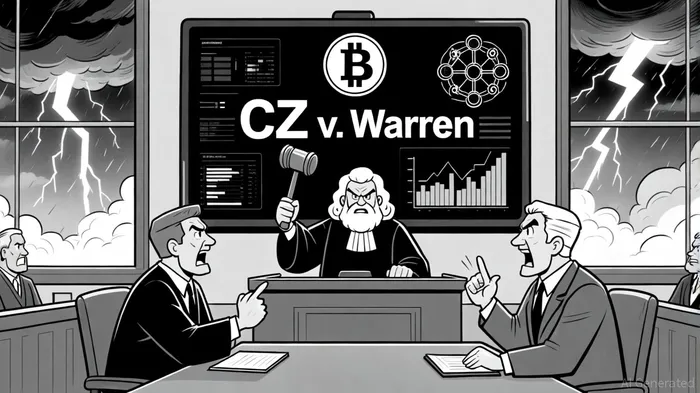
Warren's October 2025 social media post, which falsely claimed CZ had pleaded guilty to money laundering and received a prison sentence, was swiftly flagged by X's Community Notes feature as inaccurate, according to an AMBCrypto report. CZ's legal team, led by Teresa Goody Guillen, has since demanded a retraction, warning of imminent defamation proceedings; AMBCrypto later covered those demands. The crux of the legal argument hinges on whether Warren's statements-made outside formal legislative proceedings-are protected under the Speech or Debate Clause of the U.S. Constitution. If CZ prevails, it could establish a precedent limiting the immunity of elected officials for defamatory remarks on social media, a development with far-reaching consequences for political discourse and regulatory accountability, according to a CryptoNewsZ report.
This dispute is not merely a legal technicality. It underscores the deepening rift between crypto industry leaders and political figures like Warren, who has long advocated for stringent regulatory frameworks. Her recent framing of President Trump's pardon of CZ as an act of corruption further escalated tensions, illustrating how high-profile legal and political conflicts can become entangled with crypto policy debates, as noted in a Coinotag article.
Regulatory Reactions and Legislative Fallout
The CZ-Warren controversy has already spurred legislative action. In response to the Trump administration's pardon of CZ, Congressman Ro Khanna (D-Calif.) announced plans to introduce a bill banning elected officials from trading, owning, or promoting cryptocurrencies, according to a FinanceFeeds report. Khanna's proposal, which mirrors existing ethics rules for stock trading under the STOCK Act, aims to address perceived conflicts of interest stemming from CZ's ties to the Trump family's crypto ventures; FinanceFeeds offered additional analysis of those parallels. If enacted, the bill would mark a significant expansion of federal ethics oversight into the digital asset space, potentially influencing future regulations on stablecoins and decentralized finance (DeFi), per another FinanceFeeds piece.
Meanwhile, the Securities and Exchange Commission (SEC) and Commodity Futures Trading Commission (CFTC) have signaled a shift toward harmonizing regulatory frameworks for crypto assets. A joint statement from the agencies clarified that registered exchanges may facilitate leveraged or margined retail commodity transactions on crypto assets, provided they comply with existing statutory constraints, according to a Dechert analysis. This move aligns with broader White House efforts to position the U.S. as a global leader in digital financial technology. The nomination of Michael Selig, a pro-crypto advocate from the SEC, as CFTC chair further reinforces this pro-innovation stance; Dechert covered the joint statement and its implications.
The Broader Regulatory Landscape
The CZ-Warren dispute is emblematic of a larger struggle within the U.S. Congress to define the regulatory architecture for crypto. Senate Banking Committee Chair Tim Scott has championed a market structure bill to clarify crypto oversight, but bipartisan negotiations have stalled over disagreements on enforcement priorities and classification frameworks, according to a Politico report. Democrats, led by Warren, have pushed for stronger consumer protections and expanded SEC jurisdiction, while Republicans have advocated for a CFTC-centric model emphasizing innovation, as detailed in an Akin Gump alert. This divide has left the U.S. lagging behind global peers like Singapore and the UK, which have adopted more coherent licensing frameworks for crypto advisors, according to an IFCCI article.
For investors, the uncertainty is palpable. A fragmented regulatory environment increases compliance costs and operational risks for crypto firms, particularly those navigating overlapping jurisdictions. The proposed Khanna bill, for instance, could deter political endorsements of crypto projects or create conflicts for firms with ties to elected officials. Conversely, the SEC-CFTC joint statement and Selig's nomination suggest a potential easing of enforcement pressures, at least in the short term; Dechert's analysis discussed those potential effects.
Strategic Implications for Investors
The CZ-Warren dispute highlights three key risks and opportunities for crypto investors:
1. Reputational Risk: High-profile legal battles can erode public trust in crypto firms, particularly if they are perceived as entangled with political actors. Binance's stock price, for example, has historically been volatile in response to regulatory news, as reported in a Coinotag report.
2. Legislative Uncertainty: The proposed Khanna bill and stalled Senate negotiations underscore the fragility of the U.S. regulatory framework. Firms must prepare for rapid shifts in compliance requirements, especially in areas like AML and self-hosted wallets, a point highlighted in the IFCCI article referenced above.
3. Global Competition: As the U.S. grapples with internal divisions, countries like Singapore and the UK are accelerating their regulatory frameworks. Investors should monitor cross-border opportunities, particularly in jurisdictions with clearer compliance standards, as noted earlier.
Conclusion
The CZ-Warren defamation dispute is more than a legal squabble-it is a microcosm of the broader tensions shaping the U.S. crypto landscape. For investors, the stakes are clear: regulatory clarity, enforcement priorities, and political dynamics will continue to dictate the risk profile of the sector. While the outcome of CZ's potential lawsuit remains uncertain, one thing is certain: the crypto industry's future in the U.S. will be defined by its ability to navigate the intersection of law, politics, and innovation.







Comentarios
Aún no hay comentarios