
Cypherpunk Technologies' Zcash Treasury Strategy and Its Implications for Corporate Crypto Adoption
A Strategic Rebranding: From Biotech to Privacy-First Treasury
Cypherpunk's transformation began with a $58.88 million private placement led by Winklevoss Capital, which funded the acquisition of 203,775.27 ZECZEC-- at an average price of $245.37 per token. This represents approximately 5% of Zcash's total supply, a significant stake that aligns with the company's new mission to promote privacy-focused blockchain infrastructure. The rebranding, effective November 13, 2025, includes leadership changes, with Khing Oei appointed as Chairman and Will McEvoy as Chief Investment Officer, tasked with overseeing the treasury's growth. This shift reflects a deliberate bet on Zcash's unique value proposition: a privacy-first alternative to BitcoinBTC-- with optional transparency features that cater to regulatory compliance, as noted in the Blockonomi report.
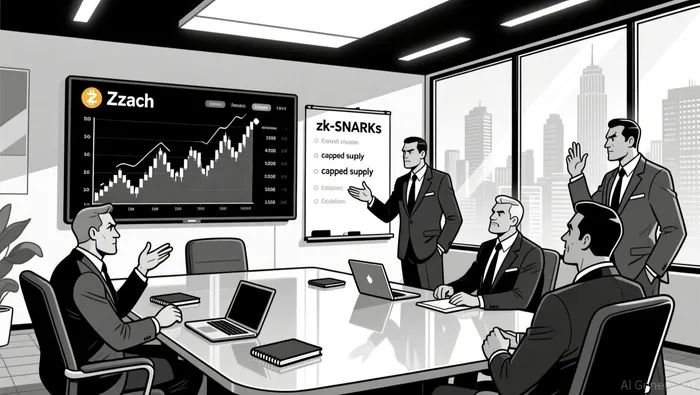
Zcash's zk-SNARKs (zero-knowledge succinct non-interactive arguments of knowledge) enable confidential transactions while allowing for selective disclosure, a critical advantage in institutional contexts. Unlike Bitcoin's transparent ledger, Zcash's optional privacy model allows corporations to balance confidentiality with compliance, making it an attractive asset for entities navigating anti-money laundering (AML) regulations, as noted in the Coinotag report. This duality has drawn comparisons to "encrypted Bitcoin," with Tyler Winklevoss suggesting Zcash could eventually capture a meaningful share of Bitcoin's market value, as noted in the The Block report.
Institutional MomentumMMT-- and Privacy-Driven Diversification
Cypherpunk's Zcash treasury strategy is part of a broader trend of institutional adoption. Grayscale, for instance, has invested $137 million in ZEC via its Zcash Trust (ZCSH), leveraging the coin's optional transparency to align with regulatory frameworks, as noted in the Bitget report. Similarly, Zenrock's wrapped ZEC (zenZEC) has generated $15 million in trading activity, bridging privacy coins with decentralized finance (DeFi) ecosystems, as noted in the Bitget report. These developments signal a maturing market where privacy is no longer a niche concern but a strategic asset class.
The Electric Coin Company (ECC), Zcash's core development team, has further bolstered the coin's appeal with Q4 2025 roadmap upgrades, including ephemeral addresses to enhance transaction anonymity and interoperability, as noted in the FinanceFeeds report. These technological advancements position Zcash as a scalable solution for institutions seeking to mitigate risks associated with surveillance and macroeconomic instability.
Market Dynamics and Long-Term Value Creation
Zcash's price trajectory in 2025 has been nothing short of dramatic, surging from $48 to over $640. While technical indicators like an RSI of 94.24 suggest potential corrections, the coin's capped supply of 21 million coins and its role as a "privacy hedge" against Bitcoin's volatility make it a compelling long-term play, as noted in the Coinotag report. Arthur Hayes, co-founder of BitMEX, has even projected ZEC reaching $1,000 in 2025 if adoption and scalability continue to grow, as noted in the Coinotag report.
Cypherpunk's treasury strategy, however, extends beyond speculative gains. By holding a substantial portion of Zcash's supply, the firm gains direct exposure to protocol advancements and network effects. This aligns with a broader thesis that privacy will become a critical asset in an era of central bank digital currencies (CBDCs) and heightened surveillance. As one analyst noted, "Zcash is not just a privacy coin-it's insurance against the future of finance," as noted in the Ellipal report.
Regulatory Clarity and the Path Forward
The U.S. Clarity and Genius Acts, which aim to provide regulatory frameworks for privacy coins, have further legitimized Zcash's role in institutional portfolios. These acts emphasize optional transparency, a feature Zcash already supports, thereby reducing legal friction for corporations, as noted in the The Block report. Meanwhile, Zcash's integration into DeFi platforms and institutional-grade risk analytics-such as Value-at-Risk (VaR) models-has made it a viable component of diversified crypto portfolios, as noted in the The Block report.
Despite these positives, challenges remain. Zcash's price volatility, coupled with regulatory scrutiny of privacy coins, poses risks. However, its decentralized governance and community-driven development model offer resilience. As one investor put it, "Privacy coins like Zcash are the next frontier of financial self-sovereignty-regulation may slow adoption, but it won't stop it," as noted in the YesMining report.
Conclusion: A Privacy-First Future
Cypherpunk Technologies' Zcash treasury strategy exemplifies a forward-thinking approach to corporate crypto adoption. By prioritizing privacy, scarcity, and regulatory adaptability, the firm has positioned Zcash as a cornerstone of strategic diversification. As institutional interest grows and technological advancements continue, Zcash's role in long-term value creation-both as a financial asset and a tool for digital privacy-will likely expand. For corporations navigating an increasingly surveilled financial landscape, the message is clear: privacy is no longer optional-it's essential.






Comentarios
Aún no hay comentarios