
Cynthia Lummis' Exit and the Future of U.S. Crypto Policy
The retirement of Senator Cynthia Lummis, a stalwart advocate for cryptocurrency in the U.S. Senate, has cast a long shadow over the future of digital asset regulation and investment in America. As chair of the Senate Banking Committee's Digital Assets Subcommittee and a key architect of bipartisan legislative efforts, Lummis has been instrumental in balancing innovation with oversight. Her departure from Congress in 2027 raises critical questions about regulatory momentum and the trajectory of the U.S. crypto market, particularly as global competition intensifies.
A Legislative Legacy of Balance
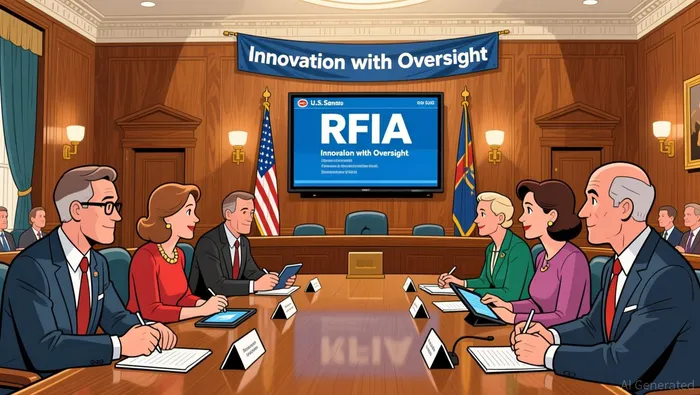
Lummis' most enduring contributions lie in her work on the Responsible Financial Innovation Act (RFIA) and the CLARITY Act, both aimed at creating a coherent regulatory framework for digital assets. The 182-page RFIA draft released in September 2025, co-authored with Senator Tim Scott, sought to clarify the roles of the SEC, CFTC, and other agencies while safeguarding consumer interests and fostering innovation. These efforts reflected her signature approach: advocating for a "pro-innovation but responsible" environment, as noted by the US Crypto Policy Tracker.
Her influence extended beyond legislation. Lummis championed the Bitcoin Reserve Strategy Act, which proposed holding BitcoinBTC-- as a strategic reserve asset, and the GENIUS Act, designed to address tax inequities for digital assets according to Onesafe. By pushing for clear market structure principles and tax reforms, she helped legitimize crypto as a mainstream asset class.
Regulatory Uncertainty and Market Reactions
The crypto industry's response to Lummis' retirement has been cautiously pessimistic. While her advocacy provided a stabilizing force, her absence risks stalling progress on key initiatives. According to a report by Onesafe, industry stakeholders fear that without her leadership, the Senate may adopt a more risk-averse stance, potentially favoring stricter oversight over innovation-friendly policies. This uncertainty has already spooked investors: the Fear & Greed Index in crypto markets hit 20 in late 2025, signaling "Extreme Fear" amid concerns over regulatory shifts.
The potential for a regulatory vacuum is compounded by the lack of clear successors. Wyoming, a Republican stronghold, will elect a new senator in 2026, but no candidate has yet emerged as a crypto champion. As The Block notes, Lummis' final act may be pushing legislation through Congress before her term ends in early 2027. However, the absence of a defined leadership pipeline raises the risk of legislative inertia, particularly in a divided Congress.
Investment Implications and Global Competition
The regulatory uncertainty has tangible implications for investors. A slowdown in U.S. crypto legislation could drive projects offshore, where jurisdictions like Singapore and the UAE offer clearer frameworks. This "brain drain" would undermine America's competitive edge in the global digital asset race, as highlighted by WisdomTree analysts. Conversely, if the U.S. maintains its pro-innovation trajectory-building on Lummis' groundwork-domestic markets could attract institutional capital seeking regulatory clarity.
Investors must also weigh the likelihood of a regulatory reset. Stricter oversight, if enacted, could curb speculative frenzies but might also stifle innovation. Conversely, a continuation of Lummis' approach could spur adoption in sectors like DeFi and tokenized assets. The challenge lies in navigating this ambiguity while hedging against geopolitical risks, such as China's tightening crypto controls or the EU's MiCA framework.
The Path Forward
Lummis' retirement underscores the fragility of political consensus in crypto policy. While her legislative legacy provides a foundation, the next phase will depend on whether her successors prioritize continuity or recalibration. For now, the market remains in flux. As InteractiveCrypto observes, the crypto Fear & Greed Index suggests investors are bracing for volatility.
For investors, the key takeaway is to remain agile. Opportunities may arise in jurisdictions with stable regulatory environments, while U.S.-based projects could benefit from advocacy groups stepping into Lummis' void. Yet, the broader lesson is clear: the future of crypto policy-and its economic impact-hinges on the ability of policymakers to balance innovation with accountability, a task Lummis mastered but one that now faces an uncertain horizon.






Comentarios
Aún no hay comentarios