
Cybersecurity Vulnerabilities and Reputational Risk in Auto Manufacturing: Assessing the Long-Term Investment Impact of JLR's Cyber Incident on Tata Motors and the Broader Sector
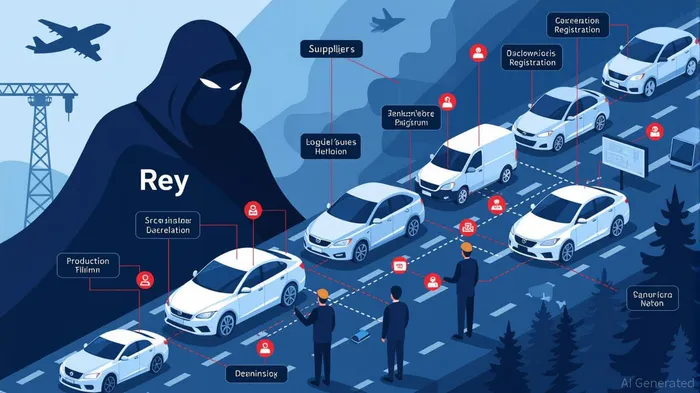
The automotive industry's digital transformation has created unprecedented efficiencies but also exposed it to systemic cyber risks. Jaguar Land Rover's (JLR) August 2025 cyberattack—attributed to a hacker known as “Rey” and linked to the Scattered LAPSUS$ Hunters—has become a case study in how interconnected supply chains and software-defined operations amplify vulnerabilities. For investors, the incident raises critical questions about the long-term financial and reputational resilience of Tata Motors, JLR's parent company, and the broader sector's preparedness for escalating cyber threats.
Tata Motors: Compounding Risks and Financial Exposure
JLR's cyber incident has exacerbated existing challenges for Tata Motors, which reported a 63% drop in quarterly profits in 2025, driven by weak sales and U.S. tariff-related export halts[6]. The attack forced JLR to shut down production at UK sites, including Solihull and Halewood, during a critical sales period coinciding with new UK vehicle registration plates[1]. Analysts estimate weekly losses in the tens of millions of pounds due to production stoppages, lost sales, and recovery costs[5].
The reputational fallout is equally concerning. JLR's inability to access its digital parts ordering platform disrupted independent garages, delaying repairs for existing vehicle owners[1]. While the company claims no customer data was compromised, internal operational systems—including production automation and supply chain logistics—were targeted[4]. This erodes consumer trust in JLR's reliability, a brand asset critical for maintaining its premium positioning.
For Tata Motors, the incident underscores systemic risks. The company's subsidiary, Tata Technologies, faced its own ransomware attacks in early 2025, attributed to groups like Hunters International[3]. These attacks, coupled with JLR's crisis, have created a volatile environment for investors. Tata's stock has faced downward pressure, with the broader manufacturing sector experiencing a 57% spike in ransomware attacks during July–August 2025[4].
Broader Sector Implications: A Wake-Up Call for Cyber Resilience
The JLR incident is part of a larger trend. In 2024 alone, the automotive sector recorded 409 cyber incidents, a sharp increase from prior years[2]. Ransomware groups like Qilin and Hellcat have professionalized their operations, exploiting vulnerabilities in telematics systems and application servers[6]. Bridgestone Americas, for instance, recently contained a limited cyber incident that paused operations at some manufacturing sites[1].
Industry responses are shifting toward proactive strategies. The EU's Cyber Resilience Act and UNECE Regulation No. 155 now mandate comprehensive cybersecurity management systems, pushing automakers to adopt Zero Trust Architecture and continuous monitoring[4]. However, implementation lags. Only 32% of automakers have fully integrated AI-driven threat detection, according to a 2025 RSM report[1]. This gap leaves the sector exposed to evolving threats, particularly as software-defined vehicles (SDVs) expand attack surfaces[4].
Investment Considerations: Balancing Risk and Resilience
For investors, the key question is whether companies can align cybersecurity spending with business continuity. JLR's cautious recovery approach—prioritizing stability over speed—highlights the trade-offs between short-term costs and long-term resilience[1]. Tata Motors' ability to navigate these challenges will depend on its capacity to invest in multi-cloud infrastructure, offsite backups, and third-party risk assessments[5].
The sector's financial exposure is also growing. A 2025 study by Rankiteo found that ransomware attacks on automotive firms could lead to intellectual property theft, reputational damage, and operational paralysis[3]. For Tata, the compounding effects of JLR's cyber incident and U.S. tariff penalties create a high-risk profile. However, companies that adopt structured cybersecurity frameworks—such as embedding security by design and aligning with regulatory standards—may gain a competitive edge[4].
Conclusion
The JLR cyberattack is a stark reminder that cybersecurity is no longer a technical issue but a core business risk. For Tata Motors, the incident has compounded existing financial and reputational vulnerabilities, testing its ability to maintain investor confidence. Meanwhile, the broader automotive sector must accelerate its shift from reactive to proactive cybersecurity strategies. Investors should prioritize companies that treat cybersecurity as a strategic imperative, not an afterthought. In an era where a single breach can paralyze global operations, resilience is the ultimate competitive advantage.







Comentarios
Aún no hay comentarios