
Cybersecurity Risks in Cryptocurrency Infrastructure: Geopolitical Threats and Market Implications
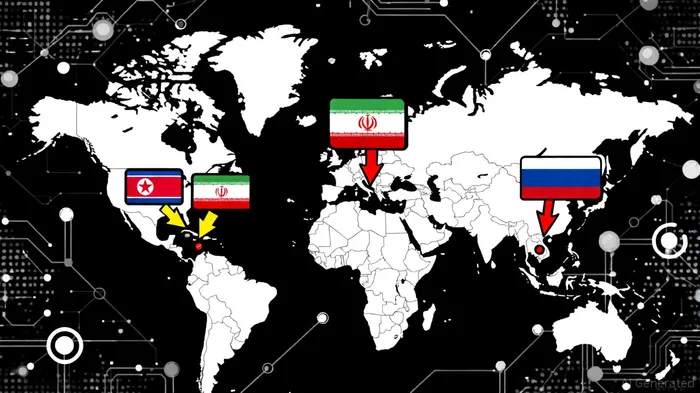
The intersection of geopolitics and cryptocurrency has never been more volatile. In 2025, state-sponsored cyberattacks, regulatory shifts, and market turbulence have converged to redefine the risks and opportunities in digital assetDAAQ-- investing. As nation-states weaponize cyber capabilities and regulators scramble to respond, the cryptocurrency ecosystem faces a dual challenge: safeguarding infrastructure from sophisticated threats while navigating the economic fallout of geopolitical instability.
The Rise of State-Sponsored Cyberattacks
North Korea's Lazarus Group has emerged as a dominant force in crypto-related cybercrime, with a $1.5 billion heist from a major exchange in February 2025 underscoring the scale of the threat [1]. These attacks are not merely financial—they are strategic tools to fund nuclear programs and destabilize global markets. According to a report by Blockchain Future at Risk, such activities have surged by 40% in 2025, with phishing attacks and fake exchange sites becoming increasingly sophisticated [1].
Centralized platforms remain particularly vulnerable. The Bybit and WazirX breaches in 2024, which exploited weaknesses in multi-signature wallets, demonstrated how critical infrastructure can be compromised. By 2025, the average hack size had doubled to $30 million, with over $2.17 billion stolen from crypto services in the first half of the year alone [5]. These incidents have eroded investor confidence, spurring demand for quantum-resistant cryptography and zero-trust architectures [1].
Regulatory Responses and Market Volatility
Geopolitical tensions have accelerated regulatory action. President Donald Trump's January 2025 executive order declared cryptocurrency a national priority, emphasizing security and responsible growth [3]. Meanwhile, the EU's Digital Operational Resilience Act (DORA) now mandates threat-led penetration testing for crypto-asset providers, reflecting a global push to standardize cybersecurity protocols [3].
However, these measures have not quelled market volatility. Following U.S. airstrikes on Iran in early 2025, BitcoinBTC-- plummeted below $100,000, with a 5% market decline and $1 billion in liquidations within 24 hours [3]. Such events highlight cryptocurrencies' dual role as both a growth asset and a barometer of geopolitical risk. While crypto's correlation with equities remains moderate, its utility as a safe haven is increasingly contested [5].
Investment Trends in a Fragmented Landscape
The fallout from cyberattacks and geopolitical events has reshaped investment behavior. Digital asset insurance, once a niche product, is projected to reach $4.28 billion by year-end as institutions demand greater protection [1]. Meanwhile, countries under sanctions—such as Russia, Iran, and Venezuela—have turned to crypto for cross-border payments and value storage. During the Russia-Ukraine conflict, crypto donations to Ukraine exceeded $136 million, illustrating its role in circumventing traditional financial systems [5].
Regulatory clarity has also driven adoption. The approval of spot crypto ETFs in the U.S. has legitimized Bitcoin and EthereumETH-- as investment assets, attracting institutional capital [1]. Conversely, stricter SEC oversight has introduced uncertainty, with market downturns following enforcement actions against exchanges [6].
The Path Forward: Collaboration and Innovation
As cyber warfare blurs with traditional conflict, collaboration is critical. Experts predict that zero-trust architectures and the integration of IT and operational technology (OT) security will become cornerstones of resilience [4]. However, the rise of state-backed digital currencies—such as China's digital yuan—threatens to displace decentralized assets, creating a fragmented global financial landscape [3].
Investors must balance the risks of cyberattacks and geopolitical instability with the long-term potential of crypto. While volatility persists, innovation in DeFi, stablecoins, and quantum-resistant security offers a roadmap for growth. The key lies in proactive risk management and a nuanced understanding of how global power dynamics shape the digital asset ecosystem.






Comentarios
Aún no hay comentarios