
Cybersecurity Risks in Crypto: Investor Sentiment and Token Valuation Impacts
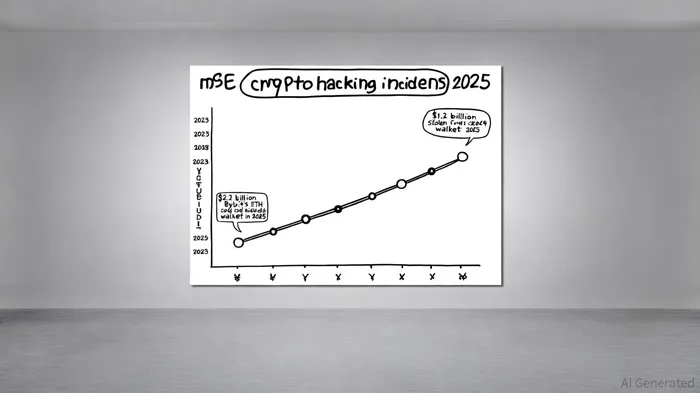
The crypto industry is at a crossroads. Over the past two years, cybersecurity breaches have escalated from isolated incidents to systemic threats, with stolen funds surging by 21.07% year-over-year in 2024 to a staggering $2.2 billion[1]. North Korean hackers alone accounted for 61% of these losses, a trend that intensified in 2025 with breaches like Phemex's $85 million loss and Bybit's $1.46 billion ETHETH-- cold wallet heist[2]. These events have not only eroded investor trust but also triggered sharp market corrections, with BitcoinBTC-- (BTC) and EthereumETH-- (ETH) plummeting by 18.47% and 26.14%, respectively[4].
Investor Sentiment: Fear, Flight, and Fragmentation
The psychological toll of these breaches is evident in the Crypto Fear and Greed Index, which hit a three-year low of 21 in early 2025[4]. Traders, spooked by centralized exchange vulnerabilities, have shifted assets to more secure custodial solutions, accelerating demand for regulated Bitcoin ETFs over direct holdings[4]. This "risk-off" behavior has amplified volatility, as seen in the aftermath of the Infini hack ($49M USDCUSDC-- stolen), where panic selling drove altcoin prices down 10–20% within 24 hours[1].
Institutional investors, too, are recalibrating. A 2025 study of 458 U.S. crypto investors revealed that trust in the asset class is now heavily influenced by technological reliability and regulatory clarity[2]. Female investors, in particular, prioritize social and regulatory trust over technical factors, signaling a broader demand for transparency[2].
The Rise of Zero-Trust and MPC: A New Security Paradigm
Amid this chaos, advanced cryptographic solutions like Multi-Party Computation (MPC) wallets and zero-trust architectures are emerging as critical tools for restoring confidence. Unlike traditional wallets, which store private keys in a single location, MPC wallets split keys into encrypted shares distributed across multiple parties or devices[4]. This eliminates single points of failure, a vulnerability exploited in the UXLINK multi-sig breach, where stolen funds were routed to exchanges[1].
Zero-trust architectures (ZTAs) further reinforce this model by enforcing continuous verification and least-privilege access[3]. For instance, IKA Token's Zero Trust MPC network requires both user participation and decentralized network collaboration for every transaction, ensuring no single entity controls assets[2]. These protocols are gaining traction: Fireblocks, Curv, and ZenGo have all adopted MPC to secure institutional and retail holdings[5].
While empirical data on post-breach volatility reduction remains limited, the theoretical framework is compelling. ZTAs reduce lateral movement risks by 70% and cut breach recovery costs by 40% for SMBs[1]. In crypto, where trust is paramount, these measures could stabilize tokenAUCTION-- prices by mitigating the "fear of theft" that drives panic selling.
The Road Ahead: Balancing Innovation and Caution
The path forward requires a dual focus: scaling zero-trust and MPC adoption while addressing gaps in regulatory oversight. For example, cross-chain bridge exploits—responsible for $520 million in losses in 2025—highlight the need for standardized security audits[5]. Meanwhile, hybrid wallet architectures combining MPC with multisig are gaining ground, offering a middle ground between privacy and flexibility[4].
Investors must also recognize that no solution is foolproof. The UXLINK breach demonstrates that even advanced systems can falter if human error or social engineering is involved[1]. Thus, education and multi-layered security strategies will remain essential.
Conclusion
Cybersecurity is no longer a peripheral concern in crypto—it is the bedrock of investor confidence and market stability. As breaches grow in scale and sophistication, the adoption of MPC wallets and ZTAs will be pivotal in curbing volatility and restoring trust. For investors, the lesson is clear: prioritize platforms with robust security frameworks, and remain vigilant in an industry where the next threat is always just a click away.






Comentarios
Aún no hay comentarios