
The Cyber Insurance Gold Rush: Why Small Business Protection is the Next Frontier for Investors
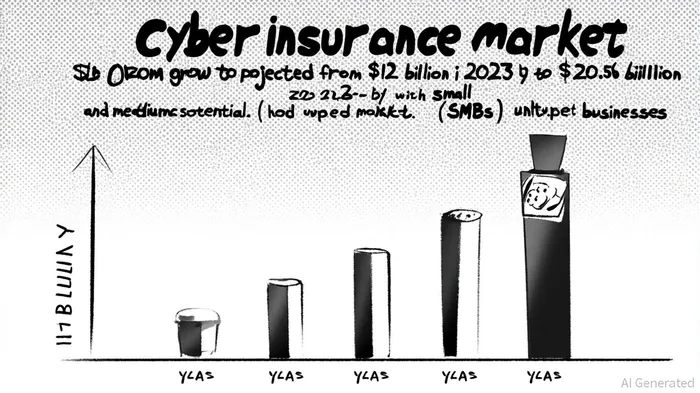
The global cyber insurance market is no longer a niche corner of the financial sector—it is a high-stakes arena where insurers, regulators, and technology firms are racing to address a rapidly evolving threat landscape. For investors, the most compelling opportunity lies not in the well-trodden paths of enterprise coverage but in the explosive potential of small business protection.
A Market on the Cusp of Disruption
The cyber insurance sector has already demonstrated its resilience. By 2024, global premiums are expected to surpass $15 billion, with a compound annual growth rate (CAGR) of 21% projected through 2030[1]. However, the true engine of future growth is the small and medium-sized business (SMB) segment. While 76% of large enterprises adopted cyber insurance in 2023[2], only 47% of U.S. small businesses had active policies, and Swiss Re estimates that just 10% of SMEs globally are insured[3]. This stark disparity highlights a $10 trillion protection gap—a void that insurers with the agility to tailor products for SMBs are poised to fill.
The urgency is driven by the escalating sophistication of cyber threats. Ransomware attacks, phishing schemes, and AI-powered breaches have made no business too small to ignore. A December 2024 Huntress survey found that 58% of insured businesses have seen their coverage reduced over the past five years, underscoring a growing mismatch between policy terms and the realities of modern cyber risk[4]. For SMBs, which often lack the resources to implement robust cybersecurity measures, the need for insurance is not just strategic—it is existential.
Risk, Resilience, and the Role of Technology
Insurers adapting to this new era are leveraging technology to mitigate risk and expand access. AI-driven underwriting tools and real-time risk assessment platforms are enabling more precise pricing models, while reinsurance and catastrophe bond markets inject liquidity into the sector[5]. For example, companies with layered cybersecurity controls—such as multi-factor authentication and endpoint detection systems—have seen premium reductions of over 20%, incentivizing proactive risk management[6].
Yet challenges persist. Cost remains a barrier for 26% of organizations seeking coverage[4], and 56% of small businesses with fewer than 50 employees lack policies[7]. Here, innovation is key. Insurers that bundle affordable, modular coverage with cybersecurity training and threat intelligence services are likely to dominate the SMB market. Munich Re's projection of a $16.3 billion global cyber insurance market in 2025[8] hinges on such adaptations.
The Investment Case
For investors, the calculus is clear: the cyber insurance sector is transitioning from a defensive play to a high-growth asset class. Insurers that prioritize SMBs—by developing scalable, tech-enabled solutions—are positioned to capture market share in a sector expected to nearly double in value by 2025[9]. Consider the following:
- Demand Drivers: The proliferation of AI-powered attacks and regulatory pressures (e.g., data breach notification laws) will force SMBs to treat cyber insurance as a non-negotiable expense.
- Margin Potential: Tighter underwriting standards and the integration of AI analytics are improving loss ratios, enabling insurers to balance growth with profitability.
- Diversification: Cyber insurance offers a unique hedge against macroeconomic volatility, as digital risk is both persistent and universal.
However, success will require more than capital—it demands a deep understanding of SMB needs. Insurers that fail to address affordability, simplify policy terms, and integrate cybersecurity support will be left behind.
Conclusion
The cyber insurance market is at an inflection point. As SMBs become the new front line in the battle against cybercrime, insurers that adapt will not only protect their clients but also unlock substantial returns for investors. The question is no longer whether to invest in this sector, but which players are best positioned to lead the charge.







Comentarios
Aún no hay comentarios