
CVS Health and Clover Health: Navigating the 2026 Medicare Star Ratings and Their Impact on Growth and Investor Confidence
CVS Health and CloverCLOV-- Health: Navigating the 2026 Medicare Star Ratings and Their Impact on Growth and Investor Confidence
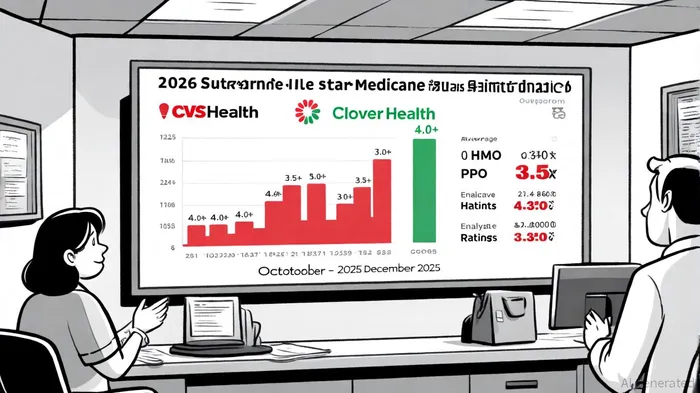
The 2026 Medicare Star Ratings, released by the Centers for Medicare & Medicaid Services (CMS), have become a pivotal metric for evaluating performance in the Medicare Advantage (MA) sector. For investors, these ratings not only signal clinical quality but also influence payment benchmarks, market share dynamics, and long-term profitability. Two key players-CVS Health and Clover Health-have taken divergent approaches to navigating this complex landscape, with distinct implications for their growth trajectories and investor sentiment.
CVS Health: Leveraging High Ratings for Stability and Profitability
CVS Health's Aetna business reported that 81% of its Medicare Advantage members are enrolled in 2026 MAPD plans rated 4 stars or higher, with 63% in 4.5-star plans, according to Aetna. This strong performance underscores Aetna's focus on quality-driven care delivery, a strategy that aligns with CMS's tightening standards. As noted by industry expert Melissa Newton Smith, CMS raised 60% of 2026 Star Rating cut points to reflect improving industry benchmarks, according to Rise Health.
Investor confidence in CVS HealthCVS-- has been bolstered by these outcomes. Mizuho reiterated an "Outperform" rating with a $80 price target, citing the stability of Aetna's Star Ratings as a "valuation tailwind." Other analysts, including Wells Fargo's Stephen Baxter, upgraded their ratings to "Overweight" with a $103 price target, reflecting optimism about CVS's ability to maintain market share amid rising healthcare costs, Benzinga reported. This positive sentiment is further supported by CFO Brian Newman, who asserted that CVSCVS-- is "delivering steady results in a dynamic environment."
However, CVS's strategy includes a defensive element. The company, alongside UnitedHealth Group, has reduced its 2026 plan footprints in certain counties to protect short-term margins amid inflationary pressures, TheStreet reported in TheStreet. This approach prioritizes profitability over aggressive expansion, a trade-off that may appeal to investors seeking stability but could limit growth potential in the long term.
Clover Health: Technology-Driven Resilience Amid Mixed Ratings
Clover Health's 2026 Star Ratings-3.5 stars for PPO plans and 4.0 stars for HMO plans-fell short of the 4.5-star benchmarks achieved by peers like Aetna, according to GlobeNewswire. Yet, the company has framed these results as a temporary hurdle rather than a long-term setback. Clover's CEO, Andrew Toy, emphasized that its AI-powered Clover Assistant platform drives clinical outcomes that outperform the Star Ratings system itself. For instance, Clover's PPO plans achieved a 4.72 HEDIS Clinical Quality Index score, a metric CMS does not fully incorporate into its Star Ratings methodology, Investing.com reported.
Clover's confidence is rooted in its financial performance: the company reported 34% revenue growth and 32% membership growth in the first half of 2025, despite operating under similar 3.5 Star payment structures in prior years, Total News reported. Analysts have noted that Clover's focus on AI innovation and physician adoption could mitigate the impact of lower Star Ratings. As QuiverQuant highlighted, Clover's "differentiated technology model allows it to deliver above-market membership growth and Adjusted EBITDA profitability through 2027, independent of Star ratings."
Investor reactions have been mixed. While Clover's stock has not seen the same level of analyst upgrades as CVS, the company's proactive engagement with CMS to reform the Star Ratings methodology-arguing that non-clinical metrics like member surveys are overweighted-has garnered attention, TradingView reported. This strategy positions Clover as a long-term innovator, albeit with near-term payment headwinds.
Strategic Divergence and Market Implications
The contrasting approaches of CVS and Clover highlight broader industry tensions. CVS's emphasis on high Star Ratings and defensive cost management aligns with its role as a market leader seeking to preserve margins in a competitive landscape. Clover, meanwhile, is betting on technology to redefine quality metrics and outperform peers in membership growth.
For investors, the key question is which strategy better balances short-term stability with long-term innovation. CVS's high-rated plans and analyst endorsements suggest a safer bet in the near term, while Clover's AI-driven model offers higher growth potential if its clinical outcomes translate into regulatory or market recognition.
Conclusion
The 2026 Medicare Star Ratings have reinforced CVS Health's position as a reliable player in the MA sector, with strong ratings and analyst support driving investor confidence. Clover HealthCLOV--, though facing lower ratings, has leveraged its technology-driven model to maintain growth and profitability, positioning itself as a disruptor in a rapidly evolving market. As CMS continues to refine its metrics, both companies exemplify how strategic choices-whether prioritizing stability or innovation-will shape the future of Medicare Advantage and investor returns.





Comentarios
Aún no hay comentarios