
CVC's Sale of Spanish University and the Shifting Power Dynamics in Private Credit vs. Traditional Banking
The recent announcement that CVC Capital Partners is exploring the sale of its majority stake in Universidad Alfonso X El Sabio (UAX) for up to €2 billion[1] underscores a broader transformation in the financial landscape. This transaction, which would nearly double CVC's original 2019 investment of €1.1 billion[2], reflects not only the firm's strategic reallocation of capital but also the growing dominance of private credit in reshaping corporate lending dynamics. As private credit surges to fill gaps left by traditional banks, the UAX sale exemplifies how non-traditional financing is redefining asset allocation strategies, particularly in sectors like education where tailored solutions are critical.
The Rise of Private Credit: A Strategic Shift in Lending
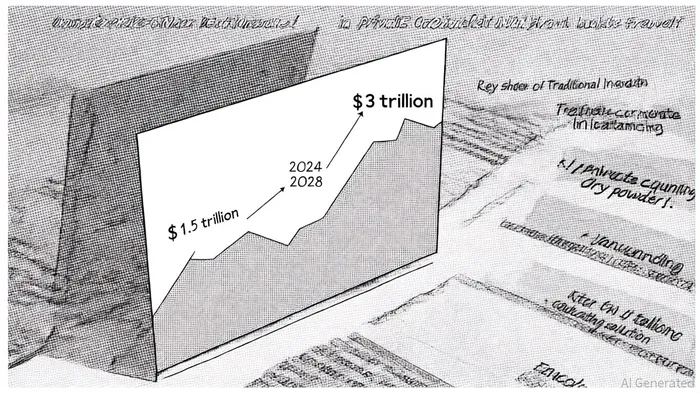
Private credit has emerged as a formidable force in global finance, with the market expanding to $1.5 trillion in 2024 and projected to reach $3 trillion by 2028[3]. This growth is driven by a confluence of factors: regulatory constraints on traditional banks, a record $1.6 trillion in private equity dry powder[4], and the demand for flexible, customized financing solutions. For instance, private credit loans typically offer faster approval timelines—often four to eight weeks—compared to the three months or more required by traditional banks[5]. This agility is particularly valuable in sectors like education, where institutions require rapid access to capital for expansion, technology integration, or operational scaling.
CVC's UAX transaction highlights this trend. The university, which has grown its revenue to €213 million in 2024 with a 20% annual student enrollment increase[6], exemplifies the appeal of education as a private credit asset. Unlike traditional banks, which often impose rigid terms, private credit allows for bespoke structures such as unitranche or mezzanine financing, enabling borrowers to optimize capital efficiency. As noted by Bloomberg Law, CVC's engagement of multiple investment banks—including Morgan Stanley and Goldman Sachs—to evaluate the UAX sale underscores the competitive landscape for non-traditional lenders[7].
Strategic Asset Allocation: Private Credit vs. Traditional Banking
The UAX case also illustrates a strategic reallocation of capital by institutional investors. Private credit now accounts for 30% of mandates in 2024, up from 21% in 2023[8], as allocators seek higher returns and diversification. In contrast, traditional banks face declining market share, with their corporate lending share dropping from 60% in 1970 to 35% in recent years[9]. Regulatory frameworks like Basel III have forced banks to prioritize larger corporate clients and reduce exposure to mid-market borrowers, creating a vacuum that private credit has swiftly filled.
For education sector transactions, this shift is particularly pronounced. Private equity firms, including CVC, are leveraging private credit to finance acquisitions, refinancings, and operational growth. For example, 63% of private equity firms now use private credit for acquisition financing[10], a trend amplified by the sector's rebound in 2024. UAX's potential sale, which includes resolving legal disputes and restructuring debt[11], demonstrates how private credit can provide the flexibility needed to navigate complex transactions.
Power Dynamics: Competition and Collaboration
Traditional banks are responding to private credit's rise through dual strategies: competing by building in-house private credit funds or collaborating with non-traditional lenders. However, these efforts vary in effectiveness. While major banks like JPMorgan Chase have developed robust private credit capabilities, regional banks often lack the scale or expertise to compete[12]. This has led to a hybrid model where banks act as facilitators, connecting corporate clients with private credit providers while retaining ancillary services like treasury management[13].
The UAX sale further highlights this dynamic. CVC's decision to engage multiple banks for the transaction reflects the competitive pressure on traditional lenders to adapt. Meanwhile, the potential involvement of private equity firms like PAI Partners and Cinven in the bidding process[14] underscores the growing role of non-bank entities in corporate lending. As Deloitte notes, this competition is driving innovation in lending structures but also raising concerns about financial stability risks, such as liquidity constraints and opaque valuations[15].
Future Outlook: A Resilient Ecosystem
Looking ahead, private credit is poised to maintain its momentum, particularly in sectors like education where growth and consolidation are accelerating. By 2025, over 50% of limited partners (LPs) plan to increase allocations to direct lending and specialty finance strategies[16], reflecting confidence in the asset class's resilience. For CVC, the UAX sale aligns with a broader strategy of optimizing its education portfolio, as seen in its extension of the Multiversity partnership[17].
However, challenges remain. A declining interest rate environment could shift capital back to traditional private equity strategies, and regulatory scrutiny of private credit's risks—such as liquidity mismatches—may intensify[18]. Nonetheless, the flexibility and yield advantages of private credit are likely to sustain its role as a cornerstone of strategic asset allocation, particularly in sectors requiring tailored financing solutions.
Conclusion
CVC's potential sale of UAX is more than a corporate transaction—it is a microcosm of the broader shift in power dynamics between private credit and traditional banking. As private credit continues to outpace banks in speed, customization, and scalability, it is redefining how capital is allocated across sectors like education. For investors, this evolution presents opportunities to enhance portfolio returns while navigating a fragmented financial ecosystem. The UAX case, therefore, serves as a compelling case study in the strategic reallocation of capital in an era of non-traditional lending growth.







Comentarios
Aún no hay comentarios