
CuriosityStream's Ownership Dynamics: Retail Dominance and Insider Selling Fuel Market Volatility
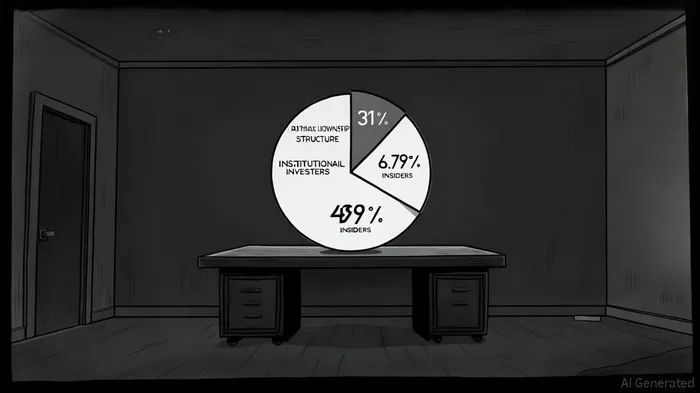
The ownership structure of CuriosityStream Inc.CURI-- (NASDAQ:CURI) presents a unique case study in market dynamics, where retail investor dominance intersects with significant insider holdings. According to a report by Yahoo Finance, retail investors collectively hold 48% of the company, while insiders—primarily executives and board members—control 31%[1]. This distribution starkly contrasts with institutional ownership, which accounts for just 6.79%[2]. Such a structure inherently amplifies market volatility, as retail investors are often more reactive to short-term trends, news, or sentiment shifts compared to institutional actors, who typically adopt longer-term strategies.
The retail-heavy ownership is further compounded by the concentration of insider stakes. John Hendricks, CuriosityStream's top executive, holds a 22% stake in the company, the largest among insiders[1]. This alignment with company performance suggests a degree of confidence in its long-term prospects. However, the recent insider trading activity in Q3 2025 has raised questions. Jonathan Huberman, a director, sold 25,000 shares at $4.6095 on September 5, reducing his beneficial ownership to 1,308,576 shares[2]. More notably, Hendricks himself offloaded 8,050,000 shares at $3.50 each on August 14, a transaction valued at $28.175 million[1]. These sales, while compliant with SEC reporting requirements[1], could signal either strategic portfolio diversification or a lack of confidence in the company's trajectory.
The interplay between retail dominance and insider selling creates a volatile environment. Retail investors, who hold nearly half the shares, may interpret insider exits as bearish signals, potentially triggering panic-driven selling. Conversely, insiders' continued ownership—Huberman still holds over 1.3 million shares—indicates that their skepticism, if any, is not absolute. This duality complicates market sentiment analysis: while insider selling often correlates with downward pressure, the retail base's resilience could counterbalance such effects.
For investors, the key risk lies in the asymmetry of influence. With institutional investors holding minimal sway, CuriosityStream's stock price is more susceptible to retail-driven swings. Social media trends, speculative trading, and even retail investor forums could amplify minor catalysts into significant price movements. Additionally, the lack of institutional oversight may reduce the company's exposure to rigorous performance scrutiny, potentially masking underlying operational risks.
In conclusion, CuriosityStream's ownership structure—a blend of retail dominance and insider control—creates a volatile landscape. While insiders' recent sales warrant caution, the company's strong retail base offers both resilience and unpredictability. Investors must weigh these factors carefully, recognizing that market reactions may be as much about sentiment as fundamentals.





Comentarios
Aún no hay comentarios