
Cullen/Frost Bankers Inc: Valuation Momentum and Long-Term Profitability in a Shifting Rate Environment
In the evolving landscape of regional banking, Cullen/Frost Bankers Inc (CFR) has emerged as a focal point for investors seeking value amid macroeconomic uncertainty. Recent analyst activity, including a strategic downgrade by RBC Capital and contrasting upgrades from Raymond James and TD Cowen, underscores the stock's complex valuation dynamics and long-term growth potential. This analysis examines CFR's financial fundamentals, strategic positioning, and the interplay between short-term market adjustments and enduring profitability drivers.
Valuation Momentum: A Tale of Contrasting Signals
RBC Capital's May 2, 2025, report marked a pivotal moment in CFR's valuation narrative. Analyst Karl Shepard maintained a "Sector Perform" rating but reduced the price target from $147.00 to $140.00, a 4.76% decline, citing revised expectations for market conditions and operational performance, according to a GuruFocus report. This adjustment aligns with broader analyst caution, as the average price target for CFRCFR-- stands at $135.60, with a "Hold" consensus from 13 firms, as noted in the same report. However, this caution contrasts sharply with recent bullish sentiment.
Raymond James upgraded CFR to "Outperform" on July 8, 2025, setting a $150.00 price target in a Raymond James note. The firm highlighted CFR's net interest margin (NIM) and net interest income (NII) benefits from repricing its securities portfolio in a high-rate environment. TD Cowen's September 26 "Strong-Buy" upgrade, reported in a MarketBeat alert, further reinforced optimism, reflecting confidence in CFR's operational resilience. These divergent signals suggest a stock at a valuation inflection point, where short-term adjustments may mask long-term value.
CFR's valuation metrics support this duality. The stock trades at a trailing P/E of 13.76 and a forward P/E of 13.50, outperforming the US banks industry average of 11.7x but lagging behind peer averages of 14.8x, according to StockAnalysis statistics. Analysts estimate a fair value of $152.35, implying a 16.3% discount to intrinsic value, per StockAnalysis. This discrepancy highlights CFR's potential as a value play, particularly given its robust balance sheet-$2.19 billion in net cash and a 15.49% return on equity (ROE)-and a sustainable 3.13% dividend yield with a 41.98% payout ratio, as noted in the earlier GuruFocus piece.
Long-Term Profitability: Strategic Positioning in a High-Rate Regime
CFR's long-term profitability hinges on its ability to leverage a high-rate environment. The bank's securities portfolio, representing 39.3% of assets (versus a peer average of 20.4%), positions it to capitalize on rising interest income, a point emphasized in the Raymond James note. Raymond James' analysis underscores this advantage, noting that CFR's NIM expansion could drive NII growth even as rate hikes plateau.
Moreover, CFR's operational flexibility is evident in its guidance for 2025. The bank anticipates a $1.7–1.8 million monthly NII boost if rate cuts-expected by its current outlook-fail to materialize, per the same Raymond James commentary. This contingency planning, coupled with a 27% quarter-over-quarter increase in its loan pipeline to $6.2 billion, suggests potential for earnings surprises in the near term. Such momentum could further narrow the gap between CFR's current price and its estimated intrinsic value of $152.35, as StockAnalysis indicates.
CFR's dividend history also bolsters its appeal. With 32 consecutive years of dividend growth, the stock offers a 3.13% yield that balances income-seeking investors with reinvestment potential, a track record highlighted by Raymond James. This track record, combined with a manageable payout ratio, signals financial discipline-a critical trait in regional banks navigating credit risk and economic volatility.
Regional Banking's Resilience: A Macro Perspective
CFR's trajectory reflects broader trends in regional banking. While megabanks face margin pressures from rate normalization, regional players like CFR benefit from niche market expertise and asset diversification. Their ability to adapt to rate cycles-evidenced by CFR's securities-heavy portfolio-positions them to outperform in environments where liquidity management becomes a competitive advantage, as noted by Raymond James.
However, risks persist. A potential economic slowdown could elevate credit provisions, impacting net income. Additionally, CFR's P/E premium to the industry average (13.7x vs. 11.7x) suggests some market skepticism about its ability to sustain growth, per StockAnalysis. Investors must weigh these factors against the bank's strategic agility and capital strength, including a CET1 ratio of 13.2% (though this metric pertains to RBC, it contextualizes the importance of capital buffers in banking), as detailed in a Royal Bank of Canada report.
Conclusion: A Cautious Bull Case
CFR's valuation momentum and long-term profitability potential present a compelling case for investors with a medium-term horizon. While RBC's price target reduction reflects near-term caution, the stock's intrinsic value discount, strategic NIM advantages, and robust balance sheet suggest undervaluation. The recent upgrades from Raymond James and TD Cowen signal growing confidence in CFR's ability to navigate macroeconomic headwinds-a confidence that could drive price discovery as the bank reports Q2 2025 earnings and refines its rate assumptions.
For now, the "Hold" consensus appears balanced, but the widening gap between analyst price targets ($105–$155) and CFR's current price hints at latent volatility. Investors who prioritize long-term value and are comfortable with short-term fluctuations may find CFR's combination of yield, growth, and strategic positioning in regional banking increasingly attractive. 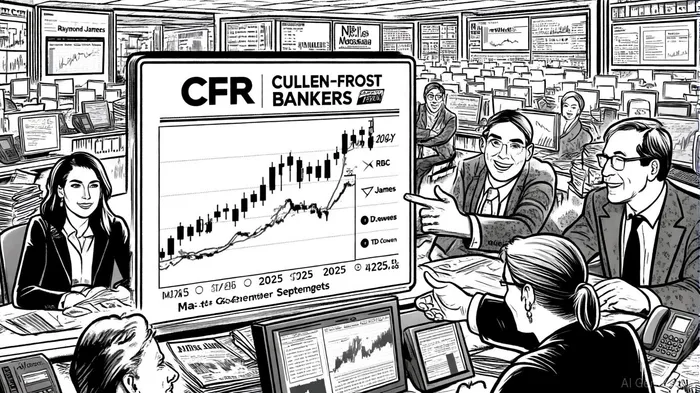





Comentarios
Aún no hay comentarios